https://twitter.com/georgegalloway/status/1664950039364665345
zondag 4 juni 2023


How Assassination Became Policy at the CIA
APRIL 9, 2023
How Assassination Became Policy at the CIA
Annals of the Covert World
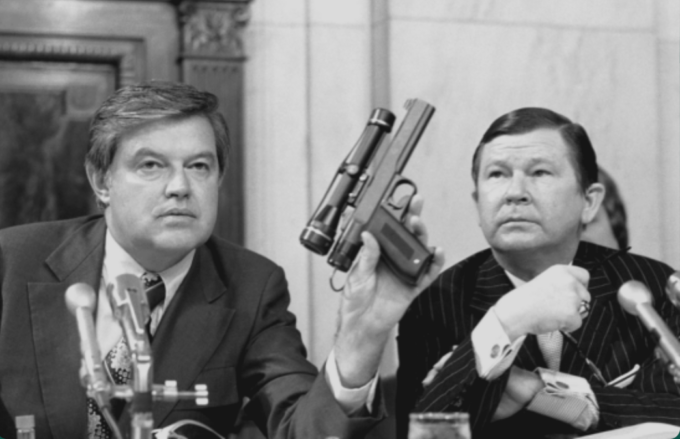
Frank Church holds CIA poison dart gun at committee hearing with vice chairman John Tower on September 17, 1975 (Source: U.S. Capital Archives. Photo by Henry Griffin)
The CIA’s role in assassination is one of those topics handled gingerly by the press or Congress from time to time and then hastily put aside, with the habitual claim that the CIA may have dreamed of it, thought about it and maybe even dabbled in it, but had never actually gone successfully all the way. But in fact, the Agency has gone all the way many times.
There’s no dispute that the CIA has used assassination as a weapon lower down the political and social pecking order, as no one knew better than William Colby. He had, by his own admission, supervised the Phoenix Program and other so-called “counter-terror” operations in Vietnam. Phoenix was aimed at “neutralizing” NLF political leaders and organizers in rural South Vietnam. In congressional testimony, Colby boasted that 20,587 NLF activists had been killed between 1967 and 1971 alone. The South Vietnamese published a much higher estimate, declaring that nearly 41,000 had been killed. Barton Osborn, an intelligence officer in the Phoenix Program, spelled out in chilling terms the bureaucratic attitude of many of the agents toward their murderous assignments. “Quite often it was a matter of expediency just to eliminate a person in the field rather than deal with the paperwork.”
Those killed outright in Phoenix operations may have been more fortunate than the 29,000 suspected NLF members arrested and interrogated with techniques that were horrible even by the standards of Pol Pot and Mobutu. In 1972 a parade of witnesses before Congress testified about the techniques of the Phoenix interrogators: how they interviewed suspects and then pushed them out of planes, how they cut off fingers, ears and testicles, how they used electro-shock, shoved wooden dowels into the brains of some prisoners, and rammed electric probes into the rectums of others.
For many of the Phoenix raids, the agency employed the services of bandit tribes and ethnic groups, such as the Khmer Kampuchean Kram, the KKK. The KKK was comprised of anti-communist Cambodians and drug smugglers who, as one Phoenix veteran put it, “would kill anyone as long as there was something in it for them.” The KKK even offered to knock off Prince Sihanouk for the Americans and frame the NLF for the killing.
These American death squads were a particular favorite of Richard Nixon. After the My Lai massacre, an operation with all the earmarks of a Phoenix-style extermination, there was a move to reduce the funding for these civilian killing programs. Nixon, according to an account by Seymour Hersh, objected vociferously. “No,” Nixon demanded. “We’ve got to have more of this. Assassinations. Killings.” The funds were promptly restored, and the death toll mounted.
Even at the senior level of executive action, Colby was being bashful about the CIA’s ambitions and achievements. In 1955 the CIA had very nearly managed to assassinate the Chinese Communist leader Chou En-lai. Bombs were put aboard Chou’s plane as he flew from Hong Kong to Indonesia for the Bandung conference. At the last moment Chou changed planes, thus avoiding a terminal descent into the South China Sea, since the plane duly blew up. The role of the CIA was later described in detail by a British intelligence agent who defected to the Soviet Union, and evidence recovered by divers from portions of the plane, including the timing mechanisms for two bombs, confirmed his statements. The Hong Kong police called the crash a case of “carefully planned mass murder.”
By 1960 Rafael Trujillo, president of the Dominican Republic, had become irksome to US foreign policymakers. His blatant corruption looked as though it might prompt a revolt akin to the upsurge that had brought Fidel Castro to power. The best way to head off this unwelcome contingency was to ensure that Trujillo’s political career cease forthwith, which in early 1961 it did. Trujillo was gunned down in his car outside his own mansion in Ciudad Trujillo. It emerged that the CIA had provided guns and training to the assassins, though the Agency took care to point out that it was not absolutely 100 percent sure that these were the same weapons that ultimately deposed the tyrant (who had been originally installed in power by the CIA).
At about the same time, CIA director Allen Dulles decided that the leader of the Congo, Patrice Lumumba, was an unacceptable threat to the Free World and his removal was “an urgent and prime objective.” For assistance in the task of banishing this threat, the CIA turned to its own Technical Services Division (TSD), headed by that man of darkness, Sidney Gottlieb “Gottlieb’s division housed a horror chamber of labs whose researches included brain-washing, chemical and biological warfare, the use of drugs and electro-shock as modes of interrogation, and the development of lethal toxins, along with the most efficient means of applying these to the victim, such as the notorious poison dart gun later displayed before the cameras by Senator Frank Church.
In Lumumba’s case, Gottlieb developed a bio-poison that would mime a disease endemic to the Congo. He personally delivered the deadly germs along with a special hypodermic syringe, gauze masks, and rubber gloves to Lawrence Devlin, the CIA chief of the station in the Congo. The lethal implements were carried into the country in a diplomatic pouch. Gottlieb instructed Devlin and his agents how to apply the toxin to Lumumba’s toothpaste and food. However, the CIA’s bio-assassins couldn’t get close enough to Lumumba, so the “executive action” proceeded by a more traditional route. Lumumba was seized, tortured, and murdered by soldiers of the CIA’s selected replacement, Mobutu Sese Seko and Lumumba’s body ended up in the trunk of a CIA officer who drove around Lumumbashi trying to decide how to dispose of it.
Mainstream Media’s Unwillingness to Challenge U.S. Militarization
JUNE 2, 2023
The Mainstream Media’s Unwillingness to
Challenge U.S. Militarization

Photograph Source: Ken Walton – CC BY 2.0
The Washington Post finally conceded in an editorial last week that the United States must “spend smarter” when it comes to defense. Instead of looking for ways to cut defense spending, however, the Post simply wants to spend differently. It favors more spending on conventional and nuclear-armed submarines, despite the huge U.S. advantage in both power projection and lethality in air and naval resources. The Post favors greater investment in cyber defenses and secure communications as well as in “predictive analytics” and artificial intelligence. And, of course, the Post joins the chorus of political and pundit voices warning that China “continues to creep toward Taiwan,” currently the main driver of militarization.
The Post makes no mention of the savings that could result from arms control and disarmament measures such as returning to the Anti-Ballistic Missile Treaty that could abolish the national missile defense. Freezing the defense budget makes far more sense than freezing domestic spending, and would allow for reevaluating the Operations and Maintenance budget as well as setting realistic priorities in a hardware budget out of control.
The simple fact is that mindless militarization is being challenged by neither the Congress nor the media. Defense spending is excessive; base agreements are being expanded; large-scale land and air exercises are being resumed; and multilateral embargoes are being expanded on dual-use technology. Later this month, NATO will conduct the largest air exercise in its history. Air Defender 23 will involve 25 nations, 10,000 participants, and 220 aircraft that will gratuitously raise the level of tension throughout Europe. A similar exercise in Europe 40 years ago, Able Archer, led to a war scare in the Soviet Union.
The United States has not undertaken a contested amphibious landing since the Korean War’s Inchon invasion in 1950, but the Marines are still spending on amphibious assault vehicles. The variants for the F-35 fighter plane, the most expensive weapons system in history, were developed for the Navy’s aircraft carriers as well as a vertical takeoff and landing F-35 for the Marines. Cruise missile technology, meanwhile, has made U.S. aircraft carriers and their related task forces obsolete. The Space Command and the Army Futures Command are wasting huge resources. Much of our overseas presence at more than 750 bases and facilities should be reduced as it serves no useful purpose and its costs are enormous.
It is particularly difficult to cut back production of aircraft carriers and the F-35 fighter plane because the supply chain for both systems is located in every state in the continental United States. It involves thousands of companies and, more importantly, hundreds of congressional districts. The fact that China introduced a long-range cruise missile to specifically target carriers, and that Russia and Iran are trying to develop similar technology has had no impact on the military-industrial-congressional complex. According to the New Republic, the Navy has allocated more than $50 billion for the building of additional supercarriers. So, two of the biggest boondoggles in Pentagon’s procurement history continue full-steam ahead.
Fareed Zakaria, a regular Post oped contributor, referred last week to the United States as “mighty,” and argues that the U.S. military is in a “league of its own, far superior to its rivals.” This is conventional wisdom in the mainstream media, but it ignores the military reversals that the United States has suffered over the past half-century in Vietnam, Iraq, and Afghanistan. These defeats incurred profound losses in blood and treasure over the years, which contributed to the American cult of greater defense spending to correct non-existent deficiencies.
Zakaria even boasts that the United States is “inflicting ruinous damage on Russia’s army” at minimal costs without the introduction of American troops. This ignores the terrible costs of the war in Ukraine that has no end in sight and is straining the economic environment in Europe and elsewhere. He believes that 750 U.S. military bases the world over are another indicator of a “mighty” United States, which ignores the debate needed over the extent and even necessity of American power projection. Zakaria acknowledges that China has only one overseas base (in Djibouti), but ignores the fact that Russia has only two (both in Syria). The overextension of U.S. power around the world is the leading indicator of the dangerous militarization of U.S. national security policy.
The Post regularly states that the United States spends as much on defense as the next 10 or 11 nations combined, but the cruel fact is that we spend as much as all other nations combined. The global total for defense spending is around $2.5 trillion, and U.S. defense spending exceeds $1.2 trillion. The Pentagon’s budget for next year is $886 billion, but that is not the full extent of defense spending. The budget for the Veteran’s Administration is over $120 billion, which takes total defense spending to more than $1 trillion. There is significant defense spending in the budgets of the intelligence community, the Department of Energy, and the Department of Homeland Security, bringing total defense spending to at least $1.2 trillion.
The United States spends five times more than China; fifteen times more than Russia; and 30 times more than Iran and North Korea combined. Moreover, we have more than 50 treaty alliance arrangements throughout Europe and Asia that create defense expenditures that accommodate U.S. global goals as well. Overall, defense spending is increasing in key European countries and Japan that address the threat from Russia and China, respectively. The agreement for strategic nuclear submarines in Australia and the recent thawing of relations between Japan and South Korea contribute to U.S. efforts to counter Chinese influence in the the Pacific. Japan also has increased security cooperation with key nations in the region, including Indonesia, the Philippines, and Vietnam.
Once again, the words of President Dwight D. Eisenhower are insightful. In his first year as president, Eisenhower recorded that “every gun that is made, every warship launched, every rocket fired signifies, in the final sense, a theft from those who hunger and are not fed, those who are cold and are not clothed.” And in his final year in office, he provided the well known warning about the military-industrial complex, which manages our militarized security state. Eisenhower believed that Congress was the key factor in the so-called complex and added the word “congressional” to the final draft of his farewell address, but dropped the word in his speech.
Sadly, the bargaining between President Biden and Speaker of the House McCarthy indicates we will continue to use defense spending to dominate every corner of the globe, while ignoring or compromising the domestic demands on American investment on the home front. We need to stop bankrolling an American empire abroad and address the needs of education and technology; infrastructure; and public health that are the hallmarks of a successful nation. It will take a profile in courage to start the debate to redefine what true security means and to end the costly spiral of militarization.
Abonneren op:
Posts (Atom)
Het Joodse Raadslid Naomi Italiaander en de Zionistische Terreur
Ik las in het Joodse propaganda-orgaan NIW dat " Het kersverse Amsterdamse gemeenteraadslid Naomi Italiaander," zowaar " J...

-
SKIP TO CONTENT Site Navigation Popular Latest Sign In Subscribe GLOBAL THE WAR PHOTO NO ONE WOULD PUBLISH When Kenneth Jarecke photograph...
-
Paul2 heeft een nieuwe reactie op uw bericht "De Israelische Terreur 938" achtergelaten: Nou Stan ,dat wordt gevangenisstraf voor ...
-
Going Underground heeft deze post opnieuw geplaatst Afshin Rattansi @afshinrattansi · 5 u Col. Lawrence Wilkerson: ‘I WATCHED MOSSAD TAKE...

