

(This article was first published at Danny Haiphong’s Substack blog. You can subscribe here.)
Russia’s military operation in Ukraine is approaching its first birthday, in February 2023. Top military brass in Russia have long declared that the conflict is not between Russia and Ukraine, but rather Russia and NATO. Simply put, Ukraine is a pawn in another U.S. war.
Europe’s economy and military have been sacrificed on the altar of U.S. warmongering toward Russia. Winter is here, and Ukraine’s prospects for getting out of the conflict with anything resembling “victory” have dissipated, if they ever really existed at all.
Such has been admitted by two of the foreign-policy establishment’s most criminal members: Condoleezza Rice and Robert Gates. In an op-ed with the Washington Post, Rice and Gates argue that time is not on Ukraine’s side. The U.S. must act fast or watch Ukraine suffer eventual defeat.
Of course, for neoconservative hawks like Rice and Gates, a negotiated settlement is simply out of the question. The only option for the U.S. political and military establishment is to fortify Ukraine with the heaviest military equipment such as armored tanks to ensure victory on the battlefield.
As geopolitical analyst Brian Berletic has noted, a major problem stands in the way of Rice and Gates’s demand: NATO is running out of weapons.
The U.S. produces about 30,000 rounds per year for its 155 mm Howitzer long-range systems, a number that Ukraine uses in just two weeks of fighting Russia on the front lines.
Russian missile strikes have made quick work of heavier equipment such as the vaunted HIMARS systems.
Only larger NATO states like the U.S. and Germany have anything left to provide.
So when Ukraine President Volodymyr Zelensky came to Congress begging for more weapons, he was likely disappointed in Joe Biden’s remark that the U.S. was not going to make promises to arm Ukraine with anything that could possibly lead to a World War III scenario between NATO and Russia.
Russia’s critical victory in the city of Soledar has only intensified concerns among a major faction in the foreign policy establishment that Ukraine is depleting the U.S.’s capacity to wage war elsewhere.
In this regard, no other matter of U.S. “national security” is more important than China.
The RAND Corporation, a research arm of the Pentagon, has called China a “peer” competitor and the U.S.’s greatest long-term threat.
Joe Biden’s Secretary of Defense Lloyd Austin has also called China the greatest threat to the U.S.’s “security.”
NATO labeled China a “malicious actor” in the alliance’s latest Strategic Conceptdocument, and pledged to play a larger role in curbing the so-called “threats” presented by its rise.
A series published just after the new year in Foreign Policy, however, has blown the lid off of any subtleties to the U.S.’s preparations for a war with China.
Titled “Lessons for the Next War,” the series features 12 essays from all corners of the U.S. foreign-policy establishment. Contributors include former Obama-era CIA director and US army commander David Petraeus, former NATO Secretary General Anders Fogh Rasmussen, and former Under Secretary of State and Trump-era NATO Deputy Secretary General Rose Gottemoeller.
Also included are representatives from a litany of hawkish think tanks, such as the US government-funded Center for a New American Security (CNAS) and the neoconservative Foundation for Defense of Democracies (FDD).
Their essays cover 12 areas of economic, cyber, military, diplomatic, and propaganda warfare. An important thread runs through each contribution: Russia has failed in Ukraine (a fabrication mixed with imperial hubris), making the present moment a perfect opportunity to prepare for an upcoming war in Taiwan against China.
Foreign Policy’s chief editor Stefan Theil makes the aim of the article quite clear:
Drawing the right lessons from the first 10 months of the Russian invasion, then, not only matters for the survival of Ukraine. It is also vital for deterring and preventing a future conflict—and, if necessary, fighting one. The most obvious potential hot spot and one that involves even greater stakes is, of course, Taiwan.
Beyond repetitive lip service to “deterrence,” contributors make concrete suggestions on the best means to wage war with China. David Petraeus’s co-authored piece asserts that (all emphasis added):
Ukraine points to the imperative for the United States and its Indo-Pacific allies to prioritize the near-term ability to field large numbers of relatively inexpensive, highly mobile anti-ship and anti-air missiles that can be dispersed and maneuvered throughout the first and second island chains against Beijing’s increasingly formidable naval and air forces. Large quantities of unmanned air, sea, and ground systems can amplify these missiles in the U.S. order of battle.
In other words, the U.S.’s record $858 billion military budget needs to grow even larger to meet the challenge of China.
Petraeus was directly responsible for targeting weddings and civilian areas during his time leading U.S. forces in Afghanistan, giving him first-hand knowledge of the capabilities of the U.S.’s military arsenal.
Former Obama-era NATO Secretary Anders Fogh Rasmussen backs up Petraeus’s emphasis on pumping weapons into Taiwan, stating:
weapons are what counts . . . With the help of its partners [Taiwan] must become a porcupine bristling with armaments to deter any possible attempt to take it by force. China must calculate that the cost of an invasion is simply too high to bear.
However, Foreign Policy’s war stenographers clarify that preparing for war with China is about much more than weapons.
Maria Shagina, research fellow on sanctions at the International Institute for Strategic Studies, a bellicose think tank funded by the weapons industry and State Department, argues that the U.S. and its allies should devise a coherent plan of “economic statecraft” against China as soon as possible.
Elisabeth Braw of the Carlyle Group-funded right-wing American Enterprise Institute proposes that the U.S. and its allies secure control over the information airwaves to ensure citizens “know exactly what to look for” from so-called “subversive” state and non-state actors that counter U.S. and NATO talking points.
Of course, these so-called “preparations” are already underway. The U.S. spends hundreds of millions in its information war against China, and it recently banned Chinese semiconductor exports to compliment an already wide-ranging economic war on China.
Foreign Policy’s “Lessons for the Next War” series was part of a flurry indications that the U.S. foreign policy establishment is preparing for war with China.
Two days following Foreign Policy’s article, top U.S. General in Japan James Bierman made the stunning admission in the Financial Times that U.S. is “setting the theater of war” by goading China into a Ukraine-style war over Taiwan.
The next day, the Center for Strategic and International Studies (CSIS) released a war simulation between the U.S. and China over Taiwan. Predictably, the U.S. government concluded that Chinese efforts to invade the island would fail at a great cost to the militaries of all parties.
In May 2022, The Center for New American Security (CNAS), which is principally funded by military contractors, showcased its own war simulation on NBC’s Meet the Press.
Back in February 2022, the U.S. Navy, Marine Corps, and Air Force joined the Japan Maritime Self-Defense Force in conducting joint military exercises, known as Noble Fusion, in the Philippine Sea.
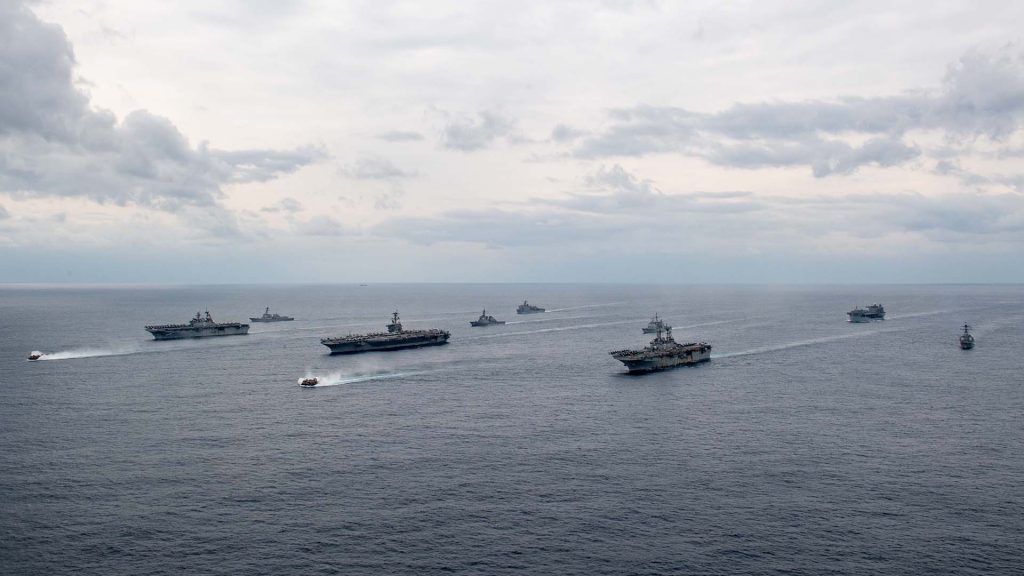
The US and Japan in the Noble Fusion military exercise in the Philippine Sea in February 2022
It’s important to note that U.S. war preparations with China have little do with Taiwan specifically. They’re a response to imperial decline and the rise of China and Russia.
Beijing and Moscow both present their own specific challenges to Washington’s hegemony.
Russia’s growing sovereignty and political independence from the U.S.-led West has undermined the Wolfowitz Doctrine of full-spectrum dominance over all territory of the former Soviet Union.
China’s massive socialist-led market economy is set to surpass the U.S.’s stagnant finance capitalist system in GDP terms by 2035.
Worse for the U.S. is that Russia and China have grown closer together.
In economic terms, the Russia-China comprehensive strategic partnership has grown by leaps and bounds since the Treaty of Good-Neighborliness and Friendly Cooperation was established in 2001. Bilateral trade is expected to increase by 25% and reach a total volume of $200 billion ahead of the 2024 target date.
Surging economic ties with China have given Russia further protection from U.S.-E.U. sanctions, with agricultural and energy exports to China increasing by the month.
China and Russia have also increased coordination on matters of military coordination, color revolutions, and diplomacy in the face of a common threat: U.S. imperialism.
But perhaps the biggest threat to U.S. hegemony resides in China and Russia’s leadership in the global movement for integration and de-dollarization.
China and Russia are the principle leaders of multilateral institutions such as BRICS+ mechanism and the Shanghai Cooperation Organization.
These multilateral institutions set out to strengthen investment in all sectors of economic and social development between participating countries, especially in the realm of finance.
In response to starvation sanctions imposed by the U.S. and E.U., and predatory loans from Western financial institutions, BRICS+ has united the largest Global South economies, uniting Brazil, Russia, India, China, and South Africa in an effort to develop an alternative to the U.S. dollar-dominated neoliberal economic system.
The strength of BRICS+ grew immensely in 2022. Saudi Arabia, Algeria, Iran, Argentina, and several other countries expressed interest in or applied to join BRICS+.
BRICS+ is complimented by China and Russia’s own integration projects which aim to develop the infrastructure necessary to break free from the petrodollar.
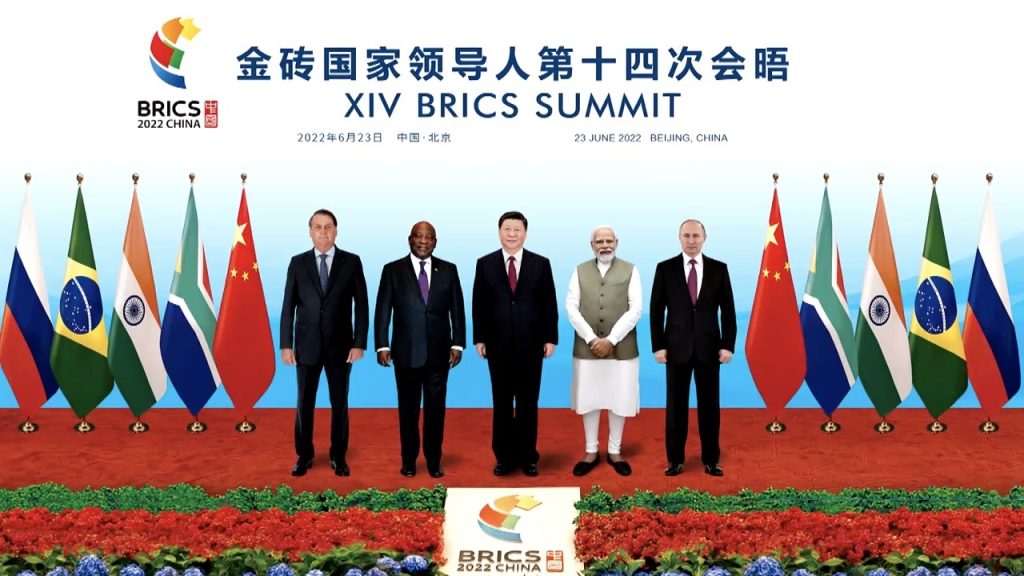
The “virtual group photo” taken at the 14th BRICS summit in 2022
China’s Belt and Road Initiative (BRI) sports major cooperation agreements with more than 140 countries and consists of at least 2,000 development initiatives, many of which are completed or under construction.
Talks of possibly merging the Russian-led Eurasian Economic Union (EAEU) and the BRI are already underway.
The same forces preparing for war with China have expressed deep concern about the future of the dollar amid growing Eurasian integration.
Foreign Policy admitted in its marathon 12-essay series that U.S. sanctions have led China to pursue alternatives to the dollar with its trading partners.
Zoltan Pozsar, an economist and former strategist at the Federal Reserve Bank of New York, recently sounded the alarm about what he termed “BRICSpansion” and the potential of China, Russia, Iran, and the Global South uniting around a new currency system backed by the wealth of commodities in their possession.
Pozsar warns of “commodity encumbrance,” or the growing possibility that resource-rich nations like Russia will use their commodities as collateral to increase reserves of credit and financing.
The interest that China and Saudi Arabia have shown in trading oil in Chinese yuan, Russia’s pursuit of an international reserve currency, and the idea of “BRICS coin” are presented as major threats to Western financial dominance.
The U.S.’s answer to fading imperial hegemony is war – and more of it.
War is an inherent feature of predatory neoliberalism, where corporations seek favorable conditions to exploit and plunder the planet’s laboring classes and resources.
War is also a permanent, and very profitable, industry dominated by a tiny few military contractors.
The ruling elite has calculated that U.S. imperialism cannot compete with China and Russia, making the rise of both an existential threat to the future of U.S.-led neoliberalism and imperialism.
This sentiment has been expressed by NATO’s Atlantic Council think tank, and in the U.S.’s successive national security strategies of “Great Power” and “Strategic” Competition.
That U.S. foreign-policy strategists and experts are planning for the next war should come as no surprise.
U.S. imperialism does not target singular “enemies”; it targets alternative development models and the nations attempting to build them.
As Henry Kissinger said, the United States “has no permanent friends or enemies, only interests.”
The Ukraine proxy war is thus a testing ground for the larger U.S. agenda of imperial expansion.
A common condition of peace and prosperity for humanity will depend in large part on undermining of this agenda, particularly within the citadel of imperialism: the United States.
https://geopoliticaleconomy.com/2023/01/16/us-preparing-war-china/