Revealed: The UK supported the coup in Bolivia to gain access to its ‘white gold’
By Matt Kennard• 8 March 2021
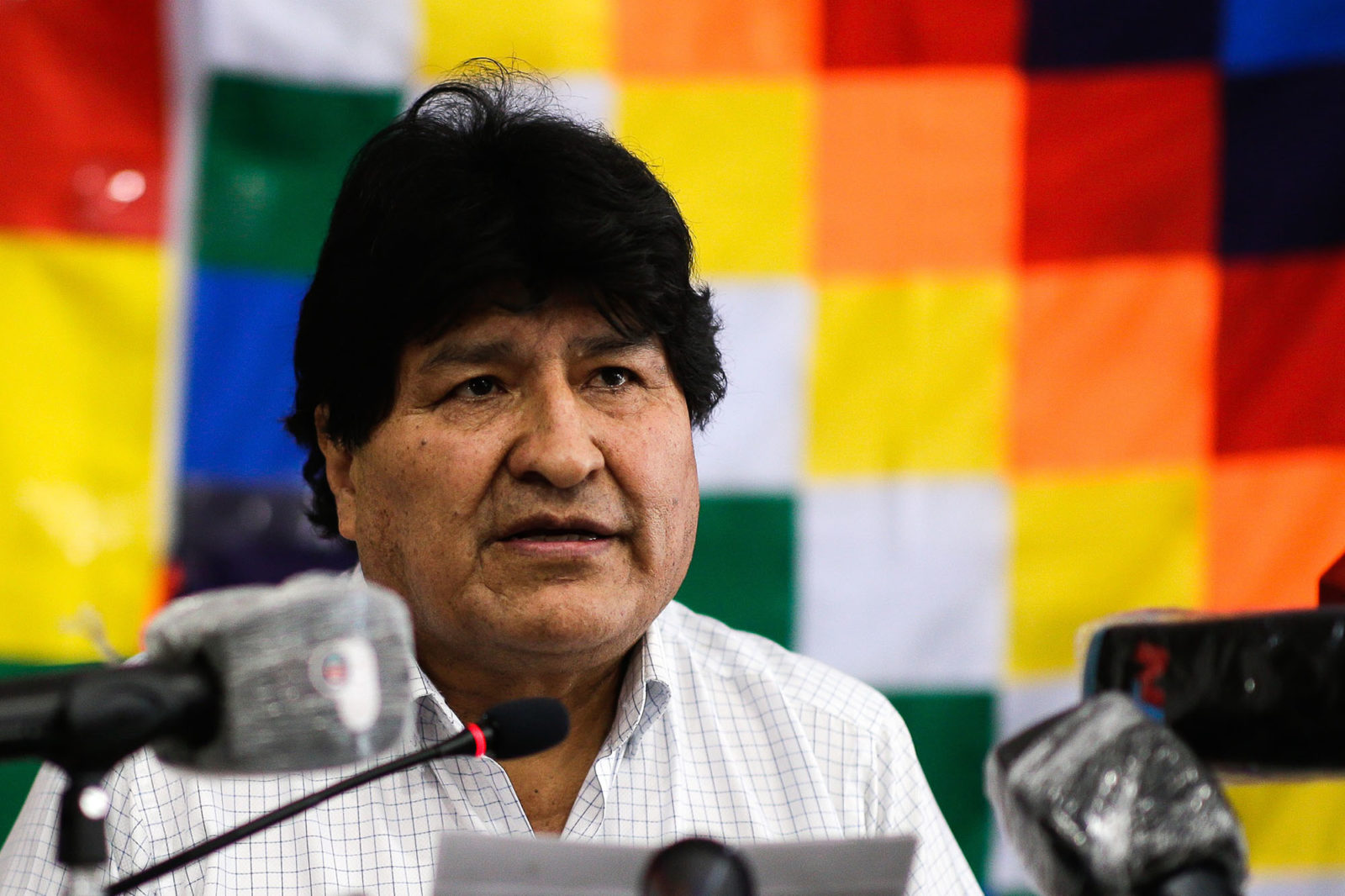
Former Bolivian President Evo Morales gives a press conference in Buenos Aires, Argentina, 18 October 2020. (Photo: Juan Ignacio Roncoroni/EPA-EFE) Less
After a coup in the South American country of Bolivia in November 2019, democratically elected president Evo Morales was forced to flee. Foreign Office documents obtained by Declassified show Britain saw the new military-backed regime, which killed 18 protesters, as an opportunity to open up Bolivia’s lithium deposits to UK firms.
Lithium – known as ‘white gold’ – is a key metal used in batteries and increasingly important to the world car industry
Britain’s Foreign Office appears to have paid Oxford-based company to optimise ‘exploitation’ of Bolivia’s lithium deposits the month after Morales fled country
UK embassy acted as ‘strategic partner’ to coup regime and organised international mining event in Bolivia four months after democracy overthrown
UK firm founded by British Army veteran was ‘now in line to offer its services’ to mining companies, Foreign Office noted after event
UK embassy provided data for the now discredited international report which was used to justify 2019 coup
UK embassy brought cybersecurity company with close links to the CIA to Bolivia in March 2019, eight months before the military takeover
On 10 November 2019, after the head of the army called for his resignation, Bolivia’s socialist president, Evo Morales, stepped down. It followed weeks of protests after the release of a report by the Organisation of American States (OAS) alleging irregularities in the election Morales had won the previous month.
Persecution from the new regime forced Morales to flee the country and an “interim president”, Jeanine Áñez, was installed. Widely condemned as a coup, resulting protests were met with lethal force.
Days after taking power, on 14 November, the Áñez regime forced through Decree 4078 which gave immunity to the military for any actions taken in “the defence of society and maintenance of public order”.
The following day, on 15 November, Bolivian military forces shot and killed eight protesters in the city of Sacaba. On 21 November, regime forces killed another 10 protesters in the neighbourhood of Senkata just outside the capital La Paz.
Despite the deadly violence, which was condemned by human rights groups, the British embassy in La Paz moved quickly to support Bolivia’s new regime, Declassified can reveal from documents we have obtained.
We have seen a project list for a Foreign Office programme in Bolivia called “Frontline Diplomatic Enabling Activity”, which the UK government describes as a “small pot of money that [embassies] receive and have authority over to spend on projects supporting [embassy] activity”.
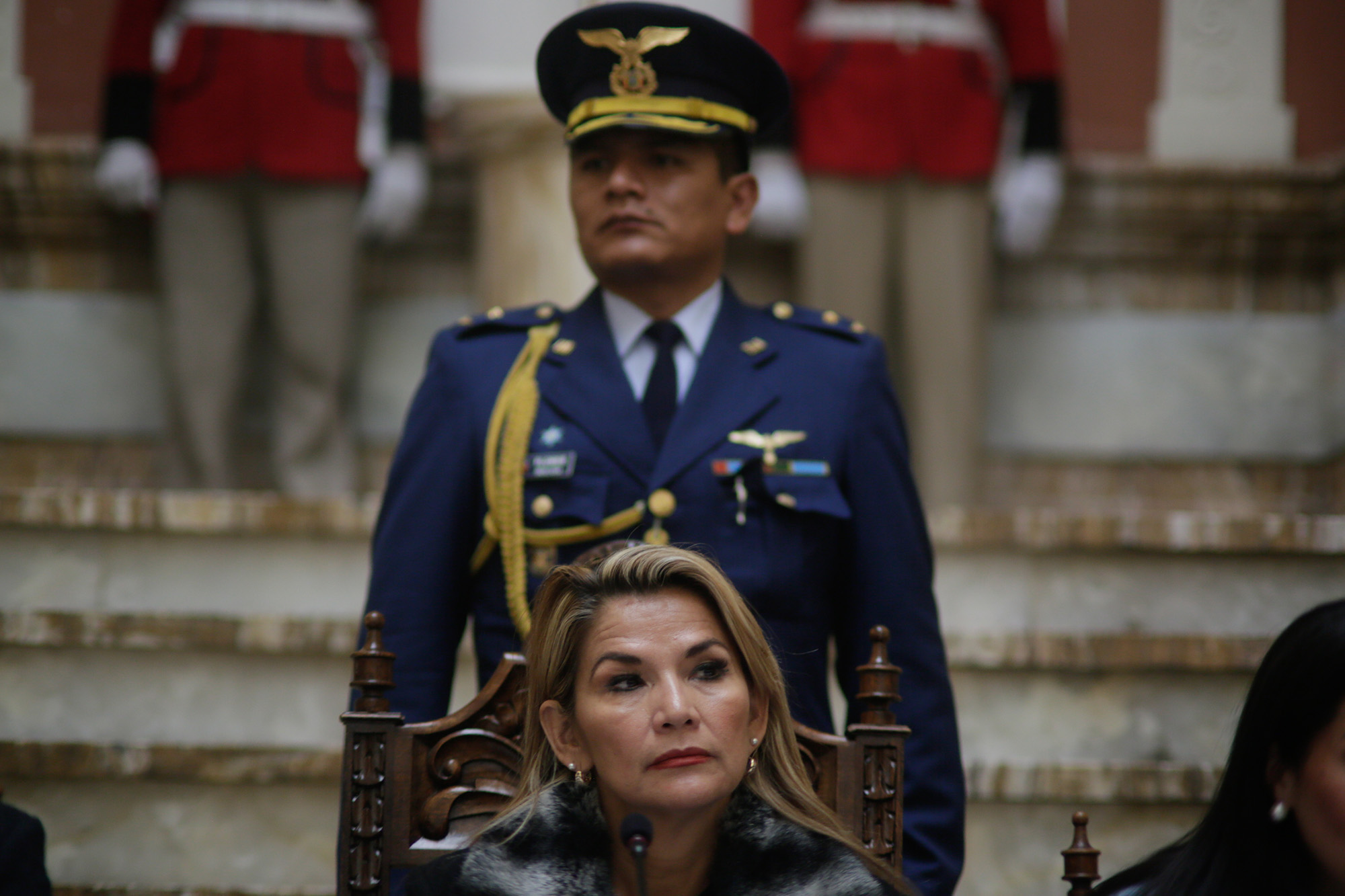
‘Interim President’ of Bolivia Jeanine Añez speaks during a press conference at the presidential palace on 15 November 2019 in La Paz, Bolivia. (Photo: Gaston Brito Miserocchi / Getty Images)
The deposits
Bolivia has the world’s second-largest reserves of lithium, a metal that is used to make batteries and which has become increasingly important due to the burgeoning electric car industry.
The UK government has stated that lithium battery technology is a priority for its “industrial strategy”. In June 2019, it announced it was investing £23-million in “electric car battery development”.
The government has further noted: “It’s estimated that South America holds 54% of the world’s lithium resources, which are increasingly in demand to manufacture batteries for electric vehicles and energy diversification programmes.”
It added: “The UK aims to have a thriving, sustainable battery industry, which would translate to a £2.7 billion opportunity … and our bilateral partnerships are essential to ensure this.”
In February 2019, Evo Morales’ government had chosen a Chinese consortium to be its strategic partner on a new $2.3-billion lithium project which would focus on production from the Coipasa and Pastos Grandes salars (salt flats under which the lithium is deposited).
But after the coup, the regime’s new minister for mining cast doubt on whether the deal would be honoured by the new government.
These particular salt flats were of interest to the UK embassy.
One project it co-funded from 2019-20 sought to “optimise Bolivia’s lithium exploration and production (in the Coipasa and Pastos Grandes salars) using British technology”.
After the coup, this project was quickly moved forward.
The abstract for the project was authorised by its main funder – the Inter-American Development Bank (IADB) – on 25 November 2019, two weeks after the coup and days after the Senkata massacre.
The project gained full approval for funding of $100,000 weeks later, in mid-December 2019.
The IADB told Declassified: “The implementation of [grant] activities are conducted in close coordination with designated government authorities and their technical teams.” At that point its “close coordination” would have been with the Áñez regime.
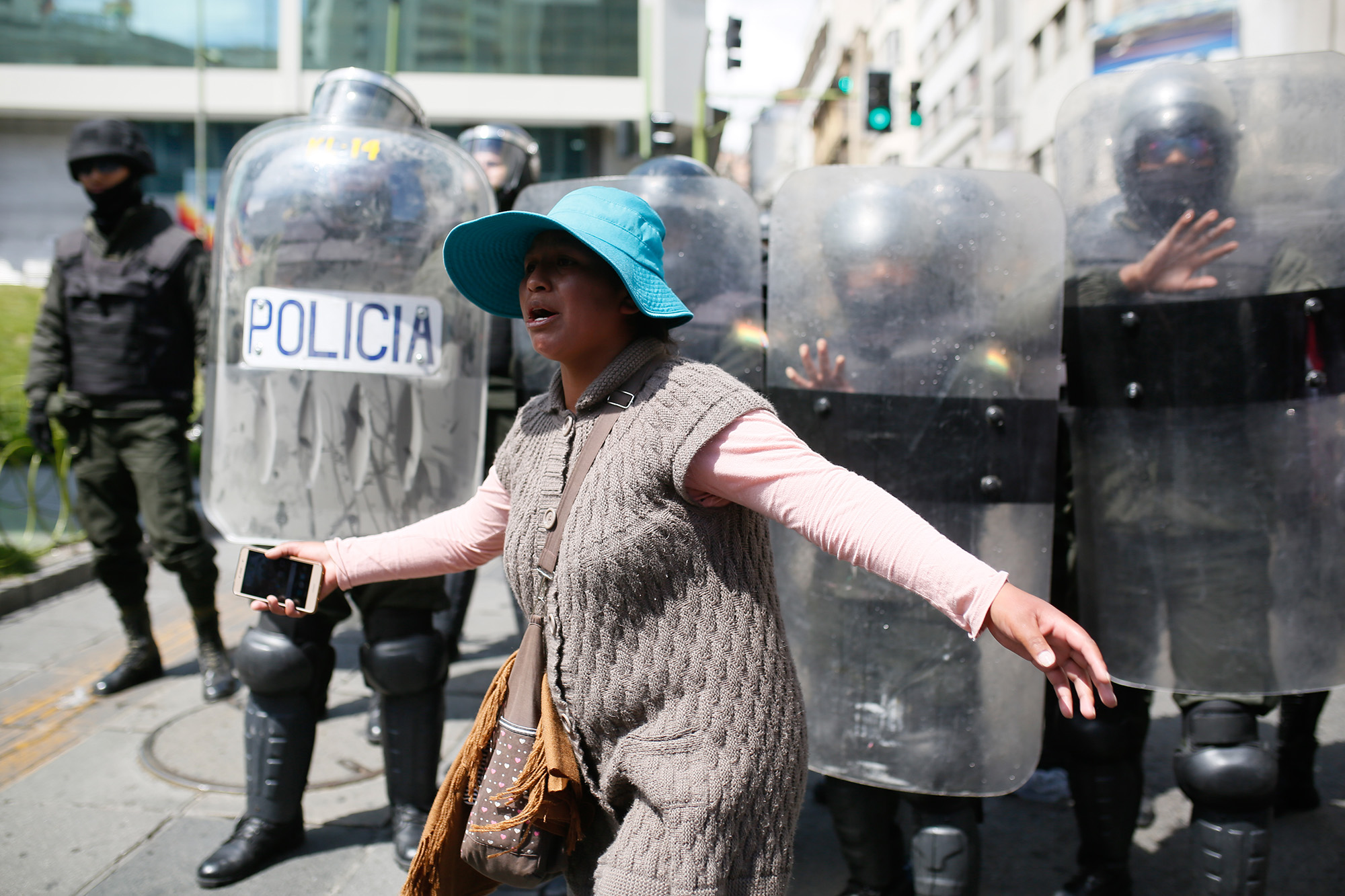
A woman shouts anti-regime slogans in front of a police line during a funeral procession of the victims killed during clashes with police at the Senkata fuel plant on 21 November 2019 in La Paz, Bolivia. (Photo: Gaston Brito Miserocchi / Getty Images)
Satellite Applications Catapult
The British embassy in La Paz provided £5,000 towards this lithium project in 2019-20, but the Foreign Office refused to tell Declassified if these funds were disbursed after the coup in November 2019.
The goal was to “design and implement a satellite data-based application that can optimise exploration and exploitation of large/best lithium sources in the Coipasa and Pastos Grandes salars in Bolivia”, the documents outlined.
The Foreign Office noted that the project was to be implemented by Satellite Applications Catapult, an Oxford-based organisation “helping organisations harness the power of satellite-based services”.
The company receives about a third of its funding from the UK government but it did not respond to Declassified’s questions about the Bolivia project.
However, we found that on 19 December 2019 – two days after the IABD gave final approval to the project – the UK Foreign Office transferred £33,220 to Satellite Applications Catapult, in a payment listed as “programme spend”.
The department refused to tell Declassified if this funding was for the lithium exploitation project in Bolivia. The IADB told us: “Coordination with the British Embassy has been particularly cooperative in search for synergies”.
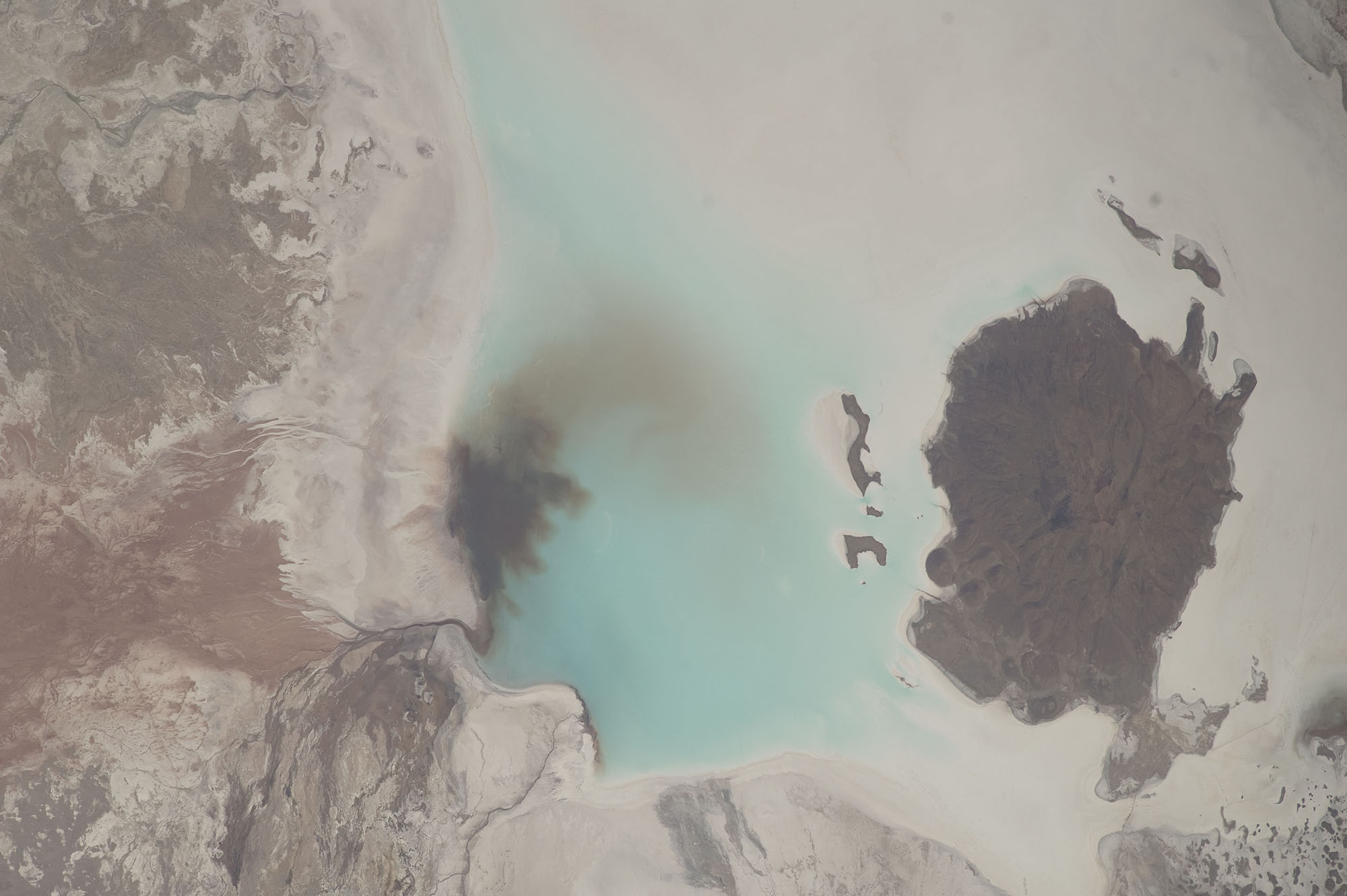
A picture of the Coipasa salt flats in Bolivia, photographed by an Expedition 33 crew member on the International Space Station. (Photo: Nasa)
International seminar
Then, in March 2020, four months after the coup, the British embassy in La Paz partnered with the regime’s Ministry of Mining to organise an “international seminar” for more than 300 officials from the global extractives sector.
A British company, Watchman, was brought in by the UK embassy to give the keynote presentation and outline the “creative solutions” it had enacted in Africa to bring local communities onside with mining projects.
The Foreign Office documents note: “Watchman UK and other consultancies are now in line to offer services in this important field to a number of Bolivia mining companies who wish to achieve win-win solutions to their controversies with indigenous inhabitants and towns located in the area of influence of their activities”.
Watchman is a risk management company set up in 2016 by Christopher Goodwin-Hudson, a nine-year veteran of the British Army who was later executive director of global security for the investment bank Goldman Sachs.
The company supports corporate clients “across the extractive, agribusiness and capital project sectors” who are having trouble operating because of local resistance. Watchman’s website carries the logo of the UK Foreign Office.
The firm’s associate director, Gabriel Carter, has held a number of senior roles in the private security industry and in 2012 founded an Afghanistan-focused security company that “supported numerous British and US development projects”.
Carter, also a veteran of risk management at Goldman Sachs, is a member of the Special Forces Club, an exclusive and secretive private members’ club for senior intelligence and special forces veterans in Knightsbridge, London.
Watchman did not respond to Declassified’s questions about the event and the UK Foreign Office refused to answer questions related to it.
UK Foreign Office documents from 2015-20 documenting a range of programmes run by the British embassy in Bolivia.
A long courtship
The quick moves of the British embassy on the lithium project followed years of trying to court Bolivia’s socialist government over the country’s reserves of the metal, the new documents show.
Morales had moved Bolivia away from the country’s traditional reliance on Western corporations since taking power in 2006. His government was widely praised for reducing poverty and increasing investment in schools, hospitals and infrastructure.
The Foreign Office notes that its “first engagement with the Bolivian Lithium Company”, known by its Spanish acronym YLB, was in 2017-18 when it paid £31,500 to organise a scientific UK mission. It focused on training the YLB on new technologies to explore and produce lithium in a “sustainable” way.
The documents note this project “allowed British organisations … to carry over projects on lithium in Bolivia with [Inter-American Development Bank] and [UK government] funding in the following years”.
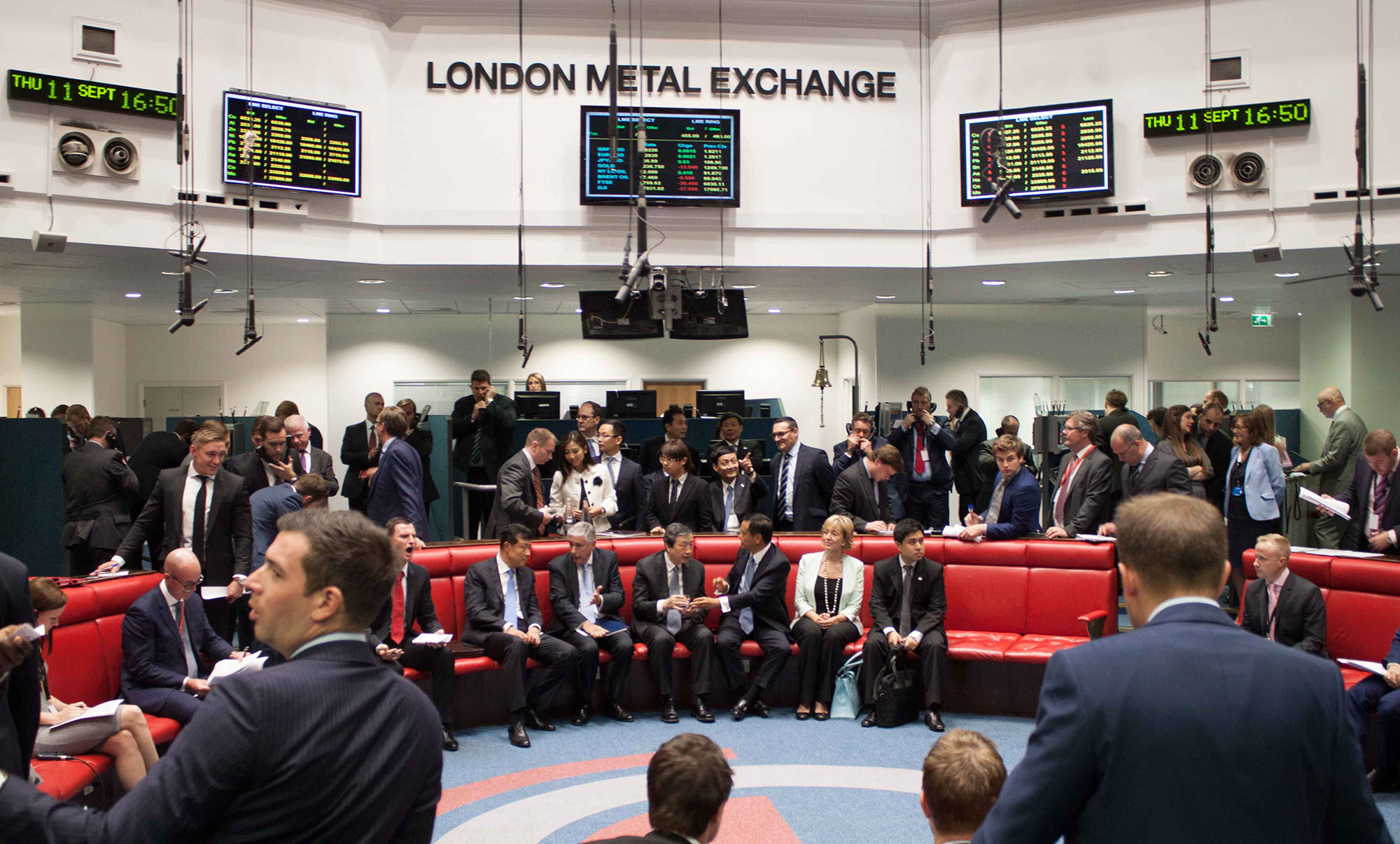
The UK government noted: “Relationship with the Bolivian Lithium Company might also prove relevant as Bolivia becomes a supplier of lithium (a critical material) to the UK”, and referenced its “effort to connect Bolivia, Chile and Argentina (ie the Lithium Triangle) with the London Metal Exchange”.
The following year’s programme notes that “stronger links” developed between the YLB and the British embassy in Bolivia.
The documents also outline how in April 2019, the British embassy in Buenos Aires, Argentina, hosted a “high-level technical meeting” with the mining and lithium authorities of Argentina, Chile and Bolivia, as well as senior representatives of the London Metal Exchange.
Those three countries together share ownership of the “lithium triangle”, the region of the Andes rich in lithium reserves. At the time Argentina and Chile had right-wing governments friendly with the UK.
Also in attendance was Bolivia’s vice-minister of lithium and the chief executive of YLB. “The project from the British Embassy in Bolivia … consisted in securing and facilitating the presence of the Bolivian authorities in the meeting”, the Foreign Office documents note.
It added that, after the meeting, the Bolivian government was now “aware of the relevance of the London Metal Exchange” and particularly “its interest to establish a lithium standard” which was to be based upon the lithium triangle production. Such standards serve “to promote understanding and communication between metal producers and users”.
The following sections in this passage are redacted under two exemptions related to “international relations” and “commercial interests”. These are the only redactions made on the programme documentation for the five years of operations seen by Declassified.
The London Metal Exchange, the world centre for industrial metals trading. (Photo: UK government)
Darktrace
There is further evidence Britain was always priming the country for a change in government. In the year before the coup, the British embassy was promoting the UK cyber sector, bringing a company to Bolivia founded by the UK intelligence community, and with close links to America’s Central Intelligence Agency (CIA).
In 2009, Morales had expelled a US diplomat who he claimed was a CIA asset heading an operation to infiltrate Bolivia’s state-owned oil company.
Eight months before the coup, the UK embassy spent more than £4,500 organising a “major event” in Laz Paz on cybersecurity for financial institutions, attended by 150 executives and senior officials from the Bolivian financial sector, according to the Foreign Office documents.
Delivered in coordination with the Bolivian Stock Exchange, Bolivian banks were said to “now be acquiring specialised services to protect their systems from cybercrime”. Further, the bankers were now aware that fighting cybercrime had to be “based upon adequate and state-of-the-art technology”.
Presentations were delivered by British company Darktrace, a cybersecurity firm set up by Britain’s domestic security service, MI5, and its signals intelligence agency, GCHQ. The company was incorporatedthe day after the first of whistle-blower Edward Snowden’s exposures was published in The Guardian.
Since its founding, Darktrace has hired personnel from the US intelligence community, including directlyfrom the CIA and the National Security Agency, where Snowden used to work.
Recruits from the CIA
Alan Wade, who sits on Darktrace’s advisory council, is a 35-year veteran of the CIA and its former chief information officer.
Darktrace also recruited Marcus Fowler, a former US Marine and 15-year veteran of the CIA, as its “director of strategic threat”. At the CIA, Fowler worked on “developing global cyber operations and technical strategies” and “conducted nearly weekly briefings for senior US officials”, he says.
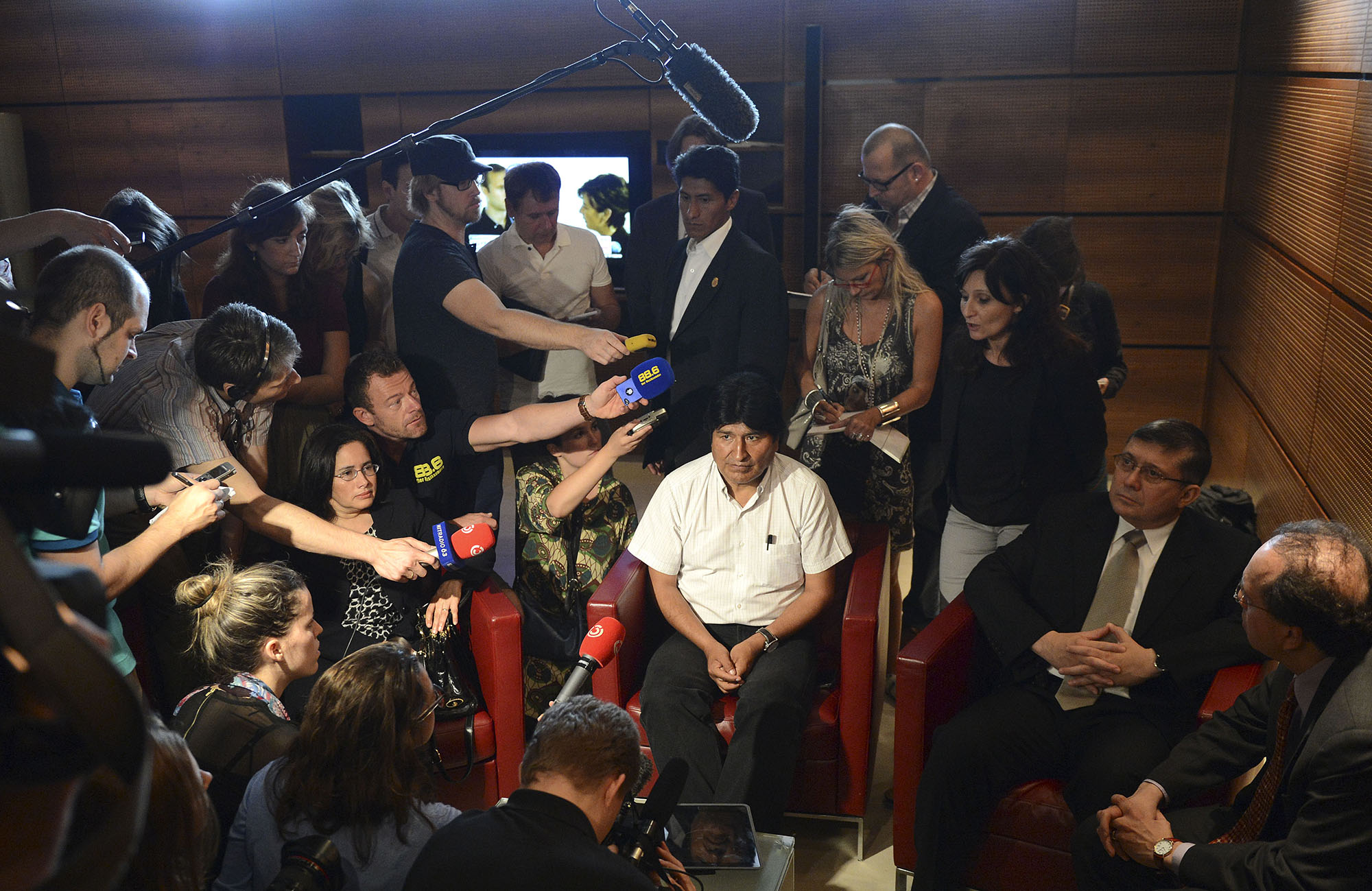
In July 2013, Evo Morales’ presidential plane was grounded in Austria after US intelligence agencies suspected it had Snowden on board.
Bolivian President Evo Morales (C) speaks to the media at the airport in Vienna, Austria, 3 July 2013. Morales’ plane landed in Vienna after the aircraft was denied access to French and Portuguese airspace over suspicions that US whistleblower Edward Snowden was on board. (Photo: Helmut Fohringer/EPA)
Morales blamed the US and other international actors for the November 2019 coup. “It was a national and international coup d’état,” he said soon after. “Industrialised countries don’t want competition.” He added: “I’m absolutely convinced it’s a coup against lithium.”
The WikiLeaks diplomatic cables show that the US embassy in La Paz worked closely with the political opposition in Bolivia to remove the Morales government after it took power in 2006.
Morales expelled the US Drug Enforcement Agency in 2008 and the US Agency for International Development in 2013, accusing them of “conspiring” against his government.
For the March 2019 event, the UK embassy also brought an expert from the London-based think tank Chatham House, whose co-president is Eliza Manningham-Buller, a former director-general of MI5.
Its funders include the US State Department, UK Foreign Office, the British Army, and the oil companies BP and Chevron.
After the event, Britain’s Foreign Office noted that “several companies in the field [are] now being hired and consulted”. It is not known if Darktrace was one of them.
The embassy kept up the engagement soon after. “New dialogue with the Bolivian government on cyber”, notes the Foreign Office in its 2019-2020 programme. It is unclear if this referred to the coup regime.
‘Important input’
The day after the Bolivian election on 20 October 2019, the Washington-based Organisation of American States – the grouping of countries in North and South America – released a report on the vote which Morales had marginally won. It cited “an inexplicable change” that “drastically modifies the fate of the election”.
It also raised doubts about the fairness of the vote and fuelled a chain of events that led to the November coup.
However, a subsequent study by independent researchers using data obtained by The New York Timesfrom the Bolivian electoral authorities found that the OAS statistical analysis was flawed.
Its conclusion that Morales’ share of the vote jumped inexplicably in the final ballots relied on incorrect data and inappropriate statistical techniques, the researchers found.
Declassified can now reveal that the British embassy provided data for the OAS’s discredited report.
The British embassy spent £8,000 putting together an alliance of civil society organisations which “coordinated an operation for citizens’ observation of the elections in 2019”.
This alliance carried out a survey on voting intentions before the elections, which “was an important input for the OAS mission report, which identified irregularities in the process”, the Foreign Office notes.
The OAS failed to respond to Declassified’s questions about the UK embassy’s role in its discredited report and the Foreign Office refused to answer any questions about it.
The British embassy’s projects to prepare for the election went even further. In February 2019, it spent £9,981 to bring the Thomson Reuters Foundation to the country to train 30 Bolivian journalists on “verification techniques and pre-planning an election on coverage that is balanced, accurate and free of polarisation”.
The Foundation said that “ahead of the elections in Bolivia” it was teaching “practical skills and tools to recognise fake news and attempts to influence the electorate with false information”.
Declassified previously revealed how the British government is using journalism as an influencing tool in Latin America. Also recently revealed was that the British government secretly funded Reuters in the 1960s and 1970s at the behest of an anti-Soviet propaganda unit linked to British intelligence.
‘Marxist solidarity’
Days after the November coup in Bolivia, the UK Foreign Office released a statement saying: “The United Kingdom congratulates Jeanine Áñez on taking on her new responsibilities as interim President of Bolivia.” It added: “We welcome Ms Áñez’ appointment and her declared intention to hold elections soon.”
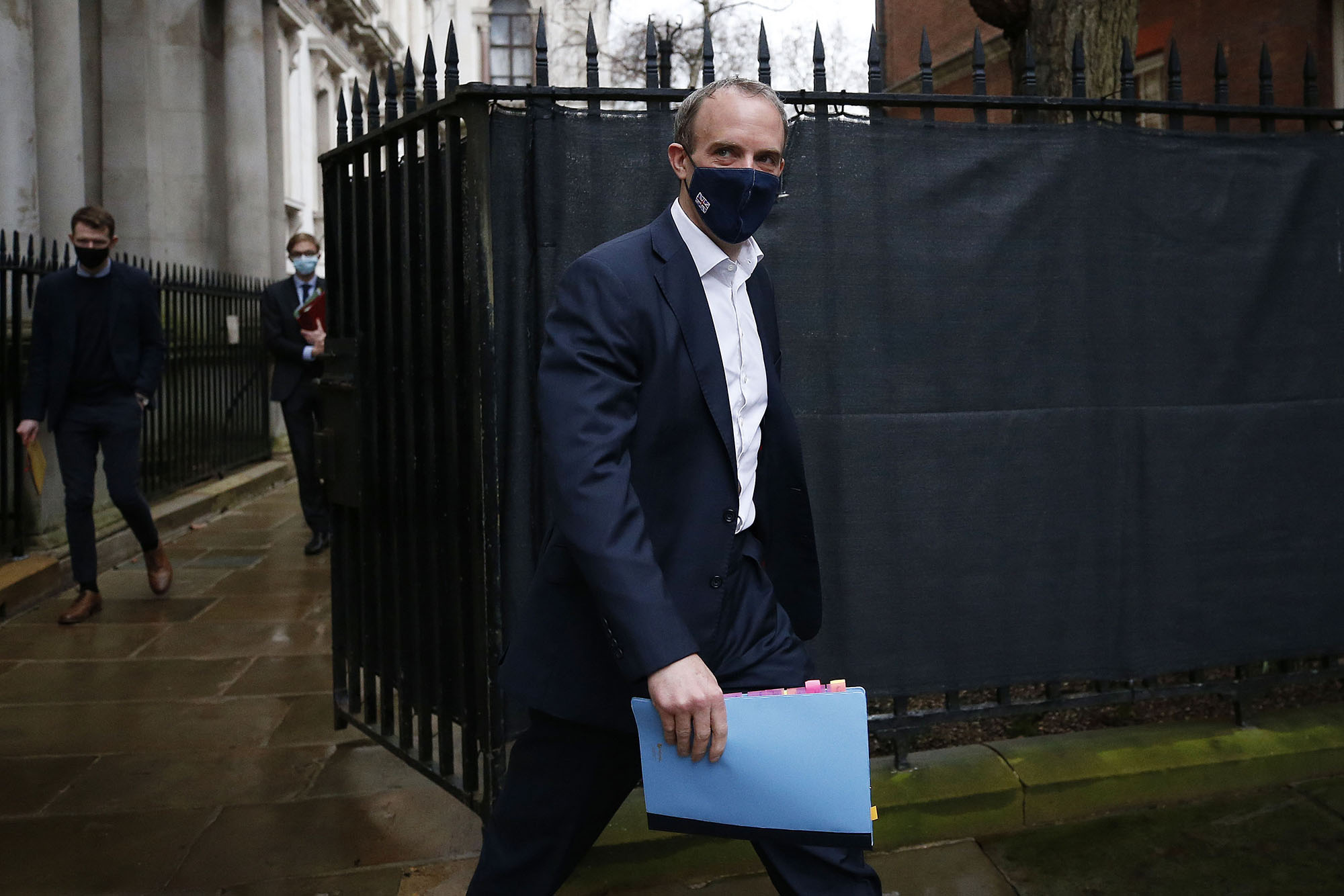
UK Foreign Secretary Dominic Raab arrives at 10 Downing Street on 3 February 2021 in London. (Photo: Hollie Adams / Getty Images)
Foreign Secretary Dominic Raab stated: “We hope that the current crisis in Bolivia can now be resolved swiftly, peacefully and in a democratic way. The Bolivian people deserve to have the opportunity to vote in free and fair elections.”
Then Labour leader Jeremy Corbyn offered a completely different view, saying: “I condemn this coup against the Bolivian people and stand with them for democracy, social justice and independence.”
Raab proceeded to attack Corbyn, quote-tweeting him and stating: “Unbelievable. The Organisation of American States refused to certify the Bolivian election because of systemic flaws. The people are protesting and striking on an unprecedented scale. But @jeremycorbyn puts Marxist solidarity ahead of democracy.”
But Raab and the Foreign Office made no further comments as the new regime’s forces carried out the Sacaba and Senkata massacres the following week.
Jeff Glekin, Britain’s ambassador to Bolivia since January 2019. (Photo: UK government)
In March 2020, four months after Morales was overthrown, the new regime was organising a series of new initiatives “with the UK as a strategic partner”, the documents note.
That same month, Britain’s ambassador during the coup, Jeff Glekin, offered a glimpse of the UK interests involved in backing the new regime.
Glekin spoke to the Bolivian media about British Week, which was bringing 12 British companies to the country for the first time.
“Many are looking for new markets in the world and Bolivia can be an opportunity to grow,” he said. “Due to the political changes in Bolivia, a more open environment for foreign investment is perceived and I believe that this will open new doors to companies that want to share their technology, their products and make alliances with different companies.”
Glekin, who remains in post, added: “We are working with the Santa Cruz Mayor’s Office … and we invite Santa Cruz corporations to participate in the event.”
In the documents seen by Declassified, a disproportionately high number of UK embassy projects have focused on the eastern city of Santa Cruz, which was the centre of opposition to Evo Morales’ government.
Glekin continued: “The previous government was not very in favour of foreign investment. So, with the changes that we are going to see, it will be easier to enter the market and do business. The companies to come are from different parts of Great Britain and from various sectors. They are modern firms that are doing innovative things and want to enter the market and share their services and products in Bolivia.”
Glekin added: “The demand for lithium is growing and Bolivia must take advantage of that opportunity.”
When new elections took place in October 2020, Evo Morales’ Movimiento al Socialismo won 55% of the votes against six rivals on the ballot, easily avoiding the need for a runoff. The runner-up was former President Carlos Mesa with just under 29%.
A Foreign Office spokesperson told Declassified: “Presidential elections held in Bolivia in October 2020 were free and fair. There was no coup. The UK has a strong and constructive relationship with current and former Bolivian administrations.” DM
Matt Kennard is head of investigations at Declassified UK, an investigative journalism organisation that covers the UK’s role in the world.
Follow Declassified onTwitter,Facebook andYouTube. Sign up to receive Declassified’s monthly newsletterhere. You can become a member and supporter of Declassified by visiting here.
Exclusive: Kash Patel, a former Russiagate investigator on the House Intel Committee and senior White House official, says US intelligence leaders blocked the release of documents that expose more malpractice and critical evidentiary holes in their claims of sweeping “Russian interference.” Patel also singles out the FBI’s “outrageous” reliance on Crowdstrike, and the burying of testimony that the firm had no concrete evidence.
As a senior House Intel investigator and Trump administration official, Kash Patel helped unearth critical misconduct by the intelligence officials who carried out the Trump-Russia probe.
In his first extended interview since leaving government, Patel tells Aaron Maté that still-classified documents expose more malpractice, as well as major evidentiary holes in the pivotal — and largely unquestioned — claims of a sweeping Russian interference campaign to elect Trump in 2016.
According to Patel, the release of these critical documents was “continuously impeded.” “I think there were people at the heads of certain intelligence agencies who did not want their tradecraft called out, even though it was during a former administration, because it doesn’t look good on the agency itself,” Patel says.
Among the tradecraft that Patel criticizes is the hastily produced and highly consequential “Intelligence Community Assessment” of January 2017, as well as the FBI’s reliance on Crowdstrike — the DNC contractor that generated the Russian hacking allegations despite later admitting, behind closed doors, that it lacked concrete evidence.
Patel also discusses other aspects of his time in the Trump White House: a secret mission to Syria; Trump’s record on foreign wars; and the January 6th riot at the Capitol.
Guest: Kash Patel. Former senior government official in the Trump administration, where he served as senior director for counterterrorism at the National Security Council, and chief of staff to the acting Secretary of Defense. Previously, Patel served as a top investigator on the GOP-led House Intelligence Committee, where he was instrumental in exposing US intelligence misconduct in the Trump-Russia investigation. Also served as a national security official in the Obama-era Justice Department and Pentagon.
Read more:
Aaron Maté’s July 2019 report on the flaws in Mueller’s claims of sweeping Russian interference: “CrowdstrikeOut”
Joining me is Kash Patel. He is a former senior official in the Trump administration who served in several top roles, including as the Deputy Assistant to the President, the Senior Director for Counterterrorism at the National Security Council, the chief of staff to the Acting Secretary of Defense, and previously he served as a top aide on the House Intelligence Committee when it was chaired by Republican Devin Nunes, where he was instrumental in exposing US intelligence conduct behind the Trump-Russia investigation.
Kash Patel, welcome to Pushback.
KASH PATEL: Aaron, thanks so much for having me. Really appreciate you doing this. Let’s have some fun.
AARON MATÉ: I appreciate the opportunity. You had a front row seat to several major stories of the Trump era. I want to start with Russiagate because that’s where I first heard of you. You helped expose the conduct of intelligence officials who carried out the investigation, including the instrumental role of the Steele dossier and the surveillance warrant on Carter Page, the former Trump campaign volunteer. And I want to get your response to actually how the media portrayed you, because when you were discussed in media accounts in several outlets, it seemed like it was a requirement to describe you as someone who was working to discredit the Trump-Russia investigation. I want to just get your response to that, how you saw your role behind the scenes, and your overall thoughts on the Trump-Russia investigation itself.
KASH PATEL: Well, thanks for allowing me the opportunity to speak about it like that. I don’t think anybody has ever really asked me to do that, so I really appreciate it.
So, I went on as a senior staffer for the House Intel Committee and not in Devin’s personal office. And long and short of it was, I didn’t really want to go over to The Hill, but Devin had said, ‘Hey, somebody with your background as a public defender and a national security prosecutor and knows how to investigate and take depositions, we sort of need someone to run this investigation.’ At the time neither of us thought it would get much coverage. We were just, like, we’ll do the investigation, we’ll make a report and we’ll put it up in Congress for the records, and that’ll be that. But I guess we were both really wrong on that one.
As the investigation unfolded, and the agreement I made with Devin, I said, ‘Okay, I don’t really want to go to The Hill, but I’ll do the job on one basis: accountability and disclosure. Everything we find—I don’t care if it’s good or bad or whatever from your political perspective—we put it out so the American public can just read it themselves.’ And he agreed to that right away. So, I said, ‘Okay, then we’re up and running.’ But then the media came in and, I think the first portrayal of me in the media, because my name as a staffer was leaked, which is generally verboten, unheard of, but was leaked, and they called me a genocidal dictator in that article—Torquemada—and I thought that was—I don’t know how to even describe that—but I felt really upset that my family name was being portrayed as someone who had killed thousands of people during the Spanish Inquisition.
AARON MATÉ: Huh, huh.
KASH PATEL: That was the first big, breaking news story. I don’t know if it was big; it was just the one that put my name out there, which I also was not expecting any of the media to be on me personally, as a staffer. That was a little surprising.
AARON MATÉ: And what were you actually doing behind the scenes, then, that you think would have elicited this attack on you?
KASH PATEL: Well, running types of investigations are hard enough when you’re a public defender with limited resources. So, I analogize going over to Congress and running an investigation in a similar fashion. When I was at DOJ [Department of Justice], you have all the resources in the world and it’s really cool, but Congress has limited capabilities. We had a limited budget and limited authorities, so I sort of went back to my public defender role and I said, ‘Okay, look, the first thing we got to do is line up key witnesses that we’re going to eventually interview. But before that we have to acquire all the relevant documents from the government agencies so that we can ask these witnesses about them and know what we’re doing before we get into the room.’ So, it was a document acquisition first step, and then, a sort of parallel track, lining up witnesses that we would ultimately interview, and I think we interviewed maybe 70 under oath, ballpark.
AARON MATÉ: And do you remember what revelation it was that made you first realize that there was some serious malfeasance going on behind the scenes, when it comes to the conduct of the intelligence officials who ran the Trump-Russia probe?
KASH PATEL: Well, it’s a combination of things, if you’ll allow me.
So, as a terrorism prosecutor at main Justice, I had personally worked on FISA applications myself, for a number of prosecutions successfully, and having done that work, I know how labor-intensive and detailed it is, and how much disclosure requirements you have to present to the FISA court, but also to the federal judge overseeing the case, ultimately, itself. So, I think the first time I read the Steele dossier was maybe a month or so after it came out, and it just seemed pretty sensational. And what I told folks was, ‘Look, the purpose of a FISA application is to go up on someone and surveil them who you think is basically working for another country against America.’ And Carter Page was the crux of that dossier, and I said, ‘This is really easy to prove or disprove.’ The big thing that made Carter Page in the dossier a quote-unquote “agent” of a foreign power was his meetings with high-level Russian officials and then bartering, as the dossier put it, for a 19-percent stake in the biggest gas company in Russia if he would help them, the Russians, trade once the Trump administration got in. Now, I told the members on House Intel if that were true, he’s definitely an agent of a foreign power. That’s the crux of the matter, so that’s where we started.
AARON MATÉ: And when you found out that the FBI was citing the Steele dossier in its surveillance applications to spy on Carter Page and listing Christopher Steele as quote “Source #1” and “credible,” what was your response, and how did you try to go about getting that out to the public?
KASH PATEL: Well, it was just sort of a Search Warrant 101, okay? So, we found out who the source is, let’s look at the source documents and the credibility of the source; that’s just basic Investigative 101. Getting those documents was another story. That was a whole different challenge that DOJ thwarted for a long time, but, ultimately, we were successful.
I think the big breakthrough was a combination of things that happened over the course of obviously many months, and we’ll condense it here. But once I found out that the Steele dossier itself was used in the FISA application, it was a huge red flag, because I was, like, this is not how we do FISA applications. And, also, this information is incredibly salacious, and some of it was just so easily disproved, such as the hotel room that they said the salacious engagement with Trump and others had occurred. Well, if you do some Investigative 101, that hotel doesn’t exist with that room in Moscow, period. And you would think an investigator like Christopher Steele, a human guy spy for the British government for so many years with Russian expertise, would get that little fact right.
The other thing was they had placed at the time Trump’s lawyer on a trip in Prague. I think it was Prague. And I said, ‘This is really easy. We just get the toll records for travel and see if the guy was ever in the Czech Republic or not.’ Turns out, he never left America during that time period. So, these credibility issues started to arise, and I said, ‘If we’re having problems with these easily disprovable facts, what about the heart of the matter?’ And that’s what we turned to next, with trying to get the documents and the sourcing of the whole Steele dossier.
AARON MATÉ: And the public became aware that it was the Clinton campaign and the DNC that was paying for the Steele dossier, in late 2017. When did you find this out?
KASH PATEL: Was it late 2017? Yeah, your timeline’s probably right. So, what we had to do was, through our investigations and our team, we were able to piece together the sort of players involved in this whole Steele dossier thing. And the Fusion GPS came out. The individual at DOJ, Bruce Ohr, came out; then we tied that to his wife’s work, Nellie Ohr, who we were sort of shocked to see involved in all this. So, these things we started really getting going on our investigative techniques and started to unveil the facts. And, ultimately, I told Devin one thing. I said, ‘Look, when you’re a prosecutor, you follow the money.’ Terrorism Financing Cases 101. This is really easy stuff, so I said, ‘Hey, let’s follow the money.’ But the difficulty was, I wasn’t in federal court. I wasn’t a DOJ prosecutor; I was at Congress with limited powers. So, I told Devin, I said, ‘Okay, give me one bank subpoena for this bank and let’s see what’s behind the curtain, and if I’m wrong we’ll just stop the investigation.’ And luckily, we got that bank subpoena, but that ultimately took us to federal court because Fusion challenged the validity of the subpoena, and now we obviously know why.
AARON MATÉ: So, I think by now the collusion allegation has been pretty much debunked. Few people actually still hold on to it except the most diehard adherents to Russiagate.
But I have a lot of questions about the other aspect of this, which is this allegation of a sweeping and systematic Russian interference campaign which has not been undermined nearly to the extent that the collusion aspect has. And the obvious question for me, even without looking at all the evidence, is that given that collusion was essentially a scam, what else about this was a scam as well? So, you looked at the intelligence used to advance these allegations of Russian meddling. Was it convincing to you?
KASH PATEL: That the Russians were interfering with the presidential election or that they were doing so for the behest of one candidate over another?
AARON MATÉ: Let’s start with that they were conducting a sweeping, comprehensive interference campaign to install Trump in the White House.
KASH PATEL: I would say the evidence did not bear that out. Now, it’s the Russians, they’re always interfering in our cybersecurity infrastructure, in our intelligence apparatus, and they will always look to get a leg up in our election cycle. So, were they involved in interfering? Sure. It’s what they do to us, period. Anyone who says otherwise has never really been in the game and understands how it works, or it’s just really making stuff up. I didn’t see this systematic, sweeping level of infiltration to pick one candidate over the other. We didn’t find that kind of hard evidence. We did find them meddling in a lot of places, of course.
AARON MATÉ: So, when it comes to the question of Russia interfering to specifically install Trump, that was an area where your report, the March 2018 HPSCI [House Permanent Select Committee on Intelligence] reporttook issue with some of the intelligence communities’ findings, when the US government, in the last days of the Obama administration, put out this Intelligence Community Assessment [ICA] in January 2017, which said that Vladimir Putin ordered this campaign of interference to install Trump. Your committee identified what it called “significant intelligence tradecraft failings.” Can you give us a sense of what those failings were?
KASH PATEL: Sure. Unfortunately, one of the documents we tried to get out during the Trump administration was that document you’re referring to.
So, the ICA was this investigation put together in a span of two to three weeks, led by John Brennan, and in two to three weeks you can’t have a comprehensive investigation of anything in terms of interference and cyber security matters. But they put it together, so we went and looked at it and looked at the underlying evidence and cables and talked to the people who did it.
We, on House Intel on the Republican side, actually put out a report, a highly classified report on the tradecraft used to make the Obama-era ICA that was made public. We wanted that underlying report made public, but we were continuously impeded in our efforts to do so by members of the Intelligence Community themselves, with the same singular epithets that ‘you’re going to harm sources and methods.’ And that was what was thrown in my face the entire time, when we were talking about Christopher Steele before he was Christopher Steele, and all the underlying methods.
And I just highlight that because we didn’t lose a single source, we didn’t lose a single relationship, and no one died by the public disclosures we made, because we did it in a systematic and professional fashion. And that’s what part of the media said would be impossible to do, but we did it, and we wanted to do it for our ICA. But that was, unfortunately, the one report which speaks directly to the issue you’re asking about, that’s still sitting in a safe, classified, and unfortunately, the American public—unless Biden acts—won’t see it.
AARON MATÉ: President Trump, though, had said that he was going to order a full declassification. Did he ever signal that he wanted that particular document released?
KASH PATEL: I don’t know if he personally singled it [out]. I know it was included in a list of documents that Congress was seeking, or some members of Congress were seeking, to have declassified. And I know that list made its way to the White House, and I also know that, I think, on the one of the last days he did declassify a bunch of material, but I still have not seen that.
AARON MATÉ: Right. That was a so-called binder of documents that have not come out yet. Who are some of the key officials who blocked the release of this material?
KASH PATEL: I think it was…look, when you’re calling out the FBI and DOJ, like, one person is calling them out to say, ‘You guys screwed up one of the biggest consequential investigations of this era,’ I think it’s right for them to take your word with caution. So, it was more of an institutional pushback, and then, ultimately, when you were able to peel back the layers and show Christopher Wray and show Rod Rosenstein that these documents in fact existed and then asked them to produce them, they would start to see the shortcomings of the FISA application and the investigative process and the Steele sourcing at the FBI.
And so, it was a repetitive process, one that even led Rod Rosenstein to threaten to investigate me because he got so annoyed at me for whatever reason, and I’m not really sure what he would investigate me or Congress on, but he made that threat, and that was widely reported.
It was just unfortunate to see the Deputy Attorney General who, at that point, was basically the Attorney General because Jeff Sessions was aside [recused] on all matters. We were having private internal discussions, and I just said, ‘Why don’t you just go get me these Bruce Ohr 302s [FBI interview reports], and if they don’t exist and they don’t say what I’m saying they’re saying, then you can say, “Hey, Kash, you’re totally wrong.”’ Well, it turned out that the Bruce Ohr 302s did exist and it took me a long time, but America finally saw 75 percent of them unredacted.
AARON MATÉ: And Bruce Ohr, for those who don’t know, is a former Department of Justice official who, even after the FBI terminated Christopher Steele as a source, he continued to act as essentially a liaison between Steele and the FBI.
KASH PATEL: Yeah.
AARON MATÉ: Let me ask you about this core assessment in the Intelligence Community Assessment of January 2017 as we discussed—that Putin ordered this campaign specifically to install Trump. It’s been reported that the main source for that judgment was this supposed mole inside the Kremlin who worked for the CIA, and that this mole, after some media reports actually was … he left Russia and came to the US and he was outed as living outside of Virginia. It’s been said that he had high-level access inside the Kremlin. Based on what you’ve seen, are the reports about the mole and his supposed high level of visibility into the Kremlin, are they credible?
KASH PATEL: So, unfortunately, I’m sort of in a bind on this one still, with all the classified information I looked at and the declassifications we’ve requested but have not yet been granted. So, through your great public reporting and investigative work, a lot of people have continued on, and I think rightly so, to get to the bottom of this. But until the ICA product that we created and some of the other documents are finally revealed, if I start talking about them, then I’m probably going to get the FBI knocking at my door, and I don’t really want that right now—or ever.
AARON MATÉ: Fair enough. Alright, I’m going to try one more angle of this, then, which I realize falls into similar territory, but I think it’s worth mentioning because some of it has been also made public.
CrowdStrike is the private security firm contracted by the DNC that generated the core allegation at the heart of all this: that Russia had hacked the DNC and stolen emails. Then, almost three years later, we get last year this declassification of a transcript from Shawn Henry, the CEO of CrowdStrike, testifying to your committee in December 2017. And he said that actually CrowdStrike had no evidence that these supposed Russian hackers actually took any data off of the server. So, essentially CrowdStrike had no evidence that Russian hackers had stolen the emails that CrowdStrike in public was accusing them of stealing.
CrowdStrike’s reports were used for the FBI’s investigation, and the FBI also relied on CrowdStrike’s forensics in terms of investigating and looking into the DNC server. What can you tell us about CrowdStrike’s credibility? Do you think that they relayed credible and accurate information?
KASH PATEL: I think CrowdStrike, as a private company contracted by the DNC, basically did the job that they were hired to do, but that doesn’t necessarily mean they served the American public well. They weren’t hired by the American public; they were hired specifically by a private company to look at their servers.
Where the FBI got it wrong—and James Comey admitted this—is that they, the FBI, who are the experts in looking at servers and exploiting this information so that the Intelligence Community can digest it and understand what happened, did not have access to the DNC servers in their entirety. The FBI only received—and for some outrageous reason agreed to having CrowdStrike be the referee as to what the FBI could and could not exploit and could and could not look at. Now, Shawn Henry, being a former FBI agent under James Comey, knew that, and I believe totally took advantage of the situation to the unfortunate shortcomings of the American public, and we were only able to have the FBI look at a piece of the cyber security hardware infrastructure for the DNC rather than all of it, which is what the FBI always does.
So, that was one of the most frustrating things to me, that the FBI, one, permitted that, and two, never went back and got the server so they could look at it. But I do think Shawn Henry testified that day accurately, that CrowdStrike didn’t have any information to support those claims that you were talking about.
AARON MATÉ: Which then leads me to question the claim itself, because it was CrowdStrike that generated it, and I think it’s a scandal that instead of us hearing back in December 2017 that the firm that generated this allegation didn’t have the concrete evidence for it. We had to wait nearly three years to find that out after so much had unfolded and so much hysterical fearmongering about Russian interference had happened.
KASH PATEL: Yeah, I think you’re totally right. And look, we wanted those depositions and those things out and declassified immediately after we took them, and we were thwarted in that ability, too, to do that. If you recall, we had sent all 60, whatever, transcripts to the DNI under then-DNI Coats just to do a quick classification check, and the Office of Director of National Intelligence under Dan Coats never processed or advanced those deposition transcripts until actually Rick Grenell and I got to the DNI and completed the work.
AARON MATÉ: But, by the time Grenell was in there, you had Adam Schiff now heading your committee—and I imagine he was not very receptive to releasing those transcripts.
KASH PATEL: Exactly. And that’s a great fact that you point out: Congress had switched majority/minority positions then, and the power to release the transcripts, even after we returned them, rested with the new chairman Adam Schiff, who, whatever your politics are, didn’t want some of these transcripts to come out. And that was just extremely frustrating because the whole purpose, as I said in the beginning, was accountability and release for the American public, and everybody should have been able to read every single page of those transcripts.
AARON MATÉ: Since we’re on the topic of Schiff, let me ask you quickly, when you see Congress reprimanding Marjorie Taylor Greene for pushing QAnon conspiracy theories, you witnessed Adam Schiff pushing Russiagate conspiracy theories, reading even the Steele dossier into the Congressional Record, including those Carter Page insane allegations that you mentioned before, about Carter Page being offered a stake in the Russian state gas company.
Adam Schiff: Carter Page, back from Moscow, also attends the convention. According to Steele, it was Manafort who chose Page to serve as a go-between for the Trump campaign and Russian interests.
AARON MATÉ: What are your thoughts on that, seeing Greene reprimanded for pushing conspiracy theories, but not Adam Schiff?
KASH PATEL: I think it’s a perfect example of why the American people have such little confidence in Congress’s abilities to do much of anything these days. It’s so infiltrated with partisan politics that people don’t know what to believe, and that’s why the only thing that I wanted to do there was to, instead of me writing stuff that I found, why not just let everybody read it, the way I found it, with a few protections here and there for some certain national security measures? But those are minimal redactions, and I asked that of everybody across the board, whether it was against people in President Trump’s universe or people at the DNC, or whatever. I said, ‘You guys have agreed to testify. We found documents pertaining to your work here. Everybody should read it.’ And that was just an argument that Congress wouldn’t let me win.
AARON MATÉ: I want to ask you something else about your March 2018 HPSCI report. There’s a very interesting line to me. You’re talking about the judgments that were inside that January 2017 Intelligence Community Assessment, the one that was put out in the last days of the Obama administration.
The report says the judgments, quote, “were mostly well reasoned, consistent with observed Russian actions, properly documented, and—particularly on the cyber intrusion sections—employed appropriate caveats on sources and identified assumptions.”
That line stood out to me because it suggests to me that when it comes to this core allegation of Russian cyber intrusions, that the evidence was not overwhelming, that there were caveats and identified assumptions. Am I right to infer from that, that when it comes to the attribution of Russian cyber meddling, that there were some qualifiers here and that the evidence was not overwhelmingly concrete?
KASH PATEL: Without speaking to the underlying intelligence, I think you’re absolutely on the right path to infer those things, because you smartly picked up on the verbiage that the IC uses a lot of times to qualify its reporting, but especially reporting of that volume done at that speed. And that’s the reason we undertook to investigate the ICA, too, as a piece of the Russia investigation, because we felt that report put out to the American public deserves scrutiny, the same scrutiny that the FISA application process received, and we created a whole separate report for it. And I really hope one of these days that report becomes public, because I think you’ll find a lot of things in that report that are facts that cannot be disputed by the IC, and that would lend a lot of credence to the things that you’re saying now.
AARON MATÉ: So, why do you think Trump didn’t let this get out? Because he had the authority to.
KASH PATEL: I don’t know if I would characterize it as whether or not President Trump let this out or not. I think there were people within the IC, at the heads of certain intelligence agencies, who did not want their tradecraft called out, even though it was during a former administration, because it doesn’t look good on the agency itself.
And again, that’s not castigating an entire agency. We’re not disparaging the entire FBI because of Peter Strzok and his crew of miscreants, where the same thing goes for the Intelligence Community. Just because I think John Brennan had four or five folks work on the ICA, if I remember correctly, if they did some shoddy tradecraft, the American public has a right to know about it in an investigation involving the presidential election.
And there were just the same barriers you run into. When we tried to declass just the Nunes memo itself, it’s institutional pushback, and then singular pushback at high levels because they didn’t want those disclosures to happen on their watch.
AARON MATÉ: Another question on this front: Guccifer 2.0 was this internet persona who the US Intelligence Community later said was actually a front for Russian intelligence, and the FBI and Robert Mueller strongly suggested in their indictment of Russian intelligence officers that it was Guccifer 2.0 that provided the stolen Democratic Party emails to WikiLeaks. Fast forward, though, to Mueller’s final report, and he includes a caveat that actually he has no idea how these emails made their way to WikiLeaks and actually they could have been transferred in person by hand. Do you have any sense of the sourcing behind this claim about Guccifer 2.0 being a front for Russian intelligence, and is it also something that we should be looking at with skepticism?
KASH PATEL: I think it’s something you should definitely be looking at with skepticism. It’s not something that we had time to focus on when we were doing the Russiagate investigation. It wasn’t one of the things that we were able to encapsulate within our sort of guidelines for purposes of investigation, and it sort of came up later. And by that point the handoff to Mueller had already happened, and so there was that cutoff date as to what we could and couldn’t look at. And once Mueller was announced, there was that spring cutoff timeline of the date of his March-April appointment; nothing past that that he was looking at was anything we could look at. But that doesn’t mean you guys can’t or shouldn’t.
AARON MATÉ: Well, speaking of which Mueller, very strangely, I think, chose not to interview Julian Assange, who was at the heart of all this because he released the stolen emails. Was there ever any discussion on your committee about interviewing Julian Assange?
KASH PATEL: I think there was. But remember, you have Robert Mueller whose special counsel is under the authorities of the Department of Justice and FBI. Big Government versus Congress and a Congressional investigator and his committee. To do those things and to make those asks is a very different request than coming from the Executive Branch of the United States government, and that’s the problem we ran into a lot of times. The FBI and the DOJ can ask and subpoena you guys and work with the heads of foreign governments to do so, but Congress’s ability to do that is much more limited.
AARON MATÉ: If you could release just a handful of documents, just say two documents that you think would give the public a better window into the real story here, what would they be?
KASH PATEL: The ICA report that HPSCI did, on the ICA itself. That, for sure, has been at the top of my list for far too long. And the other thing I would say, twofold: one, the entire subject portion of the last Carter Page FISA, and two, in conjunction with that I would release the underlying source verification reporting basically that they used to prop up that FISA. And then the American public can see what a bunch of malarkey it was that they were relying on. And not only that. It’s okay to make a mistake in a search warrant or pleading because that work you’re doing is so hard, but to intentionally make it is just something the American public needs to know about and read for themselves and make their own determination as to why their government allowed this to happen, knowingly.
AARON MATÉ: I want to move on to other aspects of your time in government. It was reported last year that you took part in a secret mission to Syria to try to broker the release of Austin Tice, the US journalist who has been held hostage there. It’s unclear what his status is, whether he’s even still alive. Let me just actually ask you that, do you think Austin Tice is still alive?
KASH PATEL: Hostage rescues are one of the most difficult and probably most rewarding parts of the job, when I was running counterterrorism for President Trump. You get to know the family so well that you just learn not to publicly comment on those matters about their loved ones because it’s just too painful, whatever the answer is. And I reserve my comments on those matters for Mr. and Mrs. Tice, in any efforts we made to get Austin.
AARON MATÉ: Can you tell us anything about your discussions with Syrian officials, what they were asking from you, their level of openness to having talks with the US government?
KASH PATEL: Sure. I mean, look, that didn’t happen overnight. One of President Trump’s priorities was, go get American hostages home, and I think we got over 50, 53-ish hostage/detainees back from 20-some countries, maybe. Maybe a little less.
But Austin Tice had been missing for going on eight years, and we had made no headway, really, on it, so we made it a priority. We started working with our counterparts in the region, and then that trip was almost 18 months in the making, and we finally were able to land a meeting in Damascus. Because I told them, I said, ‘I’ll come see you. You send someone who can represent President Assad directly because I can represent President Trump directly on this matter, and let’s go sit down.’ And they said, ‘Okay, come to Damascus.’
And I don’t know if they thought we would show up or not. But we did, and we were very clear. We said, ‘Look, I understand I’m not getting Austin home on this trip, but I would like a proof of life. What would you like in return for that?’ We had very frank conversations, and they said, ‘We want x amount of movement for the United States military and troop stuff,’ and this and that. I said, ‘Look, all of that’s on the table. We can discuss all those things. I need a proof of life.’ And they said they would take it back to Assad, at which they did. I know they did that. And then, I think, shortly thereafter I switched over to the Department of Defense and tried to continue that mission. But that one was one I just, unfortunately, didn’t succeed on.
AARON MATÉ: President Trump on the campaign in 2016, he was critical of US interventions abroad. He criticized the war on Libya, he criticized the dirty war in Syria, but his record in office did not do anything to reverse all this. And I think actually one could argue that he escalated it. What do you make for the gap between what he was saying on the campaign trail and then what he did in office?
KASH PATEL: I probably disagree with that because we did end three wars, three and a half, and that was what he campaigned on and we…
AARON MATÉ: Where? Which wars?
KASH PATEL: Well, we’re down to zero in Somalia, we’re down to less than 2,500 in Iraq. I won’t discuss the troop numbers in Syria, but it’s the lowest we’ve ever been, and we should hit zero in Afghanistan by 1 May unless the administration alters that trajectory. So, to move that amount of manning from decades of in-country fighting, we did that pretty expeditiously, and that’s something I think I’m pretty proud of, that we ended or drew to a near end so many theaters of war. Not all of them, unfortunately, but a lot of them.
AARON MATÉ: In Somalia, though, haven’t US troops just basically moved next door?
KASH PATEL: Well, yeah. Sort of. Without discussing exact troop locations, we’re no longer in Somalia with a big troop presence, and we are always going to counter terrorism in any form. And al-Shabaab, being one of al-Qaeda’s biggest affiliates, based solely out of Somalia. We, of course, are going to lend help to our forces in Kenya, which is one of our biggest partners in East Africa.
So, if you talk about moving troops from Syria to Iraq versus moving troops from Somalia to wherever, you move them to where you have more reliability, are closer to the actual fight, and your capabilities to counter the terrorist threat is greater, not less. And that’s the line of effort that we took to execute in places like Iraq, Syria, Somalia, and East Africa.
AARON MATÉ: What about the Saudi war on Yemen? Obama greenlit that war. It caused a humanitarian catastrophe—some call it a genocide. There was the ongoing risk of famine, a cholera outbreak. Why did Trump escalate US support for that?
KASH PATEL: I don’t know. The Saudi piece has never been my forte, so I’d just be speculating if I was speaking to that.
AARON MATÉ: Was there talk of ending it?
KASH PATEL: The Saudi component or the Yemeni component? Sorry.
AARON MATÉ: The support for the Saudi war on Yemen.
KASH PATEL: There was always talk of decreasing our support to any theaters of war. The problem with the Yemeni portion of it is, as you know, the Houthis are in Yemen, so that’s Iran’s proxy, and it’s one of al-Qaeda’s bigger branches, too, that bases out of Yemen, that poses a threat to American interests. So that was the balance that they had to strike with that conflict, and it’s a tough one. There are three different governments running around in Yemen. There’s two different…three different foreign terrorist organizations. Well, two now that Biden removed one as the label as a terrorist, and that conflict’s going to go on. It’s one, I do think, we need to monitor because Iran is involved, and they simply don’t like us.
AARON MATÉ: All right, we’re going to have to debate Yemen another time, because I have a much different view.
But let me ask you, finally, what did you make first of Trump’s claims that this election was stolen, and were people advising him that what he was saying was not grounded in fact?
KASH PATEL: I’m not going to speak to what people were advising him on about that, because the election stuff was never my job. My job was to head his counterterrorism program, run his DNI, and then, ultimately, help run his Defense Department. So, I stayed out of all that stuff. That never came to me.
AARON MATÉ: And what do you think explains what happened on January 6th? Do you think that…I mean, who deserves blame here for what happened?
KASH PATEL: That’s not for me to cast. Unfortunately, people died, Americans died, policemen died, which is just one of the greatest tragedies you can have. The Capitol was broken into, which is just a symbol of our democracy.
AARON MATÉ: But what about claims or allegations or suspicion that the Pentagon slowed a response? They did not answer the calls for the National Guard quick enough, and that even that this was deliberate. I mean, that is the suspicion of many people, that there was a deliberate attempt to let that mob happen on the part of even White House officials, possibly even President Trump.
KASH PATEL: I mean, that’s an extended conversation for another day. But I will politely say that that is totally, factually false. Having assisted Secretary [Christopher] Miller running the Defense Department, we put out a very public timeline for our response. We basically quelled the situation at the Capitol so that the United States Senate could go back and certify the presidential election. From the time the incident began, in less than five hours they were voting to certify the presidential election again. We—and the Capitol Police admitted this—went to the Capitol Police beforehand and said ‘Hey, do you need any help?’ They said, ‘No.’ And we, the Department of Defense, cannot lawfully send in the National Guard unless there is a specific request made by the mayor and/or a federal agency, and none were made.
Once they were made—and a caveat to that is Secretary Miller and I had gone to President Trump days before January 6th, and he had authorized 10,000 National Guardsmen throughout the country in case there was any unrest, so he had already authorized the action. The governors and the mayors still had to ask for it, and once they did in the DC area, just to give you an anecdotal example, we activated from a cold start the fastest augmentation and mobilization of uniformed military troops in the DC area since World War II, and we put 24,000 boots on the ground in less than 48 hours. I don’t know who’s saying we slow-rolled anything, because these are Guardsmen, they’re not active-duty military, and we have to pull them out of their daily lives, train them up, get them up and then deploy them, and employ them. And I think we did that. And I think the record will show with extreme alacrity that we’re very responsive because of the severity of the situation.
AARON MATÉ: Kash Patel, former senior official in the Trump administration, thank you very much.
KASH PATEL: Thanks, Aaron. I appreciate it. I had fun.