Zoeken in deze blog 🔎🔎

donderdag 2 mei 2019

Julian Assange

Assange to Extradition Court: ‘I Won’t Surrender to the US for Doing Journalism’


The WikiLeaks founder appeared via video link in Westminster Magistrates Court for the first hearing in what could be a lengthy process in the US request for extradition.

By Joe Lauria

Special to Consortium News

Julian Assange had his first day in court on Thursday in his fight against extradition to the United States in an historic press freedom case that could have a profound impact on the future of journalism.
Dressed in jeans, a dark jacket and a T-shirt, Assange appeared on a video screen inside a cramped courtroom in Westminster Magistrates Court in London. “I won’t surrender to the U.S. for doing journalism that has won many awards and protected lives,” Assange told the court, according to atweet from a USA Today correspondent.  
Assange was arrested on April 11 after Ecuador lifted his political asylum at its embassy in London where Assange had lived since June 2012. On that day the U.S. unsealed an indictment against the publisher for conspiring with WikiLeaks’ source Chelsea Manning to crack a password needed to hide Manning’s identity.  Protecting a source is a routine part of investigative journalism.  

Watch a Special Extradition Vigil for Assange on Thursday at 4 pm EDT live here on Consortium News.

The U.S. also filed a request that day to the British government to extradite Assange to face the charges, which carry a maximum sentence of five years in prison. Thursday was Assange’s first appearance in the extradition case before Judge Michael Snow.
A large group of Assange supporters gathered outside the courthouse as well as inside Court Three, where many sat on the floor for the 10-minute hearing, the Daily Express in London reported. Many reporters and supporters were unable to gain entry after the hearing was moved to a smaller courtroom.
A further procedural hearing was scheduled for May 30, and a substantive court date was set for June 12. On that day the U.S. faces a deadline to reveal any further charges against Assange for which the British courts must base their extradition decision. The court was told resolution of the case was still months away, the Express reported.
The U.S. is weighing charging Assange under the 1917 Espionage Act for unauthorized possession and dissemination of classified material. It would be the first time the Act would be used to prosecute a journalist for receiving and publishing secret information.  “It is not just a man who stands in jeopardy, but the future of the free press,” NSA whistleblower Edward Snowden said in a message to a pro-Assange rally in Berlin on Wednesday.
Assange is serving an 11-month sentence for skipping bail imposed on him on Tuesday on a Swedish investigation of sexual abuse allegations that was dropped last year. “Julian Assange‘s sentence is as shocking as it is vindictive,” WikiLeaks tweeted. “We have grave concerns as to whether he will receive a fair extradition hearing in the UK.”


Tom Engelhardt 310

May 2, 2019 
Tomgram: Rebecca Gordon, Autocrats R Us
[Note for TomDispatch Readers: Consider this a small reminder that you can get a signed, personalized copy of Rebecca Gordon’s superb American Nuremberg: The U.S. Officials Who Should Stand Trial for Post-9/11 War Crimes by visiting the TD donation page and contributing $100 ($125 if you live outside the USA). Available there as well: Frostlands, the second volume of John Feffer’s riveting Splinterlands series of novels, and Alfred McCoy’s prescient In the Shadows of the American Century: The Rise and Decline of U.S. Global Power, among other books. Do check it all out and, while you're at it, keep this website floating above the Trumpian waves. Tom]

It started with “Fort Trump.” Last September, while visiting the White House, Polish president Andrzej Duda only half-jokingly suggestedthat very name for the new U.S. base he was proposing the Pentagon set up in his country (and was offering more than $2 billion to support). In other words, he grokked this American president perfectly. If it works for golf courses, why not forts? And perhaps you won’t be surprised to learn that the administration of the man who had long promoted friendlier relations with Russia now seems to be forging ahead with Fort Trump, ensuring that thousands more U.S. military personnel will be stationed near the Russian border.

And Duda wasn’t the only foreign leader to note a presidential proclivity for spreading that name far and wide. What about, for instance, giving it to an Israeli community to be built in the once-Syrian Golan Heights that Donald Trump only recently ceded to his old friend Bibi Netanyahu? The Israeli prime minister, as the New York Times reported, recently suggested that “he would ask his government to approve naming a new Jewish settlement in the Golan Heights for President Trump, in appreciation of the American leader’s proclamation recognizing Israel’s authority over the long-disputed territory.”

There might, in fact, be quite a future in such gestures. For instance, as TomDispatch regular Rebecca Gordon points out today while taking us on a whirlwind tour of the latest upheavals in the Greater Middle East and northern Africa, the president only recently countermanded his secretary of state by making a personal call to Libyan warlord Khalifa Hifter and offering his support for the general’s push to take his country’s capital, Tripoli. Obviously, the least Hifter could do in return, should that city fall to him (still a question mark), would be to rename it Trumpoli. It not only makes sense, but fits perfectly with the famed U.S. Marine Corps hymn(“From the gates of Mar-a-Lago to the shores of Trumpoli...”)

Ah, the glories of a president who likes to see his name writ in vast golden letters across the planet! Think about that as you embark on Gordon’s tour of parts of that same globe where other autocrats have already found themselves imperiled for their “high crimes and misdemeanors.” Tom
Spring Stirrings and Misgivings 
Of Autocrats and Uprisings in the Middle East and North Africa 
By Rebecca Gordon

“Al-Shebab,” said my student Jerry early in the fall 2010 semester. “We’re calling our small group al-Shebab. It means ‘The Youth.’” From his name alone, I wouldn’t have guessed his background, but he was proud of his family’s Egyptian roots and had convinced his classmates to give their group an Arabic name.
As usually happens when the semester ends and my dozens of students scatter, Jerry and I lost touch. The following April, however, we ran into each other at a rally organized by students at my university to support the Arab Spring. Like many others around the world, I’d watched transfixed as brave unarmed civilians faced down riot police on the bridges leading to Cairo’s Tahrir Square. I’d celebrated on February 11, 2011, when the corrupt and authoritarian Egyptian president Hosni Mubarak resigned as the military took control of that country.
Jerry’s eyes sparkled when he saw me. “Isn’t it amazing?” he shouted. Yes, it was amazing... until it wasn’t.
This spring, eight years later, there has been a new set of popular uprisings in northern Africa, from Algeria to Morocco, to Sudan. Let’s hope they have more lasting success than Egypt’s Arab Spring.
Click here to read more of this dispatch.


Venezuela Coup Attempt

    • Thousands took to the streets in Venezuelan on May 1, one day after coup attempt.

      Thousands took to the streets in Venezuelan on May 1, one day after coup attempt. | Photo: teleSUR

    Published 1 May 2019 (12 hours 44 minutes ago) 

    "Today was a contrast of peace and violence in Venezuela, from that attempted coup d'état, carried out by foreign interests," said President Nicolas Maduro.

    As Venezuelans gathered to commemorate International Workers Day on Wednesday, one could not fathom that just a day earlier the country experienced an attempted coup d’etat. The tranquility felt in the capital city Caracas showed its people and the world that violence or oppression against the opposition is and won’t be government policy. 
    "Today was a contrast of peace and violence in Venezuela from that attempted coup d'état, carried out by foreign interests," said President Nicolas Maduro regarding the coup on Tuesday, adding that despite been pushed towards a “civil war” his government acted in a cool and well-thought out manner in order to promote public order and peace. 
    In contrast to other nations such as Sudan whose army, after overthrowing President Omar al-Bashir, declared a three-month state of emergency. Or neighboring Colombia, whose far-right government has systematically repressed opposition protests organized by Indigenous campesinos, students and social movements.
    “Mass media in my country and around the world has portrayed Maduro’s government as a violent dictatorship, yet the government has reacted very carefully against those extreme violent acts that for a long time the opposition has tried. This contrasts to a very democratic behavior by the Venezuelan government,” Valter Pomar from the Brazilian Worker’s Party (PT) told teleSUR.
    This comes as lawmaker Juan Guaido Tuesday urged the armed forces to support his effort to oust Maduro and appeared outside an air force base with dozens of National Guard members, which later turned out that had been tricked into showing up at the highway interchange of Altamira. Guaido and opposition leader Leopoldo Lopez, who violated his house arrest, tried to get the army and people to join their coup but failed. 
    Following their move against the government, protests took place across the capital Caracas and several clashes took place in which multiple injuries from both sides were reported, including eight security forces, one which was shot in the neck. During these clashes, the Bolivarian  Armed Forces were ordered to not draw their weapons against civilians, while opposition “guarimbas” were seen and recorded using live ammunition against the National Guard and Army. 
    “Let’s remember that back in 2002 shots against civilians were blamed on Chavez’s government to later find out they were actually perpetrated by the same opposition. So it is not crazy to assume that they might try to use that excuse once again,” added Pomar. 
    While the coup attempt was immediately supported by the U.S. government of Donald Trump, nations as Mexico, Cuba and Russia rejected the escalation of violence. Just as Maduro called for dialogue and restraint, the opposition called for more violence and chaos.  
    However, the government has been clear that they will not fall into the opposition and the U.S.’s “games” that are waiting for the government to violently react or imprisoning Guaido in order to justify an intervention in the name of so-called human rights violations. 
    President Maduro’s reaction has been the complete opposite, allowing opposition civilians to peaceful protests and even allowing those that lead the coup attempt, such as Lopez and his family, secure their rights by asking for refugee in a foreign diplomatic mission. 
    So as many have pointed out, it is rather a very “strange dictatorship” the one Venezuelans are experiencing, where the government calls for dialogue and order while the opposition for repression and war. 

    Thierry Meyssan: Daesh’s new territories

    Daesh’s new territories

    Although there is no longer any reason for the jihadists to split themselves between Al-Qaïda and Daesh, the two organisations continue their war in the Greater Middle East. Paradoxically, it is now Al-Qaïda which runs a pseudo-State, the governorate of Idlib, and Daesh which organises attacks far from the battle-fields, in the Congo and Sri Lanka.
     | DAMASCUS (SYRIA)  
    +
    JPEG - 30.8 kb
    The liberation of the zone administered by Daesh as a state does not mean the end of this jihadist organisation. Indeed, while Daesh is a creation of the NATO Intelligence services, it represents an ideology which mobilises jihadists and may outlive it.
    Al-Qaïda was an auxiliary army for NATO – we saw them fight in Afghanistan, then in Bosnia-Herzegovina, and finally in Iraq, Libya and Syria. Its principal operations were acts of war (under the command of the « Mujahideen », the « Arab League », or others), and alternatively, but more openly, terrorist operations like those in London or Madrid.
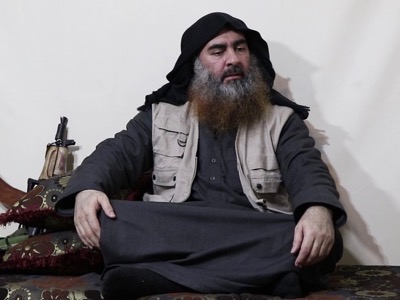
    Oussama Ben Laden, officially listed as Public Enemy Number One, in fact lived in Azerbaïdjan under US protection, as revealed by an FBI whistle-blower. [1]
    Let us not forget that the attacks of 11 September in New York and Washington have never been claimed by Al-Qaïda, that Oussama Ben Laden declared that he was not implicated, and that the video in which he contradicted this original statement has been authenticated only by his employer, the Pentagon, but has been declared to be false by all independent experts.
    While Oussama Ben Laden apparently died in December 2001, according to the Pakistani authorities, and representatives of MI6 attended his funeral, certain individuals stood in for him until 2011, the date at which the United States pretended to have assassinated him, without ever showing his corpse. [2]
    The official death of Oussama Ben Laden enabled the relooking of the jihadists as combatants led astray by their evil leader, which in turn allowed NATO to use the the support of Al-Qaïda, quite openly, in Libya and Syria, as it had done in Bosnia-Herzegovina [3].
    Daesh, on the other hand, is a project for the administration of a territory, known as Sunnistan or the Caliphate, intended to separate Iraq and Syria, as was explained by Pentagon researcher Robin Wright with the aid of maps which were drawn up before this organisation was created [4]. It was financed and armed directly by the United States during operation « Timber Sycamore » [5]. It impacted public opinion by installing a ready-made law, the Charia.
    If the jihadists of Al-Qaïda and Daesh were defeated in Iraq and Syria, it is first of all due to the courage of the Syrian Arab Army, then due to the Russian Air Force, which used penetrating bunker-buster bombs against the underground installations of the combatants, and finally, due to their allies. But if the military war is now over, [6], it is thanks to Donald Trump, who prevented the importation of new jihadists from the four corners of the world, mostly from the Arab peninsula, Maghreb, China, Russia, and finally the European Union.
    Al-Qaïda is an auxiliary paramilitary force for NATO, while Daesh is an Allied land army.
    Paradoxically, while Daesh lost the area for which it had been trained, it is Al-Qaïda which now administrates a territory, despite the fact that it was opposed to this kind of charge. The Syrians pushed the different jihadist groups back and boxed them in at the governorate of Idlib. Unable to break with this type of opportunistic ally, Germany and France took charge of them, in humanitarian terms, for their food and health needs. So when the Europeans speak today of the aid they are offering to the Syrian refugees, we should understand that they mean their support for the members of Al-Qaïda, who are generally neither civilians nor Syrians. Furthermore, the withdrawal of US troops from Syria changes very little as long as they continue to support their Al-Qaïda mercenaries in Idlib.
    Since Daesh has been deprived of its territory, the survivors can no longer play the role which was handed to them by the Westerners, but only a function similar to that of Al-Qaïda – a terrorist militia. Besides which, while it was still operational, the Islamic state already practised terrorism away from the battle-geounds, as we saw in Europe as from 2016.
    The attacks it carried out recently, on 16 April in the Congo [7], or on 21 April in Sri Lanka [8] had been anticipated by no-one, including ourselves. They could have been attributed indifferently to one organisation or another. Daesh’s only advantage over Al-Qaïda is its barbaric image, which can not last much longer.
    If Daesh was able to emerge in the Democratic Republic of the Congo, it was by entrusting its flag to the combatants of the « Allied Democratic Forces » of Uganda.
    If it managed to act in such a spectacular manner in Sri Lanka, it’s because the Intelligence services were turned entirely towards the Hindu minority, and were not paying attention to the Muslims. It is perhaps also because these services had been trained by London and Tel-Aviv, or perhaps because of the opposition between the President of the Republic, Maithripala Sirisena, and the Prime Minister, Ranil Wickremesinghe, which hindered the circulation of the intelligence.
    Sri Lanka is particularly vulnerable because it imagines that it is too refined to be able to produce such bestiality. This is wrong - the country still has not thrown light on the way in which more than 2,000 Tigers of Tamil were executed in 2009, although they had been defeated and had surrendered. But every time we refuse to look clearly at our own crimes, we expose ourselves to the danger of committing new crimes because we believe that we are more civilised than the others.
    In any case, the horrors in the Congo and Sri Lanka demonstrate that the jihadists will not disarm, and that the Western powers will continue to use them outside of the Greater Middle East.


    On This Holocaust Remembrance Day, Let Us Forget


    Opinion 

    On This Holocaust Remembrance Day, Let Us Forget 


    A woman, wrapped in an Israeli flag, stands in front of barbed wire at the Auschwitz-Birkenau Nazi death camp, as people take part in the annual 'March of the Living,' in Oswiecim, April 19, 2012.
    AFP
    The most appropriate thing to do on Holocaust Remembrance Day would be to revisit the unforgettable piece written by Yehuda Elkana in Haaretz in the spring of 1988, called “The Need to Forget.” Instead of a thousand Marches of the Living, this article should be studied in every school; instead of the host of ceremonies there should be a public debate about this essay.
    Elkana, a brilliant intellectual who was an Auschwitz survivor, said there is no greater risk to the future of the State of Israel than forcibly instilling the memory of the Holocaust. “What are children supposed to do with this experience? … Remember for what purpose? … ‘Remember’ can be interpreted as a call to blind, ongoing hatred. … For our part, we must learn to forget. I see no more important political and educational task for the leaders of this nation than to take the side of life, to dedicate ourselves to building our future and not to be preoccupied morning and night with symbols, ceremonies and lessons of the Holocaust.”
    Elkana was a prophet; as he predicted and warned, Holocaust memory has turned into incitement to hatred. Tens of thousands of teenagers and soldiers have since traveled to Auschwitz and come back haters. They hate the world, the Poles, the Germans, the Arabs and the foreigners; they love themselves, wallow in their disaster and believe only in their own power. That’s the “remembrance,” and that’s what we need to forget.
    In his essay, Elkana stated that democracy is put at risk when the memory of the victims participates actively in the democratic process. Thirty-one years later, the Holocaust is flourishing in the democratic process, whose cracks are becoming wider since the right wing appropriated it for its needs and propaganda. First they made the national flag and anthem right-wing, and now the Holocaust as well.
    In our childhood, we didn’t want to hear about the Holocaust because they taught us to be embarrassed by it; now its distorted lessons are alienating anyone who doesn’t want live in a militaristic state of hatred. Remembering the Holocaust is now for nationalists only. There’s no universal conclusion or moral lesson. It didn’t have to be this way.
    I have yet to hear a single teenager come back from Auschwitz and say that we mustn’t abuse others the way we were abused. There has yet to be a school whose pupils came back from Birkenau straight to the Gaza border, saw the barbed-wire fence and said, Never again. The message is always the opposite. Gaza is permitted because of Auschwitz.
    The conclusion is that Elkana was even more correct than it seemed back then: We have to forget as quickly as possible and make others forget to the degree possible. The time has come to get past the past. We needn’t erase it, but put it in its place; it’s over. It cannot serve as a primary guide to the present and future, certainly not in the crooked way it is being presented.
    The legacy of the Holocaust has caused Israel fateful damage; it solidified nationalism and validated militarism instead of shaping humanism, justice, morality and compliance with international law, which in Israel 2019 are considered treason or weakness. Elkana was convinced that Holocaust memory was the source of existential anxiety and it was this that led to hatred of Arabs.
    But in this he erred, I think. It’s not fear that drives the hatred and racism toward Arabs, but rather the opposite, the self-victimization. After the Holocaust we are permitted to do anything, and of course, only with force.
    During Thursday’s memorial siren I will once again imagine that I’m seeing a large fire, a conflagration. Since my childhood I’ve viewed the siren as a fire that consumes human beings. I will think about Sofie and Hugo, my grandparents, whose names are listed on a wall in a Prague synagogue among the names of other victims, and I will see them burning. I will not think about the soldiers from the paratroopers’ battalion that I met three weeks ago when they were conducting an exercise with the German army in a Bavarian forest near Nuremberg, who all declared how important it is that Israel be strong. If that’s the lesson, let’s forget it.

    Dr Hysterische Zionistische Haat

      Richard @ricwe123 That moment when Israeli police officers decided it would be a good idea to attack the Christian funeral procession of P...