Zoeken in deze blog 🔎🔎

maandag 4 februari 2013

Iran 400

Supervisor of Intelligence Estimate Hailed for Preventing War With Iran

Monday, 04 February 2013 13:14By Hassan GhaniThe Real News Network | Video

Transcript

Hassan Ghani
An award for integrity and honesty, for work that essentially prevented a war.Thomas Fingar, now a Professor at Stanford University, oversaw the National Intelligence Estimate on Iran in 2007, during a period when the Bush administration was beating the drums of war. Its conclusion, that all 16 US intelligence agencies judged with high confidence that Iran had given up its nuclear weapons programme in 2003, placed an insurmountable obstacle on the path to conflict.Critics of the report's conclusions say it was politicised. But speaking to us in Oxford, where he's currently teaching as part of an overseas programme, Thomas Fingar told us that unlike the flawed WMD report on Iraq in 2002, his assessment has withstood scrutiny over the years.Professor Thomas Fingar, Chairman of National Intelligence Council (2005-2008)“The assessment of our estimate has been reviewed many times. Many times before we issued it, many times in the years since, in the years since with additional information. Judging by the public statements, the annual threat testimony and the other statements of the administration, which must be consistent with the classified report, they haven’t changed it. It stood up as good analytic tradecraft. There are people who characterise it as if it was written in order to prevent war – that’s not why it was written, it was written to describe the situation as best we understood it.Hassan GhaniWhen asked what went wrong in 2002, Fingar says those authoring the NIE on Iraq caved in to pressure to produce a rushed report.Professor Thomas Fingar, Chairman of National Intelligence Council (2005-2008)“They produced an estimate in 17 days. That was the congressionally imposed deadline agreed to by George Tenet. So they produced something in 17 days, which had two weekends in there. It’s a classic case of you want something real bad, you get something real bad. Stuff pulled off the shelf not really re-evaluated, no ability to go back and really tear into this stuff. And we were not going to make that mistake again with the Iran estimate. So we took the heat and said ‘you don’t get it until we’re ready’.”Hassan GhaniBut he that ultimately politicians can choose to ignore the intelligence agencies, if they don't get the results they want.Professor Thomas Fingar, Chairman of National Intelligence Council (2005-2008)“The decision to go to war had clearly been made before that estimate was undertaken. Troops were moving, you could not have been in Washington and not known there was going to be war. For I&R we said there’s not evidence of a reconstituted nuclear programme – that was the only one that really mattered – and we said no, evidence isn’t there, the evidences can all be explained in other ways. That’s the third sentence of the estimate. So if you cared about this enough to read to the third sentence, you’d know that there was a dissent on the major justification for the conflict.”Hassan GhaniThe Sam Adams associates present their award each year for integrity in intelligence. Many previous awardees have been intelligence professionals and whistleblowers.2010 Sam Adams awardee, Julian Assange of Wikileaks, was piped into the ceremony by video link. He used the opportunity to tackle an upcoming Hollywood movie, which he says is an attack on Wikileaks, and renews the push for war with Iran.Julian Assange, Wikileaks“We have something here, which is a recent acquisition of Wikileaks. The script to a tens of millions of dollar budget Dreamworks movie. What is it about? It is about us, nominally. It is about Wikileaks the organisation. It is a mass propaganda attack against Wikileaks the organisation and the character of my staff and our activities and so on. But it is not just an attack against us, it fans the flames to start a war with Iran. It’s coming out in November, it’s being filmed now. So that’s the reality of where we’re at. Not merely a war of intelligence agencies, but a war of corrupt media, corrupt culture.”Hassan GhaniSam Adams himself was a CIA analyst in the Vietnam-era, tasked with estimating enemy strength in numbers. His conclusion that the Viet-cong numbered at least half a million, twice the official figure, was swept under the rug at the time, seen as politically unacceptable. He later did go public, but too late to have an impact on the war.Raymond McGovern, Former CIA Analyst“He went to an early death at age 55, with great remorse that he had not gone outside the system, that he had not said what he knew back in 1967, half way through the war. The way he explained it to me is, that Vietnam memorial, made of granite in a V, that whole left section wouldn’t be there, because there would be no names to carve into that granite. If he had spoken out, if I had spoken out, if we had spoken around 1967, when we had that cable from General Abrahams saying ‘we can’t go with the honest figures, because we’ve been projecting a view of progress’.”Hassan GhaniAnd so just as interesting as this year's award winner, are those presenting it to him. Former US Army Colonel Ann Wright resigned as a State department official in protest over the Iraq War. She argues that too many within government are carried along with political tides, often at the expense of what's best for the nation.Ann Wright, Former US State Dep. Official“There were so many people, that were a part of the decision to go ahead and invade and occupy Iraq, that knew better. That knew that the rationale for it was wrong, but they went along with the senior leadership of our country, who for whatever reason it was, whether it was for oil or for whatever it was, wanted to take out the Saddam Hussein regime.”Hassan GhaniLike other Sam Adams associates, she sees whistleblowers as an essential check to keep the system in balance.Ann Wright, Former US State Dep. Official“So many whistleblowers find that the system doesn’t want to hear what they have to say. Because usually it’s something that the government system is doing wrong and whistleblowers are saying ‘wait wait, this is going wrong’ or ‘maybe there’s even criminal acts that are happening that the government’s involved in and we’ve got to stop that and change it’. And we find that many times the government and senior officials in the government don’t want to hear that.”Hassan GhaniPrevious Sam Adams award winner, Coleen Rowley, blew the whistle after 9/11 on major intelligence sharing failures within the FBI in the run up to the attacks. Her 9/11 commission testimony helped re-organise the agency and the way information is shared.Coleen Rowley, Former FBI Agent, Whistleblower“They realised that 9/11 occurred because the agencies blocked information from each other, they blocked it vertically, horizontally, and they blocked it from the public. So the people who are in those environments, when information is blocked and there is lack of sharing, what is their choice? They almost have to either become a whistleblower or then live forever with the consequences of knowing that they could have done something. That’s why Wikileaks, or a method of sharing information, and of course I talked about sharing information between agencies, but it’s also with the public. The 9/11 commission said if the information even had been shared of Moussawi’s arrest, that would have probably prevented 9/11. So it’s an incredible situation, most people think that secrecy is protecting them, and it’s the exact opposite.”Hassan GhaniRowley believes much more information should be made public, whether or not it's politically embarrassing.Coleen Rowley, Former FBI Agent, Whistleblower“We’ve had some good inspector general investigations, for instance of torture in the CIA, to this day though it remains secret. And you see the opposite is Abu Ghraib, that report was made public, and so at least the public learned about it, and there was at the time an outcry about the fact that it was discovered that abuses were occurring in Abu Ghraib. But the CIA torture report, I think it’s probably a good investigation, but the public still doesn’t know, and so what’s happened? There’s a movie out there that’s using a false narrative – the public doesn’t know that it’s false, because how would they know? Because they’ve never seen the truth. It’s a pretty incredible situation, the truth really matters.”Hassan GhaniThe US government says it’s necessary to prosecute whistleblowers to protect national security. And for whistleblowers who do choose to go public, the consequences are increasingly dangerous.Coleen Rowley, Former FBI Agent, Whistleblower“Especially under Obama, there have been prosecutions, I think it’s 7 now, twice as many as all Presidents of all time, under the official espionage act. If you go back to deepthroat, and the FBI who knew that the highest level of President’s men were actually engaging wrongdoing – would that repeat today? I really wonder, especially now with the surveillance and the monitoring.”Hassan GhaniThomas Drake is the only whistleblower so far who's managed to fight espionage charges under Obama and win - there are six other cases. A former senior executive at the NSA, he blew the whistle to the media on a failed billion dollar surveillance programme which he believed violated the constitution.Thomas Drake, Former NSA Executive, Whistleblower“I would I eyewitness to massive fraud, waste and abuse on a multi-billion dollar program, a boondoggle programme called trailblazer, when there was actually a superior alternative, and was also a program that would have completely honoured the fourth amendment and the exclusive statute by which the US government, NSA, was authorised to violate the fourth amendment rights fo Americans. That was under FISA, the Foreign Intelligence Surveillance Act. They wilfully broke the law, criminally. But what happened later, as all of this came out and I ended up going to a reporter, decriminalised the reporting of the government wrong doing. They criminalized the reporting of government criminal conduct.”Hassan GhaniDrake says he was careful not to reveal any classified information, and after reviewing laws on disclosure, thought that the worst that could happen is that he would lose his job. Instead, he faced espionage charges amounting to 35 years in prison.Thomas Drake, Former NSA Executive, Whistleblower“I was turned into enemy of the state, I mean I'm charged with the espionage act, I'm being put into the same category as historical spies in US history, the Alder Hiss’, the Robert Hanssens, the Alrdich Ames of the world. That the category of people you become associated with. So it's probably one of the worst things an american can be charged with, under the espionage act, because you are painted into a very dark corner, you have betrayed your country. I was put under investigation by the bush administration, but the Bush administration never actually indicted me, it took the Obama administration to actually indictment me. And when they indicted me, they threw everything they had at me.In 2008, his presidential campaign, he actually lauded whistleblowers, he called them out as patriots. Who better to call the government onto the carpet when they’re up to no good. And yet he’s presided over the most draconian crackdown on truth tellers and whistleblowers of any administration, actually all administrations combined. It truly is unprecedented.Hassan GhaniDespite immense pressure to plead out, Drake maintained his innocence, and on the eve of trial government prosecutors dropped the charges. But Thomas Drake has been left blacklisted, financially bankrupt, and disturbed at the path his country is following.Thomas Drake, Former NSA Executive, Whistleblower“I'm having great difficulty recognising my own country, in terms of the government, the form of government under which I took an oath to support and defend four times in my government career. Any yet I was criminalized, and was painted as an enemy of the state, for simply speaking truth to power, and it was clear they were going to make me an object lesson, and they threw everything they had at me.Hassan GhaniOf course, it's not just US administrations that face accusations of covering up fraud and criminal acts under the guise of national security. Annie Machon was an agent in the British spy agency MI5. She claims Britain is ahead of the US in terms of stifling whistleblowers from within the intelligence community.Annie Machon, Former MI5 Agent, Whistleblower“They a rethink about the official secrets act and launched a new in 1989, the 1989 official secrets act, which obviated, got rid of, the public interest defence. And the only reason that clause was put in was to stifle whistleblowing. There’s already that old law to stop treachery, so this is designed to stifle whistleblowers. And it has been used many times in the UK since, against David Shayler, Richard Tomlinson, Katherine Gun, and it has a very chilling effect on the idea that if you see crimes committed by the spy agencies, what do you do with that information? The only person that you can go to legally under the OSA of 1989 is the head of the agency you wish to make a complaint against. So you can imagine how many of those complaints are upheld.And I think it’s particularly pertinent at the moment, certainly in the last 10 years, where we’ve seen false information fed into the political process, where we’ve seen politicisation of intelligence in the run up to the Iraq war, with the Downing Street memo and the head of MI6 saying the intelligence facts had to be fitted around the policy. And also where we see torture and extraordinary rendition, where our British spies are being used to do that and they are protected under a lot of secrecy laws, and the government in fact wants to make greater protection for them by setting up secret courts, where the accused can’t even see what they’re accused of. It’s Kafkaesque.”Hassan GhaniAllegations against British intelligence services of complicity in torture do still make it through to the media when the alleged victims speak out. But with tight laws around disclosure in the UK, it's impossible to say whether or not what we hear is just a fraction of what's taking place.Annie Machon, Former MI5 Agent, Whistleblower“I worked in MI5 in the mid-1990s for six years. That I would say would be the only marginally ethical decade of its hundred year existence, because up until 1989 it did not officially exist - it could do whatever it wanted - and post 9/11 the gloves came off with the intelligence agencies. So in the 1990s peace was breaking out, they didn’t get involved in torture, they stopped looking at political activists, the whole shebang. So that was actually the more ethical era, and yet in those six years David Shayler and I saw so much going wrong that we felt compelled to blow the whistle. So how much worse is it now? That has to be the question. I think all we’re seeing now with extradition and torture cases is definitely very much the tip of the iceberg.Hassan GhaniIt’s clear that the act of whistleblowing, even in the public interest, is under serious threat. Some may consider this a positive development in terms of national security. Others see it as the end of public accountability for those in positions of power.Thomas Drake, Former NSA Executive, Whistleblower“If the government begins to exercise increasing influence, even if it’s self-censorship where people will not speak up because they’re afraid that they’re going to be noticed by the government, that means that critical information about government activities will never see the light of day. And especially the secret side of government, you would think that’s the part of government you want the most accountability with. Well, if they’re choking off the sources and they’re making it very clear, even though I was able to prevail and hold off the government and remained a free man, the message was still sent.”


The Empire 895


The 9/11 Plan: Cheney, Rumsfeld and the “Continuity of Government”

cheney2
“If a mandarinate ruled America, the recruiting committee on September 11 would have had to find someone like Cheney.” Washington Post author Barton Gellman in his book “Angler: The Cheney Vice Presidency”
Terrorism. Emergency plans. Political careers. The history of 9/11 can be written from many angles.
But whatever point of view is chosen, Dick Cheney is a central figure. “Principle is okay up to a certain point”, he once said, “but principle doesn´t do any good if you lose the nomination”. He´s surely an elusive character. Not less than Donald Rumsfeld, his close companion. Both of their lifes are inseperably bound with a dark side of recent American history. The core of the following story was originally told by the authors James Mann and Peter Dale Scott whose thorough research is deeply appreciated. Yet a lot of background information was added. Thus a bigger picture slowly took shape, showing a plan and its actors …
Cheney and Rumsfeld were an old team. Major parts of their careers they had spent together. Both had no privileged family background. Cheney´s father worked as an employee for the department of agriculture, Rumsfeld´s father had a job in a real estate company. The families´ living conditions were modest. Both sons could go to university only with the backing of scholarships.
Rumsfeld, born 1932, chose political science. He was a rather small and sturdy person, but with energetic charisma. While at university he engaged in sport and was known as a succesful ringer. Later Rumsfeld went to the Navy to become a pilot. The Navy hat paid a part of his scholarship. At the end of the 1950s he eventually started his career in politics as assistant of a congressman. Meanwhile father of a young family, and following a short intermezzo at an investment bank, Rumsfeld himself ran for Congress, at the age of 29 only.
Getting backing
The prospects in his Chicago home district were unfavorable. He was inexperienced and almost without any voter base, compared to the other candidates. But the dynamic and ambitious Rumsfeld impressed some of Chicago´s business leaders, such as the boss of pharma heavyweight Searle. They paid for his campaign. With this economic power in his back also one of Chicago´s newspapers supported him. Rumsfeld won the election in 1962 and went to Washington as a republican representative.
At the beginning of the 1960s he visited lectures at the University of Chicago, where Milton Friedman was teaching, one of the most influential economists of his time. Friedman was one of the founding fathers of neoliberalism. He called for less influence of the state and praised the self regulation of the markets. In 1962 his bestseller Capitalism and Freedom was published. Rumsfeld was impressed by these thoughts. In a speech honoring Friedman 40 years later he remembered: “Government, he has told us, has three primary functions: It should provide for the military defense of the nation. It should enforce contracts between individuals. And it should protect citizens against crimes against themselves or their property.” (1) This self-imposed restriction of politics was also the core of Rumsfeld´s belief while he served in Congress in the 1960s.
An apprentice in politics
Cheney, 9 years younger than Rumsfeld, meanwhile studied political science as well. First at Yale, where he left soon because of poor grades, then at a less prestigious university in the Midwest. Contrary to the forceful Rumsfeld he appeared rather defensive, quiet and cautious. His imminent recruiting to the Vietnam war he avoided by getting deferred from military service because of his study at the university and the pregnancy of his wife, until he couldn´t be recruited because of his age in 1967.
At the age of 27 Cheney was looking for a job in Washington. He applied for an internship at Rumsfeld´s office. But Rumsfeld rejected him. The failed interview was embarrassing for Cheney who in later times liked to tell the story of this flop as an anecdote. But soon both men found together.
Under president Nixon, Rumsfeld had switched in 1969 from Congress to government. First he ran the Office of Economic Opportunity. There he administered federal social programs – not exactly one of his major concerns, but still one step forward in career. Rumsfeld was looking for new staffers to pass on work. By recommendation of a befriended representative he employed Cheney as his assistant. Cheney was a diligent worker and quickly made himself indispensable. Whoever wanted something from Rumsfeld, learned soon to try it via Cheney.
Rumsfeld´s career developed. People started becoming aware of him nationwide. He looked good, was energetic and had a catching smile. His intelligence was outstanding. But he also liked to exaggerate and escalate conflicts and often was unnecessarily blunt to others. Soon he became president Nixon´s advisor (who would praise him as a “ruthless little bastard”). Three years later he went to europe becoming NATO´s ambassador there – escaping from Washington shortly before the Watergate affair would kill the careers of many of Nixon´s advisors.
Tasting power
In the mid of the 1970s politics in America went through a time of upheaval. The economy was in crisis. With the lost war in Vietnam, nationwide student protests and Watergate the leadership of the superpower showed internal signs of decay, culminating in Nixon´s resignation in 1974. Successor Gerald Ford appointed Rumsfeld to become chief of staff with Cheney shadowing him closely as his deputy.
Now both men had arrived in the centre of power. The position of chief of staff was seen as highly influential in the White House. He was the closest advisor to the president, controlled his schedule and also decided who would meet him. After Nixon, Watergate and the extensively publicly discussed CIA scandals the new administration had to fight with a damaged reputation. This difficult situation, with a relatively weak president, increased the importance of the chief of staff.
Rumsfeld and Cheney were partners now and had great influence on president Ford. When he reshuffled his cabinet abruptly in 1975 in the so-called “Halloween massacre”, firing among others the CIA director and the secretary of defense, many suspected Rumsfeld being the wirepuller. Fact was at least that he and Cheney were profiteering.
Rumsfeld now took over the command at the Pentagon. There he started expensive and prolonged defense projects like the Abrams tank and the B-1 bomber, building economic impact for decades. At the same time the 34 years old Cheney moved up to become chief of staff in the White House. Now he was no longer only assistant but an authority with relevant beliefs. One of his rules went: “Principle is okay up to a certain point, but principle doesn´t do any good if you lose the nomination.” (2)
Revolving doors
However soon just that happened. After the defeat of the Republicans in 1976 both men dropped out of government. Together with their families they spent holidays with each other in the Caribbean. Rumsfeld remembers the relaxing break with pleasure: “We played Tennis, boated, and spent time in the sun talking about life. Cheney grilled steaks and made chili.” (3)
Back home Cheney started capitalizing his Washington insider knowledge by working for a consulting company, helping wealthy clients with their investment decisions. But soon he returned to politics. At the end of the 1970s he went as elected Congressman to the House of Representatives. Yet the stress and pressure had their effect on the cautious and restrained Cheney – at age 37 he suffered his first heart attack.
Rumsfeld on the other hand found his new place for a longer time in private business. Dan Searle, the Chicago pharma magnate who had financed his first election campaign 15 years before, now entrusted him his whole company, appointing him to Searle´s CEO. Financially Rumsfeld climbed to new heights with that job. As CEO he got 250.000 Dollars a year, about four times more than as secretary of defense. (4) And also in his new job he made no half measures. Within short time Rumsfeld fired more than half of the employees, generating a huge increase in corporate profit. The business newspapers praised him as an outstanding manager.
In the 1980s the Republicans came back to power with Ronald Reagan. The new president conjured up the threatening picture of the Soviet Union as an “evil empire” and increased military spending. The Cold War gained new momentum.
The Armageddon Plan
At this time the White House also developed a secret emergency plan, put in action however only at September 11th, 2001 for the first time. Initially it should guarantee that the government could continue its operations even after a Soviet nuclear strike. The plan was called COG (Continuity of Government) and called for a very special emergency measure: when disaster struck, three teams should be sent to different places in the country, replacing the government. Each team would have an own “president” as well as other people standing in for the different departments and government agencies. If one team would be killed, the next one could be activated. So the planners hoped to keep control over the military and the most important parts of the administration, after an atomic bomb or another disaster had wiped out the government in Washington. (5)
These worries about a possible “decapitation” of the national leadership were deemed very seriously because exactly this course of action was also part of the U.S. war strategy towards the Soviets. (6)
The COG plan existed not only on paper. It was exercised in reality regularly in the 1980s. Once a year the teams, each consisting of a “president”, a “chief of staff” and about 50 staffers, were secretly flown from Washington to a closed military base or a bunker somewhere in the United States. There they played the emergency scenario for several days. Not even their closest relatives knew about the location or purpose of the exercise. (7)
Richard Clarke, later anti-terror coordinator under the presidents Clinton and Bush junior, recalls one of the maneuvers at that time:
 ”I remember one occasion where we got the call. We had to go to Andrews Air Force Base and get on a plane and fly across the country. And then get off and run into a smaller plane. And that plane flew off into a desert location. And when the doors opened on the smaller plane, we were in the middle of a desert. Trucks eventually came and found us and drove us to a tent city. You know, this was in the early days of the program. A tent city in the middle of the desert — I had no idea where we were. I didn’t know what state we were in. We spent a week there in tents, pretending that the United States government had been blown up. And we were it. It’s as though you were living in a play. You play-act. Everyone there play-acts that it’s really happened. You can’t go outside because of the radioactivity. You can’t use the phones because they’re not connected to anything.” (8)
Part of every team was one authentic secretary, leading a government department also in real life. He had to play the president. Yet his real life portfolio didn´t matter – at one point even the secretary of agriculture played the president. In the end the secretary taking part in the exercise was usually just the one being dispensable. Apparently more important was the role of the chief of staff. This part was routinely played only by a person who had been White House chief of staff also in real life. (9)
Therefore Rumsfeld and Cheney were regular participants of the secret annual COG exercises. Other attendants described them as being involved in shaping the program. (10) So at a time when the two men had no position whatsoever in government (Rumsfeld, as mentioned, was boss of a pharma company, Cheney was congressman), both of them disapeared every year for a few days to practice the take-over of the government after a disaster.
Above the law
The plan was secret also because it bypassed the constitution. Since the presidential succession was already explicitly fixed by law: if the president died, the vice president took over, then followed by the speaker of the house, after him the longest serving senator, then the secretaries of state, treasury, defense and so forth. However the COG plan simply ignored this well balanced constitutional arrangement. In an emergency it called instead for a president who was not democratically legitimized at all.
The plan was authorized with a secret directive by president Reagan. According to his security adviser Robert McFarlane Reagan personally decided who would lead the individual teams. The COG liaison officer in charge inside the National Security Council was Oliver North, who later became known as the key person in the center of the Iran-Contra scandal. (11)
Only incidentally, in connection with that scandal, the first details of the secret plan came to light in 1987. Under president Reagan Lieutenant Colonel Oliver North had coordinated a series of steps building in effect a shadow government, Congress didn´t know about, let alone having approved it. The Miami Herald wrote about this in 1987: “Oliver North helped draw up a controversial plan to suspend the Constitution in the event of a national crisis, such as nuclear war, violent and widespread internal dissent or national opposition to a U.S. military invasion abroad. (…) From 1982 to 1984, North assisted FEMA, the U.S. government’s chief national crisis-management unit, in revising contingency plans for dealing with nuclear war, insurrection or massive military mobilization.” (12)
That the COG plan, suspending the constitution, could indeed not only be activated in case of a nuclear war, was laid out in a further directive authorized by Reagan in the last days of his presidency in November 1988. According to this directive the plan should be executed in a “national security emergency”, defined rather vague as a “natural disaster, military attack, technological emergency, or other emergency, that seriously degrades or seriously threatens the national security of the United States”. (13) In effect this meant a massive undermining of democratic principles. The COG plan, executed unter the circumstances mentioned, could also be used as cover for a coup d’état.
Meanwhile Cheney and Rumsfeld went on secretly exercising the take-over of the government during their annually running maneuvers. Belonging to this inner circle of potential state leaders had to be an uplifting feeling for both men. In case of a huge disaster the fate of the nation would lie in their hands.
Reach for the presidency
At the end of the 1980s Cheney moreover had climbed to the board of the Council on Foreign Relations, the elite network connecting business leaders and politicians, well known for its huge influence on American foreign policy. In the meantime Rumsfeld had become a multimillionaire through the sale of the pharma company he had led. He planned running for the presidency in 1988. But his campaign didn´t succeed. From the outset Reagan´s vice president Bush senior had been the republican frontrunner – and finally also won the election.
But now Cheney got his chance. He became secretary of defense in the new administration, the same position Rumsfeld had already held 12 years before. Cheney successfully managed the first Iraq war in 1991, which led – parallel to the decline of the Soviet Union – to a permanent deployment of U.S. troops in the oil-rich Saudi Arabia. The control over Iraq was now in reach.
After the defeat of the Republicans in 1992 Cheney also considered an own presidential campaign. Yet soon he had to realize that he lacked support. Instead he moved to the private sector, becoming CEO of Halliburton, one of the world´s biggest oil supply companies. As secretary of defense he already had build connections to the firm, leading later to multi-billion-dollar contracts with the Pentagon. The new job now also filled Cheney´s pockets, making him a multimillionaire as well.
Meanwhile Rumsfeld had established himself as a highly effective and ambitious business executive. In the 1990s he first led a telecommunications company, then a pharma corporation.
The COG plan still existed, however with other presumptions. After the fall of the Soviet Union it no longer focused on the Russian nuclear threat, but on terrorism. Though it was reported in the mid 1990s that president Clinton wanted the program to phase out, it later became clear that this announcement only applied to the portion of the plan relating to a nuclear attack. (14) Then anti-terror coordinator Richard Clarke later disclosed that he had updated the COG plan in 1998. (15) The corresponding presidential directive (PDD-67) was secret. Its precise content was never made public. (16)
Cold War reloaded
At the same time a circle of neoconservatives around Rumsfeld and Cheney prepared for return to power. At the end of the 1990s they founded an organisation called “Project for the New American Century” (PNAC). Their self declared desire: “increase defense spending significantly” and “challenge regimes hostile to our interests”. (17)
In parallel Rumsfeld headed a congressional commission assessing the threat of foreign long range missiles. Already in the 1980s Ronald Reagan had started plans for a national missile defense, which burdened the national budget over the years with about 50 billion dollars. Yet in the 1990s even the own intelligence agencies saw no longer a real threat. Because who should fire missiles on Washington in the near future? Yeltsin´s Russia? Or China, that became economically more and more interdependent with the United States? However the so-called “Rumsfeld Commission” revised the assessment of the intelligence agencies. In its 1998 published report new possible aggressors were named: North Korea, Iran and Iraq. (18)
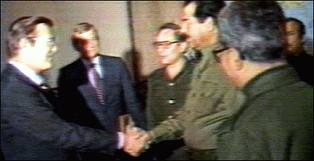
The same year Rumsfeld and his PNAC associates had already written an open letter to president Clinton, urging him to be tougher on Iraq. Saddam Hussein´s regime should be “removed”, the letter demanded. (19)
Finally, in September 2000, two month before the presidential election, PNAC published a lengthy strategy paper, giving policy guidance to the next administration. “Rebuilding America´s Defenses” was its programmatic title and it analysed principles and objections of a new defense policy.
Basically the paper called for a massive increase in defense spending and a transformation of the armed forces into a dominant but mobile, rapidly deployable power factor. The aim was enduring military supremacy, which according to PNAC would urgently require new weapons systems like the missile defense. Yet the paper made also clear that the process of implementing these demands would be a long one and provoke resistance, “absent” – quote – “some catastrophic and catalyzing event – like a new Pearl Harbor.” (20)
A question of energy
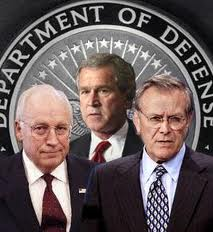
After George W. Bush´s inauguration in January 2001 the members of this circle secured important posts in the new administration. Cheney turned into the leading figure. This had become apparent well before the election. As early as April 2000 Bush had asked him to handle the selection of his vice presidential running mate. In the end Cheney had all but proposed himself for the job. (21) Meanwhile the workaholic had survived three heart attacks. One of his first recommendations to Bush was the appointment of Rumsfeld, almost 70, as secretary of defense. Deputy of his old associate became Paul Wolfowitz, a hardliner who had already worked for Cheney as chief strategist in the Pentagon at the beginning of the 1990s. Compared to these men president Bush himself was a newcomer in Washington. Though he was blessed with political instinct and a very practical intuition, he could hardly hold a candle to these old hands intellectually.
One of the first steps of the new administration was the creation of a “National Energy Policy Development Group”. It was headed directly by Cheney. Its final report, issued in May 2001, described the situation quite openly:
“America in the year 2001 faces the most serious energy shortage since the oil embargoes of the 1970s. (…) A fundamental imbalance between supply and demand defines our nation´s en­ergy crisis. (…) This imbalance, if allowed to continue, will inevitably undermine our economy, our standard of living, and our national security. (…) Estimates indicate that over the next 20 years, U.S. oil consumption will increase by 33 percent, natural gas consumption by well over 50 percent, and demand for elec­tricity will rise by 45 percent. If America´s energy production grows at the same rate as it did in the 1990s we will face an ever-in­creasing gap. (…) By 2020, Gulf oil producers are projected to supply between 54 and 67 percent of the world´s oil. Thus, the global economy will almost certainly continue to depend on the supply of oil from Organization of Petroleum Exporting Countries (OPEC) members, particularly in the Gulf. This region will remain vital to U.S. interests.” (22)
Later it was disclosed that Cheney´s energy task force had also secretly examined a map of the Iraqi oil fields, pipelines and refineries along with charts detailing foreign suitors for il-field contracts there. Again, the date was March 2001.
Anticipating the unthinkable
Concurrently to its effort in energy policy the new administration created an “Office of National Preparedness”. It was tasked with the development of plans responding to a possible terror attack and became assigned to the “Federal Emergency Management Agency” (FEMA). (23) FEMA was already responsible for the COG plan since the 1980s. To call it back to mind: “From 1982 to 1984, Oliver North assisted FEMA in revising contingency plans for dealing with nuclear war, insurrection or massive military mobilization.” (24)
Back then Cheney had played a role in shaping these plans. Now he could continue the work – because Bush appointed him to head the new program. (25) Director of FEMA on the other hand became Joe Allbaugh, who had little professional expertise, but could offer other qualities. Allbaugh was Bush´s campaign manager, a man for tough and rather rude matters and also one of the president´s closest confidants. Back in 1994 he had managed Bush´s campaign to become governor of Texas and at the end of 2000 he had helped stopping the recount of votes in Florida. (26) That an expert for political tricks was appointed to head FEMA indicates that the administration had political plans with the emergency management agency from the outset.
Till today it´s undisclosed how the COG plan was refined in detail under Cheney´s direction in 2001.  However the following is apparent: in the months leading to 9/11 Cheney linked anti-terror and emergency management measures with national energy policy. Commissions working on both issues were handled by him simultaneously. This connection anticipated the policy after 9/11, which could be summarized as using a terror attack as rationale for extending the power of the executive and waging war to seize control of world regions important for energy supply.
The emergency plans Rumsfeld and Cheney were involved with since the 1980s culminated in autumn 2001. On the morning of September 11th the secret COG program was implemented for the first time. (27) Shortly before 10:00 a.m., after the impact of the third plane into the Pentagon, Cheney gave the order to execute it. (28)
The shadow government
Almost nothing is known about the content of the plan and the specific effects of its activation. The secrecy in this respect appears grotesque. Even the simple fact of the plan´s implementation on 9/11 was concealed for months. After sporadic hints in the press the Washington Post finally disclosed some details in March 2002. In an article titled “Shadow government is at work in secret” it reported that about 100 high-ranking officials of different departments were working outside Washington as part of the emergency plan since 9/11:
“Officials who are activated for what some of them call ‘bunker duty’ live and work underground 24 hours a day, away from their families. As it settles in for the long haul, the shadow government has sent home most of the first wave of deployed personnel, replacing them most commonly at 90-day intervals. (…) Known internally as the COG, for ‘continuity of government’, the administration-in-waiting is an unannounced complement to the acknowledged absence of Vice President Cheney from Washington for much of the past five months. Cheney’s survival ensures constitutional succession, one official said, but ‘he can´t run the country by himself.’ With a core group of federal managers alongside him, Cheney – or President Bush, if available – has the means to give effect to his orders.” (29)
But what orders gave Cheney to his strange “shadow government” while his stays at the bunker? And what justified extending this emergency measure for seemingly infinite time? For the White House clearly hadn´t been wiped out by bombs. The president lived and his administration was able to act. Who needed a permanent second secret government?
After the first disclosure of these facts in spring 2002 leading politicians of the legislative immediately started expressing their astonishment. Soon it became clear that neither Senate nor House of Representatives knew anything about the activation of COG and the work of the “shadow government” in secret. The parliament had simply been ignored. (30) Later the 9/11 Commission experienced similar executive secrecy. Though it mentioned in its final report the implementation of the plan on 9/11, it also admitted not having investigated the issue in depth. Instead the Commission had only been briefed “on the general nature” of the plan. (31)
Patriots under pressure
An immediate response to 9/11 was the Patriot Act, passed only one month later, and allowing a broad range of highly controversial measures, from domestic wiretapping to warrantless detention of foreign terror suspects. The latter legalized the forthcoming procedures at Guantánamo, leading to secret U.S. prisons all over the world.
Two influential opponents of these legal changes were Tom Daschle, Senate Majority Leader, and Patrick Leahy, head of the Senate Judiciary Committee. Both received letters with spores of deadly anthrax. The source was never traced with certainty. After that Daschle and Leahy gave up their resistance against the new legislation and approved the Patriot Act. (32)
In their radical nature the hastily passed changes bore resemblance to decrees while a state of emergency. And indeed were they similarly already part of the COG plan in the 1980s. (33)
Government officials familiar with COG indicated after 9/11 that the plan could really have resulted in martial law – if additionally to the attacks on the World Trade Center and the Pentagon also large numbers of congressmen and executive branch leaders had been killed on that day. (34)
Is it in this context a coincidence only that the fourth hijacked plane on 9/11 was heading towards Washington to hit the Capitol or the White House? (35)
Killers from Sudan?
There is also circumstantial evidence for an assassination attempt on president Bush in Florida that morning. The Secret Service had received a related warning the night before at 4:08 a.m., according to a TV report by a local ABC affiliate. (36) A few hours later Secret Service agents searched an apartment in Sarasota and arrested four men from Sudan, apparently belonging to the south sudanese liberation army SPLA, a paramilitary force secretly supported by the United States. (37) Also AP reported these arrests mentioning that the suspects had been released soon again because they had “no connection” to 9/11. The whole issue just would have been a “coincidence”. (38)
President Bush spent the night before 9/11 at a resort on Longboat Key, an island right next to Sarasota where he planned to visit an elementary school on the next morning. Longboat Key Fire Marshall Carroll Mooneyhan was a further witness of the possible assassination attempt. He said that at about 6 a.m. on September 11th a van with self-proclaimed reporters of middle eastern descent had pulled up at Bush´s resort, stating they had a “poolside” interview with the president. The men asked for a special Secret Service agent by name but where turned away by the guards. (39)
Were these “reporters” identical with the Sudanese temporarily arrested by the Secret Service later that morning in Sarasota? The incident resembled at least the successful assassination of Taliban foe Ahmed Shah Massoud two days before on September 9th in Afghanistan. The suicide attackers there were also a fake TV team using a bomb hidden in a camera, as the New York Times reported on September 10th. (40)
Additionally three witnesses remembered seeing Mohammed Atta and a companion at Longboat Key´s Holiday Inn on September 7th, three days before Bush would spend the night on that same small island. (41) September 7th was also the day the White House first publicly announced Bush´s schedule to travel to Sarasota. (42) In this context it is surely worth to consider if Atta scouted out the place for an assassination plot.
Completing the plot
The question arises: Did a circle around Cheney, Rumsfeld and some associates use 9/11 for a disguised coup d’état, partly failed in its execution?
Regardless of the answer to that question – 9/11 in fact allowed the implementation of emergency measures, the weakening of the legislative, the start of several wars and a massive increase in defense spending. The amounts in question easily exceed the imagination of observers.
While in the second half of the 1990s the average national defense budget totaled about 270 billion dollars a year, that number nearly doubled in the decade after 9/11, when the average annual budget went up to over 500 billion. (43) For the Pentagon´s private contractors that meant a sales increase of inconceivable 2.300 billion dollars between 2001 and 2010.
A national economy under arms
If one looks at the development of defense spending in the United States since 1940, some far-reaching conclusions arise. (44) It seems as if the attack on Pearl Harbor and the following involvement in World War II led to a structural change of the American economy. The budgetary value of the military was never reduced to a “normal” level after that. On the contrary it increased decade by decade. Thus the whole economy got into a fatal dependency on the defense business.
This ongoing development came to a halt only with the fall of the Soviet Union. Ten years later then 9/11 became the catalyzing event to kick-start the military buildup again – with all its broad economic effects on the country.
Cheney and Rumsfeld don´t seem to be driving forces in this “game”, but merely two talented managers, risen to the top in the stream of events. Author James Mann, who had disclosed their involvement in the COG plan first in 2004, described their political role this way:
“Their participation in the extra-constitutional continuity-of-government exercises, remarkable in its own right, also demonstrates a broad, underlying truth about these two men. For three decades, from the Ford Administration onward, even when they were out of the executive branch of government, they were never far away. They stayed in touch with defense, military, and intelligence officials, who regularly called upon them. They were, in a sense, a part of the permanent hidden national-security apparatus of the United States, inhabitants of a world in which Presidents come and go, but America keeps on fighting.” (45)

Het Joodse Raadslid Naomi Italiaander en de Zionistische Terreur

Ik las in  het  Joodse propaganda-orgaan NIW dat " Het kersverse Amsterdamse gemeenteraadslid Naomi Italiaander," zowaar " J...