Zoeken in deze blog 🔎🔎

vrijdag 16 juni 2006

Iran 54


Tom Engelhardt schrijft: 'Michael Klare on Playing Chess with Iran.


Since the British imperial moment of the late nineteenth century, the image of much of the world -- especially Central Asia and the Middle East -- as but a set of pawns in a "Great Game" on a geopolitical "chessboard" where the great powers of whatever era are at play has been a commonplace. Many have died in one version or another of this "game," which, if you don't happen to be in an office in London or Washington or Moscow thinking strategic thoughts, has always had such a distinctly unplayful aspect to it, but the image persists.
In our time, that "chessboard" was revived by Zbigniew Brzezinski, former national security adviser to President Carter, who made it the title of a 1997 book, The Grand Chessboard, American Primacy and Its Geostrategic Imperatives. It has since been picked up by the Bush administration whose key officials, thinking such grand thoughts, had little doubt that, a decade after the Soviet collapse, the U.S. would have its way in the energy-rich former SSRs of Central Asia. Now, with Iraq acting as the geopolitical equivalent of a black hole, sucking all U.S. attention its way, other powers turn out to be capable of playing the game too; and new, still not fully coherent power blocs, are slowly coalescing to thwart Washington's desires.
As historian Immanuel Wallerstein wrote recently about the leftward shift in Latin America, State Department officials "are quite aware that their voice is no longer heard with the respect and fear it once was." Just this week in Asia, where perhaps the greatest tectonic shifts have been taking place, the energy-rich Russians and the energy-eager Chinese are hosting a meeting of a five year-old group, the Shanghai Cooperative Organization (SCO), which we ordinarily hear little about. But it's no less significant for that. To it belong the coming power in Asia and what's left of the fallen superpower of the Cold War era as well as the ‘stans of Central Asia that were once its possessions.
Representatives of other countries are also in attendance in Shanghai, trying to detect the shape of the New Asia and of our new world of scarcer energy resources -- the President of Pakistan, an important Indian oil and gas minister, and Iran's President Mahmoud Ahmadinejad. He is but one of many key figures in the world of energy resources -- including that close American ally, the Saudi king -- who are increasingly migrating toward Beijing (or Shanghai) for audiences. Ahmadinejad is eager to move Iran from observer status to membership in the Shanghai organization.
Not welcome: the United States. For the last two years, SCO members have even been conducting joint military exercises and they may someday become "a corral of countries capable of countering Western influence." After all, the organization's founding charter calls for it to be the foundation stone of "a new international political and economic order."' Lees verder:
http://www.tomdispatch.com/

De Israelische Terreur 31


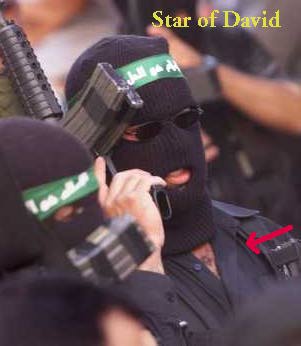
Op de bovenste foto ziet u Israelische agenten die opereren als Hamas strijders.
Palestinian terrorists, courtesy of The Mossad. The Israeli secret service should teach its operatives to take off their jewellery first: e.g. the Star of David necklace. Notice too the white skin and designer-brand sunglasses -- worn, perhaps, to conceal blue eyes -- and the brand new M-16, paid for by generous U.S. taxpayers, as a U.S. correspondent assures us. A real Palestinian terrorist carries an aged AK-47 (Photo: Reuters.)

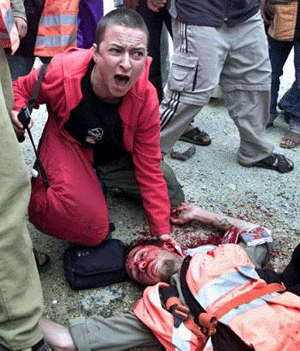
Op de onderste foto ziet u een Westerse hulpverlener die door een Israelische scherpschutter is doodgeschoten. 21-year-old Tom Hurndall spent 9 months in a coma before dying from gunshot wounds to his head. He was shot by an Israeli soldier when he tried to bring Palestinian children to safety.

Ondanks het feit dat de Nederlandse commerciele media tenminste acht correspondenten in Israel hebben, wordt hierover niet of nauwelijks bericht. Israel heeft een bevolking van zes miljoen mensen, van wie 20 procent Palestijns is. De Nederlandse commerciele media hebben daarentegen in de hele Arabische wereld met een bevolking van bijna 300 miljoen slechts 2 correspondenten.

USA TOday bericht: 'Hamas Spokesman: Group Is Ready to Restore Cease-Fire
Gaza City, Gaza Strip - The Islamic militant group Hamas said Thursday it is ready to restore its cease-fire with Israel several days after calling it off to protest a deadly explosion on a Gaza beach.
But Ghazi Hamad, spokesman for the Hamas-led Palestinian government, said the offer was conditional on Israel accepting the Palestinians' demand "to stop their aggression."
"This is very clear for us. We are interested to keep the situation and quit, especially in the Gaza Strip," Hamad said. "We are ready to do it, but (only) if the Israeli side has a strong intention to respond positively to the call ... to stop their aggression."
Hamas called an end to the February 2005 truce Friday after eight Palestinian beachgoers were killed in an explosion the Palestinians blame on Israel. The Israeli army says it was not involved in the blast.
Hamas fired several dozen rockets toward southern Israel over the weekend, but in recent days there has been a lull.
Israeli officials said Thursday the cessation is due to threats against Hamas. Israeli officials earlier this week threatened to begin killing Hamas leaders, including Prime Minister Ismail Haniyeh, if the rocket fire continued.
The Islamic Jihad militant group, which has never accepted the truce, fired five rockets toward Israel on Thursday.
Hamas, which opposes the existence of Israel, has killed hundreds of Israelis in 4 1/2 years of violence.' Lees verder:
http://www.usatoday.com/news/world/2006-06-15-hamas_x.htm Of: http://www.truthout.org/docs_2006/061506G.shtml

De Israelische Terreur 30

John Pilger schrijft: 'The war on children.

The most vulnerable people in Gaza are suffering the worst acute mental and physical trauma as a result of Israel's actions: almost half the population is under 15. "Information Clearing House"

-- -- Arthur Miller wrote, "Few of us can easily surrender our belief that society must somehow make sense. The thought that the state has lost its mind and is punishing so many innocent people is intolerable. And so the evidence has to be internally denied." Miller's truth was a glimpsed reality on television on 9 June when Israeli warships fired on families picnicking on a Gaza beach, killing seven people, including three children and three generations. What that represents is a final solution, agreed by the United States and Israel, to the problem of the Palestinians. While the Israelis fire missiles at Palestinian picnickers and homes in Gaza and the West Bank, the two governments are to starve them. The victims will be mostly children. This was approved on 23 May by the US House of Representatives, which voted 361-37 to cut off aid to non-government organisations that run a lifeline to occupied Palestine. Israel is withholding Palestinian revenues and tax receipts amounting to $60m a month. Such collective punishment, identified as a crime against humanity in the Geneva Conventions, evokes the Nazis' strangulation of the Warsaw ghetto and the American economic siege of Iraq in the 1990s. If the perpetrators have lost their minds, as Miller suggested, they appear to understand their barbarism and display their cynicism. "The idea is to put the Palestinians on a diet," joked Dov Weisglass, an adviser to the Israeli prime minister, Ehud Olmert. This is the price Palestinians must pay for their democratic elections in January. The majority voted for the "wrong" party, Hamas, which the US and Israel, with their inimitable penchant for pot-calling-the-kettle-black, describe as terrorist. However, terrorism is not the reason for starving the Palestinians, whose prime minister, Ismail Haniyeh, had reaffirmed Hamas's commitment to recognise the Jewish state, proposing only that Israel obey international law and respect the borders of 1967. Israel has refused because, with its apartheid wall under construction, its intention is clear: to take over more and more of Palestine, encircling whole villages and eventually Jerusalem. The sniper's wound The reason Israel fears Hamas is that Hamas is unlikely to be a trusted collaborator in subju- gating its own people on Israel's behalf. Indeed, the vote for Hamas was actually a vote for peace. Palestinians were fed up with the failures and corruption of the Arafat era. According to the former US president Jimmy Carter, whose Carter Centre verified the Hamas electoral victory, "public opinion polls show that 80 per cent of Palestinians want a peace agreement with Israel".' Lees verder: http://www.informationclearinghouse.info/article13627.htm

Zie ook de documentaire: 'John Pilger: "Palestine is Still the Issue" Part I
Why Has This Documentary, Never Been Broadcast On U.S. Media ?
Twenty-five years ago, I made a film called Palestine Is Still The Issue. It was about a nation of people - the Palestinians - forced off their land and later subjected to a military occupation by Israel. An occupation condemned by the United Nations and almost every country in the world, including Britain.
But Israel is backed by a very powerful friend, the United States. So in 25 years, if we're to speak of the great injustice here, nothing has changed. What has changed is that the Palestinians have fought back.
Stateless and humiliated for so long, they've risen up against Israel's huge military machine, although they themselves have no arm, no tanks, no American planes and gun ships or missiles.
Some have committed desperate acts of terror, like suicide bombing. But for Palestinians, the overriding, routine terror, day after day, has been the ruthless control of almost every aspect of their lives, as if they live in an open prison. This film is about the Palestinians and a group of courageous Israelis united in the oldest human struggle - to be free. Continued
See Also: ITC vindicates Pilger documentary
PART II - PART III - Pilger Interviews Dori Gold
Pilger Interviews Dori Gold' Zie: http://www.informationclearinghouse.info/article3499.htm

donderdag 15 juni 2006

Amerikaanse Oorlogsmisdaden 25


Op de bovenste foto ziet u Amin, een vluchteling uit Fallujah, die gewond raakte tijdens de Amerikaanse aanval op de stad en een soldaat een granaat in het huis van zijn familie gooide. Een granaatscherf zit in zijn lichaam, vlak naast een nier. Op de onderste foto ziet u een vader die tijdens de Amerikaanse inval in Fallujah op zijn woning paste uit angst voor plunderaars, maar die door het Amerikaanse leger vermoord werd. Hij werd volgens de onafhankelijke Amerikaanse journalist Dahr Jamail na het vertrek van de Amerikanen door zijn familie geidentificeerd.

Via Truthout kunt u kijken naar een gesprek met de onafhankelijke Amerikaanse filmmaker Mark Manning: 'Caught in the Crossfire. The Untold Story of Fallujah A Film by Mark Manning

Independent filmmaker Mark Manning was the only Westerner to travel to Fallujah un-embedded, and he lived with the refugees of Fallujah and experienced life from their point of view, returning with them to their destroyed city after the siege by the United States. Unknown to any authorities, he recorded what he saw. He went through the checkpoints, witnessed the devastation of thousands of homes, shops and mosques, and documented the horrors of the siege as recounted by those who survived inside the city during the battles. The people of Fallujah asked him to tell their story to the world, and he is now fulfilling that request with the release of Caught in the Crossfire.
Shot from November 2004 to April 2005 inside the city of Fallujah, Caught in the Crossfire details the conditions experienced by civilians as they endured the violent clashes and consequences of Operation Phantom Fury and became refugees outside the eyes and care of the international community. Zie: http://www.truthout.org/multimedia.htm. Hier kunt u de film bestellen.
http://conceptionmedia.net/projects/caughtinthecrossfire/
Meer beelden van Fallujah en Irak kunt u hier zien: http://dahrjamailiraq.com/gallery/

De Nederlandse regering steunt het Amerikaanse geweld in Irak en Afghanistan. We kunnen straks niet zeggen dat we van niets geweten hebben.

De Oorlogsstaat 65


Alternet: ' The Marine Who Saw Too Much.


A former lance corporal explains why he intentionally failed a drug test to avoid going back to war-torn Iraq.The following text is an excerpt from Peter Laufer's new book, Mission Rejected: U.S. Soldiers Who Say No to Iraq (Chelsea Green, 2006).


Recruiters convinced a listless Californian named Daniel to join the Marines. On September 11, 2001, he was taking classes at a junior college near San Jose while holding down two jobs: managing a PurWater store and squeezing fruit at a Jamba Juice stand.
His patriotism combined with the recruiters' sales pitches convinced him to drop out of school two units short of his associate's degree. By the next summer he was in boot camp. When we meet, the 23 year-old ex-Marine asks me to restrict my identification of him to his first name; he's fighting the Veterans Administration for benefits and the Marines for an honorable discharge, and he fears publicity may hurt his case.
Daniel is slouched in his chair when we first start talking. He's wearing a camouflage baseball cap with the image of a Canada goose on its front. His black T-shirt carries the legend POW-MIA you are not forgotten. His forearms are covered with tattoos. His blue jeans are well faded and his black cowboy boots well worn.
"I decided my country needed me and I was pretty fit," he says about his decision to join the Marines after the attacks on the World Trade Center and the Pentagon. "I decided to go do my part. I wasn't sure what branch until I walked into the recruiting office and a Marine Corps office was before all the other ones. They kind of pulled me in, told me all their jarhead jargon, and filled my head with a whole bunch of good stuff. I was sold quickly."
Daniel speaks fast, with a slight twang and the hint of a stutter. He says his childhood stutter returned as a symptom of his combat-related post-traumatic stress disorder.
By February 2003, Daniel was trained as a radio operator and was the proud owner of a brand new Dodge Ram 1500 truck. A week after he bought the truck, he was told he was being deployed to the Middle East. "There goes my truck payments," he remembers thinking. But he parked the pickup and managed to keep the payments current while he saw the other side of the world. "It was a pretty scary time," Daniel says about his three months on a ship, patrolling Kuwaiti waters during the initial U.S. assault on Iraq.
Rotated back to the States, Daniel hopped back into the Dodge and unwound. "Came back over stateside, happy to be back. Spent all my money and had a good time. Early in 2004 we was back in the desert. This time I went directly into Iraq." He found himself on an assault boat, patrolling for "insurgents." His unit saw action in the toughest neighborhoods throughout much of 2004, often beaching the boat and joining forces with land-based troops in hot spots like Fallujah. "Pretty scary, that's all I've got to say about that," Daniel says regarding Fallujah, his speech turning percussive. "You never know when it's your time to go. Explosions from mortars going off all around you. Shots fired. You try to keep your head up. Trust the guy next to you. That's about it."
Fighting in the war flipped Daniel's political beliefs. "I came back very anti-Bush. I used to be a Republican before I joined the military. Not any more." His experiences on the ground, he says, convinced him he'd been lied to. The Iraqis "are a defeated people," he says, not a threat to America. "It's a third-world country. These people walk around with no shoes, nothing. These guys are working for a dollar a day. The military would pay the village people to come on base and build sandbags so that they can be more comfortable in their tents and pay them a dollar a day, and these guys will work making seven dollars a week just to feed their family."' Lees verder: http://www.alternet.org/story/36898/ Of: http://www.truthout.org/docs_2006/061506P.shtml

Terrorisme 3

De Toronto Star bericht: 'War on Terror Called Failure.

Another 9/11 "inevitable," experts conclude. Washington's diplomatic efforts rated 1.8 out of 10.
Washington is failing to make progress in the global war on terror and the next 9/11-style attack is not a question of if, but when. That is the scathing conclusion of a survey of 100 leading American foreign-policy analysts.
In its first "Terrorism Index," released yesterday, the influential journal Foreign Affairs found surprising consensus among the bipartisan experts.
Some 86 per cent of them said the world has grown more, not less, dangerous, despite President George W. Bush's claims that the U.S. is winning the war on terror.
The main reasons for the decline in security, they said, were the war in Iraq, the detention of terror suspects in Guantanamo Bay, U.S. policy towards Iran and U.S. energy policy.
The survey's participants included an ex-secretary of state and former heads of the Central Intelligence Agency and National Security Agency, along with prominent members of the U.S. foreign-policy establishment.
The majority served in previous administrations or in senior military ranks.
"When you strip away the politics, the experts, almost to a person, are very worried about the administration," says Joe Cirincione, vice-president of the Center for American Progress, the Washington think-tank which co-sponsored the survey.
"They think none of our front-line institutions is doing a good job and that Iraq has made the terror situation much worse."
The findings will be picked up immediately by politicians and policy-makers, he adds: "Just about any one of these people saying this would make news. When the opinions come together, it really carries weight."
Almost 80 per cent of the analysts said widespread rejection of radical Islamic ideologies is crucial if terrorism is to be eradicated, but that goal requires "a much higher emphasis on its non-military tools."' Lees verder: http://www.truthout.org/docs_2006/061506N.shtml

Neoliberale Globalisering


Le Monde bericht: 'Reinventing Globalization.

Nine thousand kilometers! That's the total average distance covered by a shot of milk, fruit, and plastics before they're transformed into a container of yogurt and find their way into your refrigerator. In thirty years, global shipping volume has tripled while road transport in France has jumped 43% in less than fifteen years. The globalization of reciprocal trade is such that international trade represents a third of global production.

Will we be able to maintain this rhythm over the next thirty years? Not very likely. These long trips, voracious in their use of fuel, are only possible because transportation cost is barely reflected in the final price of a container of yogurt, for example. The heralded increases in oil costs due to the exhaustion of reserves and global warming linked to CO2 emissions are going to force us, experts believe, to take a new look at the global flow of merchandise in the next thirty to forty years.

In the scenario where the price per barrel goes from 70 to 180 dollars, as the Conseil général des ponts et chaussées [French "General Council for Bridges and Roads"] envisions in a report on transport in 2050, the logistical situation is likely to be profoundly changed. Diesel fuel represents 20% of the costs for a transport company that clears a 4% profit. We see that if the fuel price variable is affected, the whole economic model teeters. "We don't pay a fair price for energy," reasons Thierry Raes, in charge of the energy and transport sector in the PricewaterhouseCoopers consulting firm. "There's a very perverse logic at work. Globalization's collateral damage - social and environmental - is only very partially taken into account."

The aberrations are easily discernible in daily life. Pears from Argentina can be purchased by a distributor for less than those produced in the European Union. Chinese strawberries have become ultra-competitive, although when they're sold in France, they demand twenty times the equivalent in gasoline of a strawberry from Périgord. "Between a quarter and half the weight of a pair of blue jeans is given off as CO2 by virtue of the product's outsourcing," points out Alain Morcheoine, Director of the agency for the environment, "Ademe."

These aberrations are all the more untenable given that global energy consumption will increase 65% from now to 2025, from - most notably - China and India's economic catch-up. If the Chinese purchased as many cars as Europeans tomorrow, their energy consumption would be one billion tons equivalent of oil a year, or as much as the United States, Japan and Europe today.' Lees verder: http://www.truthout.org/docs_2006/061406H.shtml Of in het Frans:
http://www.lemonde.fr/web/article/0,1-0@2-3234,36-781854,0.html

Dr Hysterische Zionistische Haat

  Richard @ricwe123 That moment when Israeli police officers decided it would be a good idea to attack the Christian funeral procession of P...