Zoeken in deze blog 🔎🔎

maandag 5 juni 2006

Israelisch Expansionisme 19

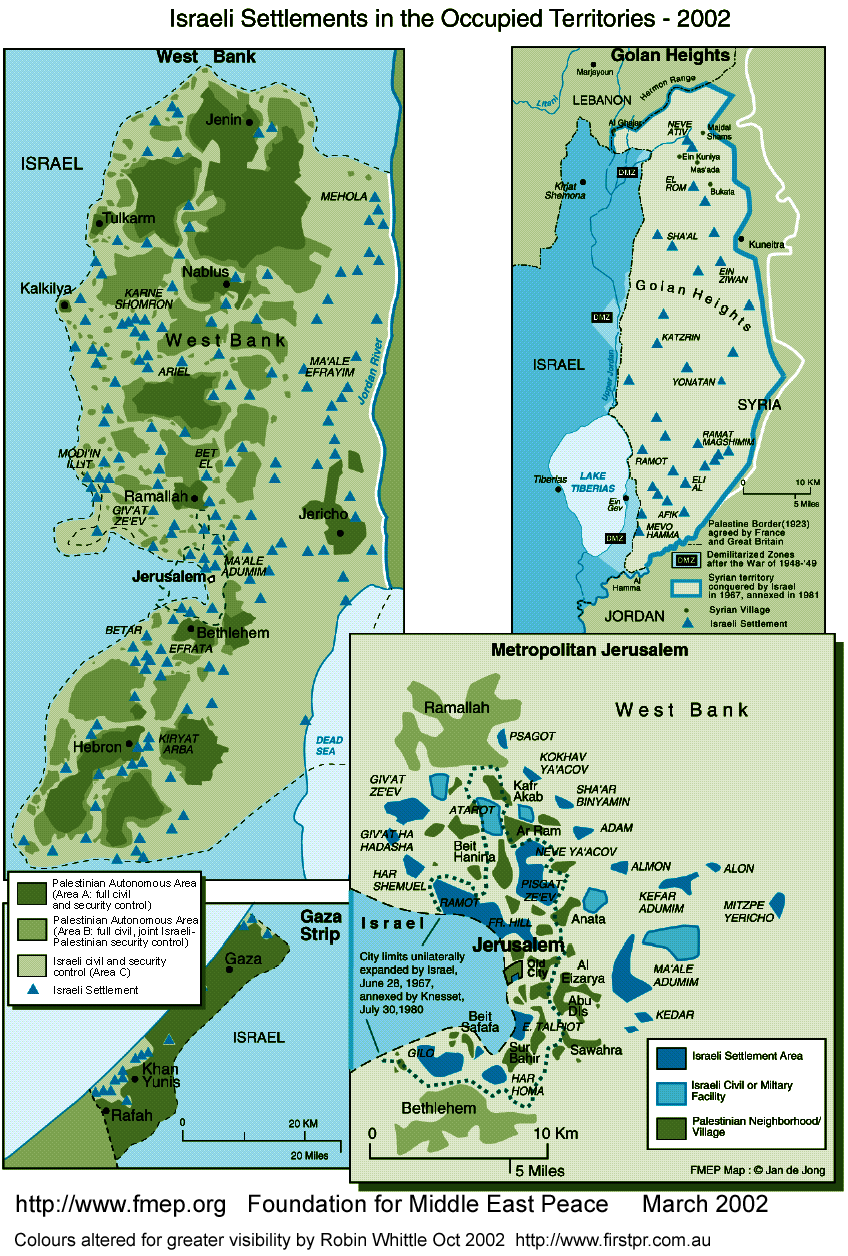
Het Israelisch expansionisme gaat ongestoord door. Nu kijken welke Nederlandse media hierover berichten. 'West Bank - Israel has begun laying the foundations for a new Jewish settlement deep in the West Bank — breaking a promise to Washington while strengthening its hold on a stretch of desert it wants to keep as it draws its final borders.
The construction of Maskiot comes at a time when Israeli Prime Minister Ehud Olmert seeks U.S. backing for eventually annexing parts of the West Bank as part of a plan to set Israel's eastern border with or without Palestinian consent.
The Palestinians and Israel's settlement watchdog group Peace Now say the Maskiot construction amounts to a new attempt to push Israel's future border deeper into the West Bank. "It's about grabbing land," said Yariv Oppenheimer of Peace Now.
Otniel Schneller, an Olmert adviser, confirmed Israel is building in additional West Bank areas to ensure they are not included in the lands given to the Palestinians. He said Israel needs to keep the Jordan Valley, where Maskiot is located, as a security buffer against Islamic militants based in Iraq, Iran and elsewhere.
Olmert has said that if efforts to resume peace talks fail, as expected, he would annex large Jewish settlement blocs in the West Bank and draw Israel's final borders by 2008. A separation barrier Israel is building in the West Bank is to serve as the basis for the future border.' Lees verder: http://www.miftah.org/Display.cfm?DocId=10448&CategoryId=5

Iran 52

We zijn gewaarschuwd. De Financial Times bericht: 'Iran threatens oil disruption in event of US "mistake."
Iran's supreme leader yesterday warned that energy supplies from the Gulf would be disrupted if the US made a "mistake" against his country, as officials in Tehran prepared to receive the details of an international package of "carrots and sticks" aimed at resolving the nuclear dispute.
Main page content:
In an attempt to raise the diplomatic stakes and deflect growing international pressure, Ayatollah Ali Khamenei, the ultimate decision-maker, appeared to contradict earlier assurances from Tehran that the world's fourth largest oil producer would not use the oil weapon.
"If Americans make a mistake about Iran, the flow of energy from this region will definitely be jeopardised," he said in a speech, insisting, however, that Iran would never be the initiator of war. His comments are likely to unsettle oil markets when they open today.
Iranian analysts say the regime considers one of its most potent cards the ability to disrupt energy supplies through the straits of Hormuz, from which much of the world's oil shipments pass.' Lees verder: http://news.ft.com/cms/s/19ff99b6-f42f-11da-9dab-0000779e2340.html

zondag 4 juni 2006

Lewis Mumford


Lewis Mumford wrote in his 1946 book, Values for Survival: http://www.nd.edu/~ehalton/mumfordbio.html

"If we are to create balanced human beings, capable of entering into world-wide co-operation with all other men of good will--and that is the supreme task of our generation, and the foundation of all its other potential achievements--we must give as much weight to the arousal of the emotions and to the expression of moral and esthetic values as we now give to science, to invention, to practical organization. One without the other is impotent. And values do not come ready-made: they are achieved by a resolute attempt to square the facts of one's own experience with the historic patterns formed in the past by those who devoted their whole lives to achieving and expressing values. If we are to express the love in our own hearts, we must also understand what love meant to Socrates and Saint Francis, to Dante and Shakespeare, to Emily Dickinson and Christina Rossetti, to the explorer Shackleton and to the intrepid physicians who deliberately exposed themselves to yellow fever. These historic manifestations of love are not recorded in the day's newspaper or the current radio program: they are hidden to people who possess only fashionable minds. Virtue is not a chemical product, as Taine once described it: it is a historic product, like language and literature; and this means that if we cease to care about it, cease to cultivate it, cease to transmit its funded values, a large part of it will become meaningless, like a dead language to which we have lost the key. That, I submit, is what has happened in our own lifetime."

De Commerciele Massamedia 10

Sophie McNeill is a freelance video journalist whose work regularly appears on Australia’s SBS Television “Dateline” program. She lives in New York. In Information Clearing House schrijft ze: 'Normalizing the UnthinkableJohn Pilger, Robert Fisk, Charlie Glass, and Seymour Hersh on the failure of the world’s press.

The late journalist Edward R. Murrow might well have been rolling in his grave on April 21. That’s because Secretary of State Condoleezza Rice gave a lecture that day in Washington, DC to journalists at the Department of State’s official Edward R. Murrow Program for Journalists. For the Bush administration to use the memory of a person who stood up to government propaganda is ironic to say the least. Secretary Rice told the assembled journalists that “without a free press to report on the activities of government, to ask questions of officials, to be a place where citizens can express themselves, democracy simply couldn’t work.”One week earlier in New York City, Columbia University hosted a panel on the state of the world’s media that would have been more in Murrow’s style than the State Department-run symposium. Reporter and filmmaker John Pilger, British Middle East correspondent for the Independent Robert Fisk, freelance reporter Charlie Glass, and investigative journalist for the New Yorker Seymour Hersh appeared together at this April 14 event.Before the afternoon panel began, I met up with John Pilger at his hotel. He’d just flown in from London and was only in New York for the panel before flying to Caracas, Venezuela the next day. A journalist for over 30 years, Pilger has reported from Vietnam, Cambodia, East Timor, Palestine, and Iraq—to name a few of the countries to which his investigative reporting and filmmaking had taken him. Pilger told me that he’d never been as concerned about the state of the media as he was today. “I think there’s a lot of reasons to be very concerned about the information or the lack of information that we get. There’s never been such an interest, more than an interest, almost an obsession, in controlling what journalists have to say.”Despite the fact that the war in Iraq is reported daily in most U.S. newspapers and networks around the world, Pilger didn’t think the world’s press accurately conveyed the reality of life for Iraqi civilians. “We get the illusion that we are seeing what might be happening in Iraq. But what we’re getting is a massive censorship by omission; so much is being left out,” he said. “We have a situation in Iraq where well over 100,000 civilians have been killed and we have virtually no pictures. The control of that by the Pentagon has been quite brilliant. And as a result we have no idea of the extent of civilians suffering in that country.”I asked Pilger what the untold story of Iraq was that’s just not getting through. “Well, the untold story of Iraq should be obvious,” Pilger said. “But it never is. The untold story of Vietnam was that it was an invasion and that huge numbers of civilians were killed. And in effect it was a war against civilians and that was never told and that’s exactly true of Iraq.”With the majority of the world’s press holed up behind 4.5 miles of concrete barrier in the green zone, it seems impossible for the standard of reporting to improve anytime in the near future. I asked Pilger if he blamed journalists for not wanting to put their lives at risk? “No, I can’t,” he said. “But I don’t see the point of being in the green zone. I don’t see the point of wearing a flak jacket and standing in a hotel in a fortress guarded by an invader.“But there have been journalists—and others—who have actually gone with the insurgents; who have reported about them. One of them, for instance, is a young woman named Jo Wilding, a British human rights worker. She was in Fallujah all through that first attack in 2004. Jo Wilding’s dispatches were some of the most extraordinary I’ve read, but they were never published anywhere.”Pilger said the mainstream press needs to get over its hang up of “our man in Baghdad” and prioritize whatever information can be obtained by whoever is brave enough or has the best contacts. “There are sources of information for what is happening inside Iraq. Most of them are on the web. I think those who give a damn in the mainstream really have to look at those sources and surrender their prejudice about them and say we need that reporter’s work because he or she has told us something we can’t possibly get ourselves. And I think that’s the only way we will really serve the public.”We had talked too long and had to quickly jump in a cab to make it to the panel on time. The hall was packed with university students, professors, and the public.' Lees verder: http://www.informationclearinghouse.info/article13492.htm

Amerikaanse Oorlogsmisdaden 17

De Washington Post bericht: 'In Haditha Killings, Details Came Slowly.
Official version is at odds with evidence.

At 5 p.m. Nov. 19, near the end of one of the most violent days the Marine Corps had experienced in the Upper Euphrates Valley, a call went out for trucks to collect the bodies of 24 Iraqi civilians.
The unit that arrived in the farming town of Haditha found babies, women and children shot in the head and chest. An old man in a wheelchair had been shot nine times. A group of girls, ages 1 to 14, lay dead. Everyone had been killed by gunfire, according to death certificates issued later.
The next day, Capt. Jeffrey S. Pool, a Marine spokesman in Iraq, released a terse statement: Fifteen Iraqis "were killed yesterday from the blast of a roadside bomb in Haditha. Immediately after the bombing, gunmen attacked the convoy with small arms fire. Iraqi army soldiers and Marines returned fire, killing eight insurgents and wounding another."
Despite what Marine witnesses saw when they arrived, that official version has been allowed to stand for six months. Who lied about the killings, who knew the truth and what, if anything, they did about it are at the core of one of the potentially most embarrassing and damaging events of the Iraq war, one that some say may surpass the detainee abuse scandal at Abu Ghraib prison.
The Marine Corps is saying only that it would be inappropriate to comment while investigations are underway. But since that Saturday afternoon in November, evidence has been accumulating steadily that the official version was wrong and misleading. The more military investigators learned about what happened that day in Haditha, the more they grew disturbed.
On Nov. 29, the Marine unit in question - Kilo Company of the 3rd Battalion, 1st Marine Regiment - had a memorial service at a Marine base for Lance Cpl. Miguel Terrazas, a well-liked 20-year-old from El Paso, Tex. He was killed in a roadside bomb explosion that appears to have been the trigger for what looks to investigators like revenge shootings of Iraqi civilians. Lance Cpl. Roel Ryan Briones said that Terrazas had been "like a brother to me." Staff Sgt. Travis Fields, Terrazas's platoon sergeant, called him "a man of heart." Not long after the bodies were discovered, Maj. Dana Hyatt, a Marine reservist whose job in part was to work with the civilian population when damage was inflicted by the U.S. military, paid out $38,000 in compensation to the families of the 15 dead. The Iraqis received the maximum the United States offers - $2,500 per death, plus a small amount for other damage.
Kilo Company did not dwell on what happened Nov. 19. Mike Coffman, who was a Marine Reserve officer in Haditha at the time, recalled that another officer, telling him about the incident, "indicated to me that he thought from the beginning that it was overreaction by the Marines, but he didn't think anything criminal had occurred."
When the Haditha city council met in January for the first time in many months, "none of them [Iraqi members] ever raised it as an issue," said Coffman, who attended the meeting. Rather, he said, they complained about how car and truck traffic in the area had been shut down after two Marines were killed at a checkpoint bombing.
That same month, a top military official arrived in Iraq who would play a key role in the case: Lt. Gen. Peter W. Chiarelli, the new No. 2 military officer in the country. He is an unusual general in today's Army, with none of the "good old boy" persona seen in many other top commanders. He had praised an article by a British officer that was sharply critical of U.S. officers in Iraq for using tactics that alienated the population. He wanted U.S. forces to operate differently than they had been doing.' Lees verder:
http://www.truthout.org/docs_2006/060406Y.shtml Of: http://www.truthout.org/docs_2006/060406Y.shtml
Nederlanders


Wie zijn Nederlanders? De Leeuwarder Courant berichtte gisteren dat 'ruim een kwart van de Nederlandse bevolking zeer negatief [is] over allochtonen. Tien procent is zelfs uitgesproken racistisch. Die groep voelt zich superieur aan allochtonen en vindt dat Nederlanders zich niet moeten mengen met andere nationaliteiten. De helft van de Nederlanders heeft een afkeer van moslims.' Ik was vanmiddag in het Kamp Westerbork waar meer dan 100.000 joodse Nederlanders door de Nederlandse politie en de Nederlandse Spoorwegen (4,80 gulden p.p. enkele reis) tijdens de Tweede Wereldoorlog naartoe getransporteerd werden. Vandaaruit werden ze afgevoerd naar de vernietigingskampen. In het nabijgelegen dorp Orvelte kocht ik een oud exemplaar van het tijdschrift 'Het Leven Geillustreerd' van 8 december 1914 over 'De Europeesche Oorlog. Met 34 foto's, meerendeels van onze eigen foto-redacteuren.' De reportage over het front in Belgie begint met een foto getiteld 'Winter 1914 in Nederland.' Te zien is een boer in uniform die met twee paarden zijn land ploegt. Een en al rust. Op de volgende foto zien we op weg naar het front een 'totaal verbrande hangar,' vervolgens het opgraven 'van lijken van gesneuvelden, om het stoffelijk overschot van een familid te zoeken,' de dode is zo te zien een burger, een Belg moeten we aannemen. Dan een foto van 'twee paarden, door een bom uit een vliegmachine gedood.' En dan ineens op de volgende bladzijde een foto van een asielzoekerskamp met mensen achter prikkeldraad. Het bijschrift vermeldt het volgende: 'Het oproer in het interneeringskamp bij Zeist. Tengevolge van een reeds eenige dagen achtereen zich uitend verzet der Belgische geinterneerden in het kamp bij Zeist, hebben de bewakingstroepen zich te slotte genoodzaakt gezien tot krasse maatregelen hun toevlucht te nemen en na herhaalde waarschuwing van hun geweren gebruik gemaakt. Zeven geinterneerden werden gedood, tweeentwintig gewond, waaronder vier zwaar. Onze foto geeft een kijkje op het kamp. Het schieten gebeurde toen de Belgen stonden voor het met X gemerkte huisje en op den ingang, dien men eveneens op de foto ziet, toeliepen om uit het kamp te ontvluchten. Een Belgische soldaat, die in het huisje op een naaimachine zijn kleeren verstelde, werd eveneens gedood.' Verder niets. Wie zijn Nederlanders? En wat zijn ze? Tolerant? Open? Gastvrij?

De Bush Bende 13

Mark Ames is editor of the Moscow English alt weekly, The eXile. He is the author of Going Postal: Rage, Murder, and Rebellion-From Reagan's Workplaces to Clinton's Columbine and Beyond.


In Alternet schrijft hij: 'Cheney Starts New Cold War Over Oil.
One of the oddest reactions to Vice President Cheney's now-infamous speech in Lithuania, the one which many Russians believe officially heralded the start of a new Cold War, came from the mainstream American media. What was so strange? They actually did their job.
Instead of simply parroting the Administration's latest pieties, they actually allowed themselves to smell a rat. And what a putrid, bloated, rotting-in-a-flooded-Manila-gutter rat odor it was! You'd have to have been literally brain dead not to have smelled it.
The rat of course was the insane hypocrisy of a foaming fascist like Dick Cheney suddenly getting all Amnesty International righteous over a bad regime that does bad things. The fact that Cheney flew straight to Kazakhstan and Azerbaijan right after squirting over Russia's human rights problems turned the rank hypocrisy into a bad black comedy routine, barely fit for even a Tom Green. Kazakhstan is a country where opposition politicians and media aren't merely jailed, exiled or cowed as they are in Russia, but are shot and dumped in forests, Miller's Crossing-style, on behalf of a despot whose family runs the country like its own fiefdom.
Azerbaijan is even worse, if such a thing can be imagined not only because the Azeri authorities brutally suppress pro-democracy protests, but because it is the first and only post-Soviet state to officially create a despotic family dynasty. After former leader Heydar Aliyev died in office, he passes power (along with control over the country's vast oil wealth) to his son, Ilham Aliyev, in 2003, a dynastic transfer that was then "legimitized" by rigged elections that the Bush administration somehow manages each time to view as a democracy cup 1/100 full rather than 99/100 empty.
Incredibly enough, a few members of the mainstream American press were shocked into action by Cheney's crackpipe hypocrisy. On May 9th, the normally anti-Putin New York Times published an editorial titled, "Cheney as Pot, Putin as Kettle," tepidly calling into question Cheney's bizarre meta-irony act: "spearing Russia while flirting with its even more undemocratic neighbors confuses the message, especially when done by a vice president identified with oil interests." Tepid, but at least a rare acknowledgement of Cheney's insane logic.
The hypocrisy was so bizarre and brazen that even bland newswire agency AP got in on the outting bandwagon, with a May 8th article, "Analysis: Cheney promotes democratic reform everywhere but oil-rich Kazakhstan." You'd almost think that the American media actually questions its leaders' motives!
Even the pro-Cheney Wall Street Journal published an op-ed by Andrew Kuchins, although in a clever ruse he tried to diffuse it by pointing out how obvious it was: "Alert the media: We've identified double standards in U.S. foreign policy!" he sneered, before moving on to the "real" issues raised. As if obvious evil is somehow less pernicious than the kind of evil you have to look for.' Lees verder: http://www.alternet.org/story/36881/ Of:
http://www.truthout.org/docs_2006/060306I.shtml

Professor Marandi RIPS into Epstein lawyer, Dershowitz with precision

https://x.com/DD_Geopolitics/status/2083669958685254033 Professor Marandi RIPS into Epstein lawyer, Dershowitz with precision. 11:43 p.m. · ...