Zoeken in deze blog 🔎🔎

zaterdag 28 november 2015

Turkey Servant of Washington and Wall Street

Did Washington just tell Erdogan to 'man up'?
Finian Cunningham
Finian Cunningham (born 1963) has written extensively on international affairs, with articles published in several languages. Originally from Belfast, Ireland, he is a Master’s graduate in Agricultural Chemistry and worked as a scientific editor for the Royal Society of Chemistry, Cambridge, England, before pursuing a career in newspaper journalism. For over 20 years he worked as an editor and writer in major news media organizations, including The Mirror, Irish Times and Independent. Now a freelance journalist based in East Africa, his columns appear on RT, Sputnik, Strategic Culture Foundation and Press TV.
Turkish President Tayyip Erdogan © Umit Bektas
In the space of a few hours, Turkish President Recep Tayyip Erdogan went from running scared to defiant belligerence over the shooting down of the Russian fighter jet. It would appear that someone had a stiff word in his ear. 
Tough-talking Turkish President? No. More like somebody’s message boy.
When the news first broke on Tuesday that Turkish F-16s had downed a Russian Su-24 bomber near the Syrian border, the Erdogan government in Ankara immediately called for an emergency NATO summit.
Ankara rushed to explain that it was the party that had incurred an act of aggression from Russia. Erdogan was running scared because the facts were such that it was the Turks who had actually carried out an act of aggression against Russia, not the other way around.
And they knew it.
Suspiciously, Ankara did not contact Moscow about the incident, which would have seemed a normal thing to do in the aftermath of a serious incident in which a Russian aircrew was forced to eject and one of the pilots was subsequently killed.
Recall that Turkey claimed that it did not know the identity of the Russian warplane as it allegedly approached Turkish airspace. So if, as it turned out, the Turks shot down a Russian jet in a rapid encounter of uncertainty about its “national security”, then why didn’t Ankara make subsequent attempts to resolve the matter with the Russians as an urgent matter when the circumstances soon became clear? That would have been the expected behavior if the incident was simply an unfortunate, unforeseen confrontation.
Again, the inference is that Ankara knew full well that it was committing a sinister deed.
As noted, Ankara hastily conferred with NATO, rather than Moscow. That act alone of running off to NATO suggests that the Turks were well aware from the outset that they had carried out something underhand against Russia, and they were hurriedly seeking a line of protection from the US-led military alliance.
The day after the incident, Erdogan and his Prime Minister Ahmet Davutoglu were seriously back-pedaling over the whole incident. The Turkish version of the confrontation appeared to be unraveling from a lack of credibility with several anomalies in terms of the flight path of the Russian fighter jet. Even Western sources were beginning to acknowledge that Moscow’s version of the incident was correct in the details that the Russian jet did not cross the Syrian border.
The unsettling conclusion beckoned: the Russian jet was hit unlawfully by the Turks.
Erdogan was busily saying through Wednesday that he did not want an escalation of the conflict between Turkey and Russia. Davutoglu was even more craven, saying, in pleading tones, that “Russia is a friend and a neighbor.” Ankara’s foreign ministry sounded abject by almost begging for Moscow not to cut off supplies of natural gas on which Turkey depends for 60 per cent of its fuel consumption.
Then came a sudden, dramatic gear-change in Ankara. On Thursday, Erdogan sounded a markedly different, more belligerent tone, more in line with the initial event of the shooting down. Maybe it was because Moscow had said that Russia was not contemplating going to war with Turkey over the downed jet. But Erdogan appeared to become emboldened in contrast to his sheepish conduct over the preceding 24 hours.
The Turkish president said that his country would not be offering an apology to Russia over the downed jet and the loss of its pilot, as well as the death of a Russian marine soldier killed by militants while trying to rescue the second airman where the Su-24 bomber came down in northern Syria. Erdogan instead upped the defiant rhetoric and implied that Russia should be the one to offer an apology for its alleged infringement of Turkish territory, even though the evidence points to the opposite.
Erdogan also spoke publicly on Thursday to rubbish Russian accusations that Turkey is financing the Islamic State (IS) and other jihadist groups through sales of crude oil. The Turkish leader, moreover, claimed that Turkey’s “fight against IS is indisputable” and he asserted that only the US-led military coalition, which includes Ankara, is combating terror groups in Syria. Russia and Iran are not waging a fight against the IS network, claimed Erdogan, implying that they are merely propping up their ally – the government of Syrian President Bashar al Assad.
Erdogan told France 24 news channel that he tried to phone Russian President Vladimir Putin about the downing of the jet, but that Putin did not take his call. Earlier, Moscow had bitterly remarked that it had not received any communication from Ankara over the incident.
So what happened, whereby Erdogan and his ruling clique appeared to go through a remarkable shift in attitude in the space of a few hours? From pugnacious to pusillanimous and back to pugnacious almost overnight.
Assuming that the shooting down was approved at the highest level of the Ankara government in circumstances that merit the description of an act of aggression or even war against Russia, that was certainly a bold, recklessly daring move. However, for the next 24 hours, Ankara appeared to have been overcome with trepidation about what it has just done. But then Erdogan seemed to acquire some backbone from somewhere by resuming a truculent attitude towards Russia.
The erratic behavior points to Erdogan and his cronies in Ankara not being in control of their own conduct. Of course, we can only speculate at this stage. But let’s make the reasonable conjecture that Ankara carried out the aerial ambush of the Russian jet in a cold-blooded, premeditated way, as Russian Foreign Minister Sergei Lavrov has said.
Let’s also conjecture, reasonably, that the deliberate act of aggression was carried out with the collusion of the United States, which operates a NATO base in Turkey’s Hatay Province adjacent to the Syrian border where the incident occurred.
It makes sense that Washington sanctioned the aerial ambush knowing that the resulting geopolitical tension would scupper moves elsewhere from French President Francois Hollande for the formation of a broader anti-IS coalition to include the participation of Russia.
Why the US is not serious about forming such a coalition, indeed is implacably opposed to it, is because Islamic State and other jihadist mercenaries are a covert creation of the US and its NATO allies, including Turkey, for the objective of regime change in Syria.
Thus, Erdogan’s Turkey carried out the dirty deed against Russia under US authorization. But in the immediate aftermath, Ankara evidently got cold feet about what it had just done, no doubt fearing the wrath of Russia. That’s when Washington got on to Erdogan and told him to grow some balls. Hence the apparent turnaround feistiness out of Ankara in the space of 24 hours.
Which just goes to show that Erdogan, for all his tough talk, is really nothing more than a pathetic, sniveling little message boy for his boss in Washington.

Brave New Paris

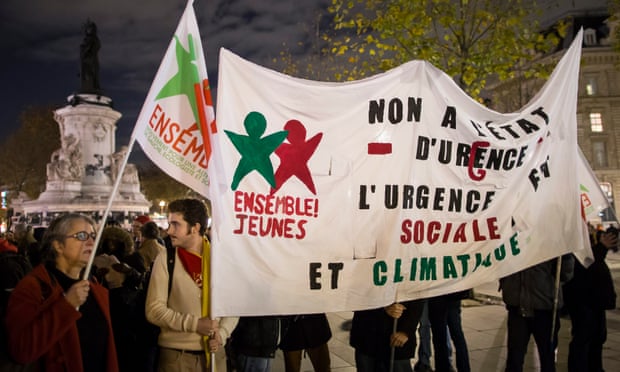
Paris climate activists put under house arrest using emergency laws

French police arrest activists for flouting ban on organising protests during climate talks next week 
Activists protest against French authorities using emergency law to ban demonstrations at the Place de la Republique in Paris.
 Activists protest against French authorities using emergency law to ban demonstrations at the Place de la Republique in Paris. Photograph: Ian Langsdon/EPA
At least 24 climate activists have been put under house arrest by French police, accused of flouting a ban on organising protests during next week’s Paris climate summit, the Guardian has learned. 
One legal adviser to the activists said many officers raided his Paris apartment and occupied three floors and a staircase in his block. 
French authorities did not respond to requests for comment but lawyers said that the warrants were issued under state of emergency laws, imposed after the terror attacks that killed 130 people earlier this month. 
The author and climate change campaigner, Naomi Klein, accused French authorities of “a gross abuse of power that risks turning the summit into a farce”.
“Climate summits are not photo opportunities to boost the popularity of politicians,” she told the Guardian. “Given the stakes of the climate crisis, they are by their nature highly contested. That is democracy, messy as it may be. The French government, under cover of anti-terrorism laws, seems to be trying to avoid this, shamefully banning peaceful demonstrations and using emergency powers to pre-emptively detain key activists.” 
Since Thursday, three people have been placed under house arrest in Rens, two in Paris, two in Rouen and one in Lyons, according to campaigners. They may now only leave their houses to sign a post office register verifying their whereabouts, three times a day. 
Joel Domenjoud, a legal activist, said that he had been served with a restraining order wrongly describing him as a “principal leader of the ultra-left movement” just hours after a judge refused to hear an appeal against the ban on the climate demo that he had petitioned for. 
“I wasn’t there when they came to my house but my neighbour called me to say ‘What’s wrong? The stairs are full of cops from the first to the third floor!’” he said. 
Domenjoud says he was then followed by several undercover officers, before returning home, where he was served with the restraining notice. 
“I feel angry about it because I think they made a big mistake,” Domenjoud added. “They weren’t looking for people like us activists – or if they were, it shows that they can target people for no reason at all and our civil liberties are in danger.” 
Several sources said that officers also raided three squats in Paris – and more across the country – seizing computers, documents and personal effects. 
Thousands of climate campaigners, including high-profile Indian activist Vandana Shiva, have vowed to defy the blanket ban on demonstrations. One protest on Sunday will be protected by a ‘human chain’, while a day of civil disobedience will take place when the summit ends on 12 December, dubbed as ‘red lines’ day.
Numbers are expected to be smaller than previously hoped, but artists have been working around the clock on creations such as a series of ‘inflatable cobble stones’, alluding to a famous slogan from the May 1968 protests: Beneath the cobble stones the beach.
Some protesters argue that the permission granted to football matches, trade fairs and Christmas markets in Paris over the summit period suggests that the authorities’ real concern is to suppress dissent.
“We are trying to find grey areas in the law,” said John Jordan, a prominent activist. “At the moment, a demonstration is legally defined as more than two people who share a political message. We are trying to find creative ways around these laws.”
During recent protests by Quebec students, participant numbers were kept to below 50 on each march, to avoid a prohibition order.

IDFA


Anoniem heeft een nieuwe reactie op je bericht "Hillary Paid By Zionist Lobby" achtergelaten:

Het kan nog net, de laatste IDFA screening van de documentaire 'Censored Voices' is morgen 29/11 nog te zien om 19:30u in bioscoop Kriterion, Amsterdam

Hier een review: The Prescient Memories of “Censored Voices” van 'Jewschool', progressive jews and views.


Geplaatst door Anoniem op  stan van houcke op 28 november 2015 12:40:00 CET 

Anoniem heeft een nieuwe reactie op je bericht "Hillary Paid By Zionist Lobby" achtergelaten:
En morgen dus eveneens de Global Climate March met demo's in Wageningen om 13:00u op de Markt en om 12:00u in Amsterdam op het museumplein de Klimaatparade. Dat het net zo'n mooie dag mag worden als bij de demo tegen TTIP!

De klimaatonderhandelingen in Parijs gaan over rijkdom en armoede - Down To Earth. En dus ook over de gevaren dieTTIP en ISDS met zich meebrengen:

Documents and emails obtained by the Guardian reveal ‘collusion’ between Brussels and industry over the fossil fuel push in free trade negotiations - The Guardian 


Geplaatst door Anoniem op  stan van houcke op 28 november 2015 13:24:00 CET 


Anoniem heeft een nieuwe reactie op je bericht "Hillary Paid By Zionist Lobby" achtergelaten:
That Dystopian Climate Change Future Has Arrived "Saudi Arabia is a prime example of how overuse of resources can have detrimental effects. The desert springs are fed by a massive aquifer system that predates recorded history. A 2004 report showed that wealthy farmers had been draining the aquifers for three decades. At the time, Saudi Arabia was the leading exporter of wheat in the region. Three years ago the Saudi government announced that 2016 would be its last wheat harvest and that it would be relying heavily on imported food from other nations to feed its millions of people." 


Human Cost of Climate Change

U.N. Counts the Human Cost of Climate Change 

Posted on Nov 27, 2015
By Tim Radford / Climate News Network

    Victims of Cyclone Nargis, which devastated Myanmar in 2008, receive supplies. The cyclone claimed at least 138,000 lives. (TZA via Flick)
This Creative Commons-licensed piece first appeared at Climate News Network.

LONDON—In the 20 years since the first UN conference on climate change, weather-related disasters have claimed 606,000 human lives, damaged or destroyed 87 million homes, and injured, displaced or left helpless a total of 4.1 billion people.
A new study from the UN Office for Disaster Risk Reduction (UNISDR) demonstrates that 90% of all disasters are now weather-related. And the average of 335 weather-related disasters per year in the last 10 years is twice that recorded between 1985 and 1995
The report, The Human Cost of Weather-Related Disasters 1995-2015, is intended to focus attention during the UN climate change conference —which opens in Paris on Monday—on the damage already inflicted by global warming as a consequence of rising levels of greenhouse gases in the atmosphere, in turn as a consequence of the human combustion of fossil fuels and the destruction of the planet’s forests.
Development cost
As world leaders head for the summit, referred to as COP21, the numbers alone tell the story. In the last 20 years, there have been 6,457 floods, storms, heatwaves, droughts and other climatic events that meet the UN definition of a disaster—that is, they killed people, displaced communities, or caused damage calculated in millions.
But there are figures nobody can assess. One of these is the true economic cost, especially in terms of economic development.
The UN’s Centre for Research on the Epidemiology of Disasters, based at the Catholic University of Louvain in Belgium, puts the tally at US$1.891 trillion over the last 20 years.
However, that accounts for about only 71% of all losses attributable to natural hazards. The true figure for disasters—including earthquakes and tsunamis—could be between $250bn and $300bn a year, which would mean a total of up to $6 trillion just for the last decade.
In terms of numbers, the US was hit most often, with 472 recorded tornadoes, ice storms, hurricanes, floods, heatwaves, droughts and other events. China followed with 441, India with 228, the Philippines with 274, and Indonesia with 263.
“An agreement in Paris at COP21 on reducing greenhouse gas emissions will be a significant contribution
to reducing damage and loss from disasters.”
The greatest loss of lives was in Asia, where 332,000 people died and 3.7 billion were affected. Cyclone Nargis, which hit Myanmar in 2008, claimed 138,000 lives.
Floods accounted for 47% of all weather-related disasters in the 20 years, affecting 2.3 billion people and killing 157,000. Storms accounted for 242,000 deaths, or 40% of the total. Almost 90% of these deaths were in the lower-income nations.
Paradoxically, higher-income countries felt the impact of temperature extremes. Of the 164,000 who perished when the thermometer dropped or climbed to catastrophic levels, 148,000 died during heatwaves, and 90% of these deaths were in Europe.
Greater extremes
But drought hit Africa more than any other continent, with 136 arid spells between 1995 and 2015, and 77 of these were in East Africa.
Researchers have repeatedly given warnings that global warming is likely to be accompanied by greater extremes.
“In the long term, an agreement in Paris at COP21 on reducing greenhouse gas emissions will be a significant contribution to reducing damage and loss from disasters, which are partly driven by a warming globe and rising sea levels,” says Margareta Wahlström, head of UNISDR.
“For now, there is a need to reduce existing levels of risk and avoid creating new risk by ensuring that public and private investments are risk-informed and do not increase the exposure of people and economic assets to natural hazards on flood plains, vulnerable low-lying coastlines, and other locations unsuited for human settlement.”

Tim Radford, a founding editor of Climate News Network, worked for The Guardian for 32 years, for most of that time as science editor. He has been covering climate change since 1988.

http://climatenewsnetwork.net/un-counts-climates-human-cost/


Humanity Is at Stake

Published on 
by 

Forget ISIS: Humanity is at Stake


We either live in dignity together or continue to perish alone, warring tribes and grief-stricken nations. (Photo: Franck Schneider/flickr/cc)


    Memorial to victims of the November 2015 Paris attacks at the French Embassy in Moscow. (CC BY-SA 3.0)

I still remember that smug look on his face, followed by the matter-of-fact remarks that had western journalists laugh out loud.
“I’m now going to show you a picture of the luckiest man in Iraq,” General Norman Schwarzkopf, known as ‘Stormin’ Norman, said at a press conference sometime in 1991, as he showed a video of US bombs blasting an Iraqi bridge, seconds after the Iraqi driver managed to cross it.
But then, a far more unjust invasion and war followed in 2003, following a decade-long siege that cost Iraq a million of its children and its entire economy.
Advertisement
It marked the end of sanity and the dissipation of any past illusions that the United States was a friend of the Arabs. Not only did the Americans destroy the central piece of our civilizational and collective experience that spanned millennia, it took pleasure in degrading us in the process. Their soldiers raped our women with obvious delight. They tortured our men, and posed with the dead, mutilated bodies in photographs - mementos to prolong the humiliation for eternity; they butchered our people, explained in articulate terms as necessary and unavoidable collateral damage; they blew up our mosques and churches and refused to accept that what was done to Iraq over the course of twenty years might possibly constitute war crimes.
Then, they expanded their war taking it as far as US bombers could reach; they tortured and floated their prisoners aboard large ships, cunningly arguing that torture in international waters does not constitute a crime; they suspended their victims on crosses and photographed them for future entertainment.
Their entertainers, media experts, intellectuals and philosophers made careers from dissecting us, dehumanizing us, belittling everything we hold dear; they did not spare a symbol, a prophet, a tradition, values or set of morals. When we reacted and protested out of despair, they further censured us for being intolerant to view the humor in our demise; they used our angry shouts to further highlight their sense of superiority and our imposed lowliness.
They claimed that we initiated it all. But they lied. It was their unqualified, inflated sense of importance that made them assign September 11, 2001 as the inauguration of history. All that they did to us, all the colonial experiences and the open-ended butchery of the brown man, the black man, any man or woman who did not look like them or uphold their values, was inconsequential.
All the millions who died in Iraq were not considered a viable context to any historical understanding of terrorism; in fact, terrorism became us; the whole concept of terror, which is violence inflicted on innocent civilians for political ends, abruptly became an entirely Arab and Muslim trait. In retrospect, the US-Western-Israeli slaughter of the Vietnamese, Koreans, Cambodians, Palestinians, Lebanese, Egyptians, South Americans, Africans, was spared any censure. Yet, when Arabs attempted to resist, they were deemed the originators of violence, the harbingers of terror.
Furthermore, they carried out massive social and demographic experiments in Iraq which have been unleashed throughout the Middle East, since. They pitted their victims against one another: the Shia against the Sunni, the Sunni against the Sunni, the Arabs against the Kurds, and the Kurds against the Turks. They called it a strategy, and congratulated themselves on a job well done as they purportedly withdrew from Iraq. They disregarded the consequences of tampering with civilizations that have evolved over the course of millennia.
When their experiments went awry, they blamed their victims. Their entertainers, media experts, intellectuals and philosophers flooded every public platform to inform the world that the vital mistake of the Bush administration was the assumption that Arabs were ready for democracy and that, unlike the Japanese and the Germans, Arabs were made of different blood, flesh and tears. Meanwhile, the finest of Arab men were raped in their jails, kidnapped in broad daylight, tortured aboard large ships in international waters, where the Law did not apply.
When the Americans and their allies claimed that they had left the region, they left behind bleeding, impoverished nations, licking their wounds and searching for bodies under rubble in diverse and macabre landscapes. Yet, the Americans, the British, the French and the Israelis, continue to stage their democratic elections around the debate of who will hit us the hardest, humiliate us the most, teach the most unforgettable lesson and, in their late night comedies, they mock our pain.
We, then, sprang up like wild grass in a desert, multiplied, and roamed the streets of Rabat, Baghdad, Damascus and Cairo, calling for a revolution. We wanted democracy for our sake, not Bush’s democracy tinged with blood; we wanted equality, change and reforms and a world in which Gaza is not habitually destroyed by Israel and children of Derra could protest without being shot; where leaders do not pose as divinities and relish the endless arsenals of their western benefactors. We sought a life in which freedom is not a rickety dingy crossing the sea to some uncertain horizon where we are treated as human rubbish on the streets of western lands.
However, we were crushed; pulverized; imprisoned, burnt, beaten and raped and, once more, told that we are not yet ready for democracy; not ready to be free, to breathe, to exist with even a speck of dignity.
Many of us are still honorably fighting for our communities; others despaired: they carried arms and went to war, fighting whoever they perceive to be an enemy, who were many. Others went mad, lost every sense of humanity; exacted revenge, tragically believing that justice can be achieved by doing unto others what they have done unto you. They were joined by others who headed to the West, some of whom had escaped the miseries of their homelands, but found that their utopia was marred with alienation, racism and neglect, saturated with a smug sense of superiority afflicted upon them by their old masters.
It became a vicious cycle, and few seem interested now in revisiting General Schwarzkopf’s conquests in Iraq and Vietnam - with his smug attitude and the amusement of western journalists - to know what actually went wrong. They still refuse to acknowledge history, the bleeding Palestinian wound, the heartbroken Egyptian revolutionaries and the destroyed sense of Iraqi nationhood, the hemorrhaging streets of Libya and the horrifying outcomes of all the western terrorist wars, with blind, oil-hungry dominating foreign policies that have shattered the Cradle of Civilization, like never before.
However, this violence no longer affects Arabs alone, although Arabs and Muslims remain the larger recipients of its horror. When the militants, spawned by the US and their allies, felt cornered, they fanned out to every corner of the globe, killing innocent people and shouting the name of God in their final moment. Recently, they came for the French, a day after they blew up the Lebanese, and few days after the Russians; and, before that, the Turks and the Kurds, and, simultaneously, the Syrians and the Iraqis.
Who is next? No one really knows. We keep telling ourselves that ‘it’s just a transition’ and ‘all will be well once the dust has settled’. But the Russians, the Americans and everyone else continue bombing, each insisting that they are bombing the right people for the right reason while, on the ground, everyone is shooting at whoever they deem the enemy, the terrorist, a designation that is often redefined. Yet, few speak out to recognize our shared humanity and victimhood.
No - do not always expect the initials ISIS to offer an explanation for all that goes wrong. Those who orchestrated the war on Iraq and those feeding the war in Syria and arming Israel cannot be vindicated.
The crux of the matter: we either live in dignity together or continue to perish alone, warring tribes and grief-stricken nations. This is not just about indiscriminate bombing - our humanity, in fact, the future of the human race is at stake.

http://www.commondreams.org/views/2015/11/27/forget-isis-humanity-stake


Turkey's Jailed Journalists

Anoniem heeft een nieuwe reactie op je bericht "Turkey's Motives for War" achtergelaten: 

The New Yorker march 2012:

Quick: What country jails the most journalists? 
If you guessed China, you were close, but no cigar. Twenty-seven reporters are in prison there, according to the Committee to Protect Journalists in New York. If you guessed Iran, you’re getting warmer—forty-two in prison there—but you’re still off. 
How many of you guessed Turkey? 
Measuring strictly in terms of imprisonments, Turkey—a longtime American ally, member of NATO, and showcase Muslim democracy—appears to be the most repressive country in the world. 
According to the Journalists Union of Turkey, ninety-four reporters are currently imprisoned for doing their jobs. More than half are members of the Kurdish minority, which has been seeking greater freedoms since the Turkish republic was founded, in 1923. Many counts of arrested journalists go higher; the Friends of Ahmet Sik and Nedim Sener, a group of reporters named for two imprisoned colleagues, has compiled a detailed list of a hundred and four journalists currently in prison there. 
The arrests have created an extraordinary climate of fear among journalists in Turkey, or, for that matter, for anyone contemplating criticizing Prime Minister Recep Tayyip Erdogan’s government. During my recent visit there, many Turkish reporters told me that their editors have told them not to criticize Erdogan. As I detail in my piece in the magazine this week, the arrests of journalists are part of a larger campaign by Erdogan to crush domestic opposition to his rule. Since 2007, more than seven hundred people have been arrested, including members of parliament, army officers, university rectors, the heads of aid organizations, and the owners of television networks.
Mind you, Turkey is a democracy, or at least, it’s supposed to be. Erdogan’s triumph, and that of his party, in 2002, represented an epochal shift in Turkey’s political history. The election threw out an entrenched secular minority that had governed the country since its founding, often suppressing the majority of moderately religious Turks. In his nine years in power, Erdogan has transformed Turkish society in many positive ways. But, more and more, Erdogan’s Turkey is coming to resembled Putin’s Russia—a kind of one-party democracy. 
If you bring this up with Turkish authorities, you won’t get very far. When I raised the issue of domestic repression with Ahmet Davutoglu, the Turkish foreign minister, last month, he told me in an irritated voice that his government wasn’t responsible. Ibrahim Kalin, an Erdogan adviser, told me that most of the arrested journalists were not journalists at all, but terrorists or criminals. “Just because you have a press card doesn’t mean you’re a journalist,” Kalin said. 
In December, Joel Simon, executive director of the Committee to Protect Journalistswrote to Erdogan to ask to him to stop citing C.P.J.’s annual report as evidence of press freedom in Turkey, which Simon called “perverse.” The report, compiled last year, confirmed that eight journalists were in jail in Turkey because of their work. (No number to be proud of, to be sure; as Simon pointed out to Erdogan, it put Turkey “just behind Burma.”) But Simon has since said that the report was incomplete, and hampered by, among other things, the extreme difficulty of verifying arrests in Turkey, and that eight was a starting point, a “minimum.” In recent weeks, Simon has sent a team to Turkey to review more than a hundred cases to determine the real number of journalists in prison. He told me he expects the number to climb significantly, probably closer to the figure of ninety-four released by the Journalists Union of Turkey. In late December, for instance, Simon sent a letter to Erdogan condemning the arrests of some thirty journalists in raids around the country. (Most of those reporters are still in prison, he said.)
“It’s incredibly cynical of Erdogan to cite C.P.J. as proof of press freedom,” Simon said. “Turkey is a highly repressive country.” 
Remember, too, that when you start arresting journalists, the freedom for those not in jail shrinks, too. One of the journalists I interviewed while I was in Turkey was Nuray Mert, a brave and outspoken columnist for Milliyet, a daily newspaper. Last year, after Erdogan publicly criticized Mert, her public-affairs television show was cancelled. Two weeks ago, she told me that her editors at Milliyet had fired her.
Photograph by Abbas/Magnum.

Truthout Sunday 20/11/2026

  SUNDAY, SEPTEMBER 20, 2026 Walking September 11’s Other Crime Scenes Millions had fled along the highway I had taken. Behind them Iraq was...