The Unz Review • An Alternative Media Selection


 Over the last couple of weeks there have growing media reports that we were preparing to launch a ground invasion of Iranian territory even as more and more American troops were brought into the region. But at this very moment, the Trump Administration suddenly fired Randy George, America’s top Army general, along with a couple of others also of very high rank. It seems implausible that these important developments were totally unconnected.
Conducting such a military purge in the early stages of a major war seemed unprecedented in our national history, so this was merely the latest example of how the government of Donald Trump has done things that no previous American president had ever considered doing.
On the Internet, Trump partisans quickly declared that those generals had been removed for ideological reasons unconnected with any disputes over the management of our Iran War. The Army commanders fired had allegedly been hangovers from the Biden Administration, overly “woke” in their views, and indeed media leaks supported this, indicating that disputes over the diversity policies in promotions had been a crucial factor. But numerous leading Congressional Republicans soon publicly praised George and expressed shock and dismay over his ouster, suggesting that if he had been too liberal, most right-wing Republicans loyal to Trump had apparently been unaware of that fact.
Furthermore, very soon after his second inauguration, Trump had replaced the chairman of the Joint Chiefs of Staff along with other members of that body, and the top leaders of the NSA had been fired a few weeks later. Trump had apparently made these personnel changes on ideological grounds, so if George had fallen into that same category, he surely would have also been swept out at that time.
Meanwhile, unconfirmed claims suggesting that very different factors were involved have attracted millions of views on Twitter:
Indeed, when questioned by members of Congress, Pete Hegseth seemed completely unable to provide an explanation of why he had fired all those top-ranking generals. This suggested that a major factor had been their huge concerns about the course of our war with Iran.
Our current war is certainly the most serious conflict America has fought in decades. Iran is a nation of over 90 million, possessing a huge arsenal of ballistic missiles and powerful drones, so in many respects our foe seems larger, better armed, and more effective than any we have faced since the Korean War three generations ago. Only a sliver of the current American population personally remembers that conflict or the major military defeats that we had suffered at the time.
And as I emphasized late last year, the Trump subordinate who purged those top generals hardly has the sort of personal background that would inspire great confidence among any of our military commanders.
Similarly, some of the top officials that he has appointed to implement his national security policies appear to be completely unprecedented in their outrageous personal history and lack of qualifications, notably including his Secretary of Defense Pete Hegseth whose department Trump suddenly renamed the Department of War in a surprisingly candid executive order.
Although a military veteran of the Iraq War, Hegseth had never commanded anything larger than a rifle platoon, but he had apparently caught Trump’s eye as a gung-ho commentator on FoxNews. However, when Trump nominated him, it quickly came out that he had a long and severe drinking problem while the non-profit veterans organizations he led had financially collapsed.
Worse still, while drunk at a Republican conference he had been very plausibly accused of raping one of the women there, who had both told her colleagues about the brutal attack and also reported it to the police at the time, with Hegseth desperately begging her not to press charges and later paying $50,000 for her silence. This nearly led to the defeat of his nomination in the Republican-controlled Senate, but massive pressure from Trump had allowed him to squeak through on a tie-vote broken by Vice President JD Vance, only the second time this had happened in American history.
Once in office, Hegseth violated all security protocols by sharing details about missile strikes with his friends and relatives, an incident that was widely but mistakenly expected to result in his immediate termination.

I’m not sure of the last time any major power has put its military under the control of a totally unqualified, incompetent, and heavily tattooed drunken rapist, and I suspect that even the overwhelming majority of Third World countries would balk at such a doubtful personnel decision.
- Donald Trump as Our President Caligula
Ron Unz • The Unz Review • December 15, 2025 • 8,300 Words
In the most recent example of Hegseth’s remarkable venality and incompetence, a few days ago the Financial Times reported that because of his advance knowledge of our attack on Iran, he sought to place a multimillion-dollar bet on a basket of defense stocks, but that the ones he selected actually lost rather than gained value.
Given Hegseth’s manifest incompetence, I couldn’t help considering how different matters might have gone if Trump had instead appointed Col. Douglas Macgregorto that same important position.
After serving as a celebrated military commander during our Gulf War against Iraq, Macgregor had authored several highly regarded books on military history and strategy, and as a strong right-winger and defense expert he had become a regular guest on Tucker Carlson’s top-rated FoxNews show. During Trump’s first term, Macgregor had been quite close to the president, who had nominated him as our ambassador to Germany, and after the U.S. Senate blocked that appointment, named him as a senior advisor to the secretary of defense and placed him on the board of the U.S. Military Academy.
But more recently, Macgregor’s historical knowledge and military expertise had led him to become a very sharp critic of our Iran War, so if he had held Hegseth’s position and had Trump’s ear, our current disaster might have been averted. However, as someone pointed out to me, the powerful pro-Israel donors and lobbyists who fervently sought this war would have obviously recognized that political threat and would have vetoed any Macgregor appointment for exactly that reason.
Meanwhile, Hegseth seems so totally unqualified for his position and so much given to outrageous remarks and behavior that there are widespread suspicions that he has been kept in his job merely so that he can deflect attention away from Steve Feinberg, the controversial Jewish billionaire who serves as his deputy and may actually be running the department. Feinberg had co-founded Cerberus Capital Management, a buyout firm heavily involved in military contracting, and during his long business career he had been notoriously secretive, even going so far as boasting to his shareholders that he would “kill” any employee who got his picture in the newspapers. So an idiot such as Hegseth might serve as a very useful lightning rod.
Our official 2026 Pentagon budget was a trillion dollars and Hegseth recently demanded an additional $200 billion in supplemental funding to cover the unexpected costs of our Iran War. But even before attacking Iran, Trump had raised his proposed 2027 military spending to an astonishing $1.5 trillion dollars, a figure roughly as large as that of the rest of the world combined. These gargantuan sums will surely be extremely lucrative for Feinberg’s former colleagues and those in a similar line of business.
With someone as stupid and ignorant as Hegseth apparently serving as Trump’s chief American military advisor, our decision to attack Iran becomes far less inexplicable.
Iran was Israel’s most formidable regional rival and for decades Israeli leaders and their zealous American partisans had heavily pressed every American president to attack and destroy that country. But for decades our Pentagon and CIA officials had successfully dissuaded those American presidents from taking any such reckless action.
Iran had always threatened to close the Strait of Hormuz if attacked and that crucial waterway carried the oil shipments and other vital resources of the Persian Gulf to the rest of the globe. These represented a substantial fraction of the world’s total exports of those important commodities, so any such blockade would devastate the global economy. Our intelligence experts were convinced that the Iranians would carry out that threat and our military experts believed that it would be very difficult for our forces to prevent them from doing so. So although administrations regularly denounced the Iranians and imposed various sanctions against their economy, any major military action was off the table.
The closest we ever came may have been in the aftermath of the 9/11 Attacks of 2001, which had allowed the fiercely pro-Israel Neocons to gain a dominant position of influence in the George W. Bush Administration. Even as they were preparing to launch their ill-fated invasion of Iraq, another major regional rival of Israel, they also hoped to follow that up with a similar invasion of neighboring Iran.
However, the Pentagon held a massive simulation exercise around that time that helped to torpedo those plans. The Millennium Challenge 2002 wargamessuggested that if the Iranians closed that waterway, any American naval effort to reopen it would be utterly disastrous. Marine Corps Lt. Gen. Paul K. Van Riperplayed the part of our Iranian adversaries and in that role he immediately sank an American aircraft carrier along with all its accompanying warships. In real life, America would have lost 20,000 dead after just a single day of combat, certainly representing the greatest military catastrophe in our entire national history. With that powerful lesson in mind, neither Bush nor any subsequent American president prior to Trump had ever seriously considered an attack on Iran.
That was almost a quarter-century ago, long before the Iranians had acquired the highly accurate ballistic missiles or powerful drones that are currently their most formidable weapons. So with the Iranian control of the waterway vastly stronger today, any American naval forces attempting to challenge that blockade would probably suffer the total destruction suggested by that Pentagon exercise.
Unfortunately, President Donald Trump completely disregarded such concernsand instead launched his massive surprise attack against Iran. But when the angry Iranians refused to surrender and instead followed through with their threat to cut off a substantial fraction of the world’s oil, energy, and fertilizer supplies, he was completely flummoxed and apparently lacked any Plan B.
The sharp rise in world oil prices quickly provoked such desperation in the Trump Administration that they responded by removing all existing sanctions on Russian oil sales. Even more remarkably, Trump also lifted all existing sanctions on Iranian oil sales, thereby hugely boosting the governmental revenues of the country we were attempting to defeat and destroy, something perhaps unique in recorded military history.
America has the world’s most powerful navy and prior to attacking Iran, Trump had already deployed two of its carrier strike groups to the region. So faced with the dire economic consequences of the Iranian blockade, our president repeatedly declared that he would send American warships to reopen that final waterway to cargo traffic.
But such a proposal was so suicidal that even erstwhile Trump supporters publicly rebelled. Popular history podcaster Darryl Cooper had a strong military background and he said he hoped that senior American military commanders would refuse to carry out such a presidential order rather than condemn so many thousands of their American servicemen to a watery grave. Whether or not such a hidden mutiny of our top naval commanders actually happened, Trump soon backtracked on his proposal, instead absurdly demanding that our NATO allies send their own ships to be sunk, or even more absurdly saying that Iran’s Chinese ally should do so. Meanwhile, America carefully kept all the warships of its carrier strike groups around 1,000 kilometers away from Iran lest they be hit by Iranian missiles.
From the very beginning of the war, Trump had repeatedly declared that it would soon end in a total American victory that would force the Iranians to reopen the waterway, and for weeks most Wall Street traders had regularly fallen for those ridiculous claims, bringing down rising oil prices whenever Trump promised a quick end to the war. But over the last few days, the oil markets finally concluded that Trump’s words meant absolutely nothing, and prices spiked to nearly double what they had been earlier this year and remained there regardless of anything our president said.
However, much higher prices are probably still to come. According to a Saudi report cited a couple of weeks ago in the Wall Street Journal, if the Iranians maintained their blockade, oil prices would triple to $180 per barrel by the end of this month, thereby plunging the world into a severe global recession or something even worse.
Around one-third of all fertilizer exports also came from the Persian Gulf, and with the planting season soon to begin in the northern hemisphere, analysts feared that the result would be a global famine.
Having apparently been pulled back from the idea of sending our large naval fleet to be sunk by Iranian missiles in the Strait of Hormuz, Trump more recently seemed to be moving ahead with the only slightly less insane idea of ordering many thousands of American ground troops to invade and seize Iranian territory.
As I discussed last week, these plans were apparently based upon the totally forlorn hope that such an attack could be used either to directly reopen the waterway or exert sufficient pressure upon the Iranian government that it would be forced to do so itself.
Soon after Trump recognized that it would be impossible for his warships to break the Iranian blockade, he ordered a Marine expeditionary unit deployed to the Gulf, quickly followed by a second one. Taken together, these numbered less than 5,000 Marines, of which perhaps half were actual fighting troops.
Another 2,000 paratroopers of the 82nd Airborne Division were also sent there, and an article in The Intercept noted that “dozens of transport aircraft used to ferry troops and cargo have been flying out of airfields used by America’s most elite commandos, including the Army’s Delta Force and the Navy’s SEAL Team 6,” suggesting that those units may have also been deployed to the theater. A couple of days ago the Wall Street Journal reported that the Pentagon might be sending an additional 10,000 troops to join them, which would bring the total commitment of American ground forces to around 17,000.
According to many media reports, Trump might use these troops to seize Kharg Island, the site the Iranians used for loading 90% of their oil shipments, and enterprising journalists discovered that Trump had been suggesting an attack on Kharg as far back as the 1980s. But according to different reports, various other small islands in the Persian Gulf were more likely to be the targets.

There was absolutely no sign that deployment of these rather small ground forces concerned the Iranians. Instead just a few days after the beginning of the war, the Iranian foreign minister had stunned his NBCinterviewer by explaining that his country’s troops were eager to finally face their American foes in direct ground combat.
A well-regarded MAGA military analyst named Brandon Weichert considered this sort of ground operation as something close to suicide:
We had recently published an article analyzing this assault scenario, and I would especially recommend a long podcast discussion by military experts Lt. Col. Daniel Davis and Cmdr. Steve Jermy of the Royal Navy. These latter two individuals had been among the first analysts to raise doubts about whether the war with Iran was going well, thereby considerably enhancing their credibility.
The most obvious point is that although Marines together with their amphibious landing craft had been sent to the region, attacking any of those islands by sea was totally impossible. They were located well past the Strait of Hormuz, and we had already recognized that any heavily armed warships sent there would almost certainly be sunk by Iranian missiles and torpedoes. So landing craft packed with troops would surely suffer the same fate, with all the thousands of Marines they carried either drowning or being captured and held as POWs. Therefore, any attack would have to be by air, as was also suggested by deploying units of the 82nd Airborne.
However, that scenario also seemed quite difficult. Large-scale parachute drops over enemy-held territory had almost completely gone out of fashion after World War II. Although our units still probably trained in those tactics for tradition’s sake, trying such an attack in real life for the first time in decades would be extremely perilous. So the initial airborne assault would presumably be undertaken with helicopters or tiltrotor Osprey transports until a large landing zone had been secured for the possible use of cargo transport aircraft.
But even this approach seemed fraught with risk. Counting the regular military and the IRGC, the Iranians had an army of nearly a million men, and faced with ground combat they had now mobilized another million of their reserves. All those islands presumably had small garrisons of Iranian troops, and weeks of media discussion of planned American assaults had surely led them to be further reinforced and prepared for combat. The Iranian defenders would be well-equipped with manpads and RPGs, so any incoming helicopters or other transports would be at serious risk of getting shot out of the sky.
These problems would certainly continue once any troops had landed. The American military units involved might be elite forces but none of them have had any experience facing the modern drone warfare that has evolved during the Ukraine war, while the Iranians had an enormous arsenal of such weapons and these could surely inflict heavy losses upon the American invaders. Our strategic radars in the region had been very well protected and they had been overwhelmed and destroyed by waves of Iranian drones, so light infantry would certainly be vulnerable. Hitting targets far outside Iran was obviously much more difficult than hitting those on Iranian soil.
One of our aircraft carriers has been driven from the theater and the other is operating at extreme range for fear of Iranian attacks. The same was true for our land-based aircraft, which required refueling by aerial tankers to reach the battlefield, limiting the time they could spend on close air support.
As experienced military professionals, Davis and Jermy especially focused upon logistical problems, and they emphasized that any troops we successfully landed on those islands would have a very difficult time getting resupplied with ammunition and food, or having their wounded evacuated. Any such flights would be at constant risk of being ambushed by the manpads of the hidden and dug-in Iranian defenders.
My impression is that many decades of our recent wars have accustomed American troops to acting as if they had access to infinite supplies, so they might quickly exhaust their limited ammunition. Meanwhile the local Iranians would presumably have very large available stocks of pre-positioned munitions and food.
Therefore it hardly seems impossible if after a week or more, the American troops might be so worn down by the constant drone and missile attacks and so short of ammunition and food that they might be forced to surrender to the far smaller number of Iranian troops on that same island. If our soldiers were out of bullets and they couldn’t easily be evacuated, what else could they do? The obvious historical analogies of the Fall of Singapore and Dien Bien Phu came to my mind.
- The Fall of Singapore, Dien Bien Phu… and the Battle for Kharg Island?
Ron Unz • The Unz Review • March 30, 2026 • 5,900 Words
In the last few days, there has been some increasing Internet speculation that rather than attempting to seize any islands in the Persian Gulf, our ground forces would attack one or more targets on the Iranian mainland, but if so, the same difficulties or even worse ones would apply. Whereas the Iranians might have had problems in reinforcing their isolated island garrisons after an American landing, that would not be the case on land.
Even more importantly, in his Wednesday evening speech Trump had declared that Iran’s air defenses had already been completely annihilated. But ironically enough, on Friday America’s Air Force had one of its worst days so far, losing an F-15E and an A-10C in their attacks on Iranian targets while several advanced combat helicopters were damaged or destroyed in the effort to rescue the downed pilots. According to a detailed analysis on a military website, the total losses in American equipment amounted to some $2 billion. If the account provided were accurate and the scenes of strewn American wreckage authentic, the operation was mostly a disaster and a major propaganda victory for the Iranians.
But the latest word is that the alleged rescue attempt seems to have merely been cover for a large-scale special forces operation aimed at seizing Iran’s nuclear enriched material. And the total failure resulted in a couple of billion dollars of destroyed hardware and numerous American casualties.
Apparently the disastrous results of that commando-raid drove Trump into “an absolute paroxysm of witless rage” as indicated by his post on Truth Social, hardly the sort of decorous public statement that one might expect from the political heir of George Washington or Thomas Jefferson:
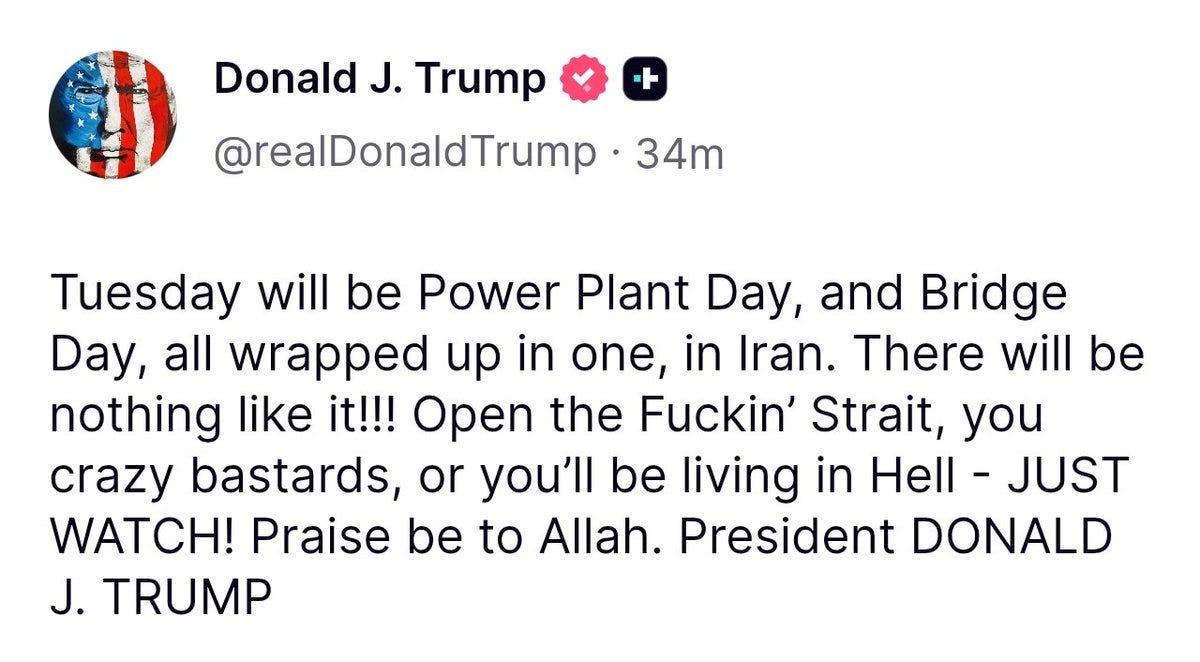
The sheer inappropriateness of that presidential message was noted by former Rep. Marjorie Taylor Greene, once one of his staunchest supporters, whose Tweet was viewed over 8 million times.
The overall results suggested that although Iran’s air defenses may have been degraded, they had hardly been eliminated, and this sudden flurry of losses supported the speculation that the Iranians had instead been husbanding their limited systems for use when and if American airpower were deployed in close support of a ground operation.
Indeed, some analysts have argued that a large majority of American attacks on Iranian targets have made use of cruise missiles or other stand-off weapons fired from outside Iranian airspace in order to avoid the threat of such residual air defenses. If so, these sudden new losses may have occurred because we had mistakenly believed that it had now become safe to do so or if we had exhausted too much of our stockpile of such weapons. Last week, I had discussed that latter possibility:
We originally developed our Tomahawk cruise missile in the 1970s and it was first used in 1991. Although slow and rather elderly, it has remained the mainstay of our arsenal of stand-off weapons, and we’ve now burned through our inventory at a fearsome clip. According to a recent Washington Post article, we had somewhere between 3,000 to 4,500 available at the beginning of the war, and we’ve now fired 850 of those or 20-30% of that total stockpile accumulated over the decades. A Business Insider article mentioned that our annual production had been around 60-70 each year, so in just four weeks we’ve expended at least a dozen years’ worth of production…
The British Royal United Service Institute (RUSI) has reported that within another month or less, our global stockpiles of ATACMS missiles and THAAD interceptors will be empty, while Israel has already exhausted its supply of Arrow interceptors. Meanwhile, the Iranians still apparently have vast stockpiles of ballistic missiles and drones, enough they claim to easily sustain six months of intense combat operations.
Indeed, it may have been more than purely coincidental that Trump’s public statement that Iranian air defenses had been completely eliminated was so quickly followed by the shootdowns that disproved that assertion. Perhaps Trump believed his own boastful words and demanded that our pilots prove he was correct by beginning to freely overfly Iranian airspace on their combat missions. And if Friday’s results apparently demonstrated that our planes cannot safely be used on ground-support missions, the insertion of American troops becomes even riskier than had previously been assumed.
Furthermore, with nearly all our regional bases severely damaged or destroyed by Iranian missile strikes, our planes have been forced to operate from distant locations requiring one or more mid-air refuelings, and that has minimized the time they can spend in their combat operations against Iran. For example, the F-15E that was shot down had apparently been operating from an airbase in the UK, and with our carriers forced to remain at great distance from Iranian missiles, the same was true of the aircraft they provide.
James R. Webb had enlisted in the Marines and fought in the Iraq War, while his celebrated father Jim Webb was the former senator from Virginia who had served as secretary of the Navy under Ronald Reagan. A couple of days ago, the younger Webb reported that the loss of American aircraft had actually persuaded the Trump Administration to embark on further escalation, including the use of ground troops.
His cautionary Tweet was viewed well over a million times and the operational concerns he expressed were exactly the same as those of nearly all other objective analysts, myself included:
This would be madness. I truly hope that someone in the Pentagon or elsewhere can prevent this from happening. If anything was proven today, it’s that Iranian AD is still very capable and very intact.
Any US ground operation will be heavily reliant on helicopters and other slow-moving airframes. Despite the assertions of both the Pentagon and POTUS, it is crystal clear that we have not reduced Iranian AD to the point where a ground operation is even a remotely wise decision. Let alone potentially inserting by air and then being exclusively reliant on an air corridor for things such as resupply and CASEVAC. History is replete with examples where this reliance has been disastrous.
Further, the hard part would be after troops were on the objective. Our lack of manpower leaves little room for maneuver, and once static (which would be required), Americans will become a stationary target for the entire inventory of Iranian indirect fire capabilities on Iranian soil, and it is a recipe for failure.
Despite all these logical concerns, it does look like the Trump Administration may be about to invade a heavily armed nation of over 90 million with a few thousand lightly armed airborne ground troops. This seems as boldly courageous a military undertaking as may be found in the recorded annals of history.
Given these onrushing events, I think it’s worth recapitulating the rather unusual circumstances of our current war.
Just over five weeks ago, we launched our massive surprise attack against Iran, an operation that President Donald Trump later boasted had been inspired by the infamous December 7, 1941 Japanese attack on Pearl Harbor. Together with our Israeli allies, the initial missile strikes that constituted our official declaration of war successfully assassinated most of the top Iranian political and military leadership from its 86-year-old Supreme Leader and his family on down.
This sort of decapitating first strike had been the subject of countless strategic research studies during the the many decades of our long Cold War with the old USSR. But nothing like it had ever actually ever been carried out in modern history, so our willingness to conduct such a risky and ruthlessly bold operation against a large country of more than 90 million naturally inspired considerable concerns elsewhere around the world. However, this sudden attack on Iran was fully aligned with Trump’s loud public declarations that he had absolutely no respect for any international law or norms, and that he would instead do whatever he wanted in military or political matters. This obviously forced everyone around the world to now take his audacious words much more seriously.
Over the last few years, Russia’s retaliatory nuclear deterrent forces have been subject to repeated attacks almost certainly greenlighted and assisted by American intelligence services, which have similarly assisted apparent attempts to assassinate Russian President Vladimir Putin. Therefore, it was hardly surprising that a prominent Russian policy analyst declared that our unprecedented surprise attack and decapitation strike against Iran sent “shockwaves” around the world, with Russians becoming fearful that it might be the model for a similar future attack on their own country and its leadership.
Russia’s nuclear arsenal is somewhat larger than our own and its suite of hypersonic delivery systems far superior. But perhaps reckless American military planners might foolishly decide that the Russian retaliation following a sufficiently successful American surprise attack would result in acceptable levels of losses. The Russians must now surely take this possibility very seriously and they will probably adjust their nuclear war fighting doctrine as a consequence, perhaps somewhat relaxing the centralized control of their nuclear forces to take into account the risk of the sudden annihilation of their command and control system. Unfortunately, this obviously might also increase the risk of an accidental nuclear war.
But although our attack on Iran and its top command hierarchy had been extremely successful, the long recent history of surprise attacks that they and their regional allies had suffered at the hands of Israel and America had led the Iranians to prepare themselves for such an unexpected blow. As a result, their highly decentralized military leadership very quickly responded with heavy retaliatory missile and drone strikes against American and Israeli targets, while also successfully shutting down the Strait of Hormuz to cargo traffic as they had always threatened to do.
Based upon rather wishful thinking, Israeli and American analysts had believed that if their forces assassinated most of Iran’s top leadership, the Iranian state would disintegrate, leading to a quick surrender. But this belief turned out to be totally mistaken, and instead Iran absorbed these losses, and even the additional assassinations that soon eliminated some of their newly elevated leaders. Rather than forcing a surrender, the surprise attack and the killing of so many important Iranian leaders together with their families seemed to greatly strengthen popular support for the government, as indicated by enormous daily marches by ordinary Iranians.
Meanwhile, with Iran having demonstrated that it exercised total control over the strategic waterway responsible for a substantial fraction of the world’s shipments of oil, natural gas, fertilizer, and many other vital commodities, the global geopolitical landscape shifted.

Despite the heavy bombing it suffered, Iran’s full control of the Strait of Hormuz gave it a chokehold over the entire world economy. And although the Israelis and the Americans could destroy vital Iranian infrastructure, the Iranians could effectively respond by similarly destroying the extremely vulnerable infrastructure of America’s Gulf Arab allies and that of Israel itself. Unfortunately, there was a growing risk that this cycle of attack and retaliation could inflict such enormous damage upon Persian Gulf facilities that the rebuilding and recovery process could take many years.
Although it had considerable misgivings about the war, the Economist had always been fiercely hostile to Iran so the coverage it provided of the conflict was absurdly one-sided. But by last week, it had been forced to admit that Iran was clearly winning the war.
Based upon these developments, Trump announced that he would give a major public speech on the current Iran war, and there was considerable speculation that he would use it to announce a pull-back of our forces, sugar-coating that retreat as best he could.
But to the great consternation of military experts, Trump’s 18 minute televised speech on April Fools’ Day merely doubled-down on all his past policies, refusing to admit that he had been disastrously wrong and instead declaring that he would continue his attacks on Iran. He also emphasized that these attacks would now heavily target Iranian civilian infrastructure, perhaps one of the first times that an American president has declared his intent to commit major war crimes in such a high-profile fashion.
And although he didn’t say he was planning to deploy American ground forces in Iran, the continuing movement of troops into the region suggested that this had become a near-certainty.
Col. Macgregor was absolutely scathing in his reaction to Trump’s speech.
Lt. Col. Davis interviewed a legal expert named Robert Barnes, who apparently had numerous close contacts both at the Pentagon and the Trump White House, and his evaluation was also extremely negative. Barnes claimed that outraged Pentagon staffers routinely described their department under Hegseth as neither the Department of Defense nor the Department of War but instead the Department of War-Crimes.
Barnes also claimed that Trump had been fed a non-stop diet of lies about the huge successes of our military operations, and based upon such delusional information, his speech had originally been intended to announce the beginning of ground operations in Iran. But under massive pressure from Vice President JD Vance and others, more realistic information was finally put before Trump, and although he supposedly responded with rage, he temporarily deferred the public initiation of full ground operations.
Having digested these somewhat different but rather negative appraisals of Trump’s speech along with a couple of others, I decided to finally watch it for myself. Over the years, most of Trump’s speeches have seemed very long and uninteresting, so this was one of the very few that I’d ever watched in more than short clips.
Many Internet commenters have claimed that Jeffrey Epstein had acquired terrible blackmail material about Trump, and the Israelis had used evidence to force Trump into attacking Iran, but I’ve always been skeptical of the blackmail angle.
Other have argued that Trump was now suffering from senile dementia, but I saw no signs of the severe mental deterioration that had become so obvious in the case of Joseph Biden. The Trump of today seemed only slightly different than the Trump of a decade ago.
However, although Trump’s delivery was reasonably crisp, the content he presented was simply an appalling agglomeration of totally ignorant nonsense, most of it laughably misinformed or non-factual, the sort of statements even random Internet commenters would be ashamed to make. This seemed to strongly support the claims of journalist Michael Wolff, who had spent the last decade cultivating numerous Trump sources and using the information he acquired to publish a string of bestsellers on our president.
I’d never read any of Wolff’s writing nor listened to any of his podcast discussions, but I recently came across a very interesting Wolff interview that seemed quite convincing to me.
In it, Wolff explained that the deep secret to understanding Trump was to recognize that he was a profoundly stupid man, so profoundly stupid that he never realized just how stupid he was. Since Trump never read nor understood almost anything, that explained the erratic, inconsistent, illogical nature of his statements and his behavior. When Trump sometimes said popular things that no other politician would dare to say, his followers eagerly seized upon those items while ignoring all the other nonsense.
Trump’s wealth and his bluster led most of those around him to assume otherwise, but the void between his ears was the deep mystery behind his behavior. Whenever he seemed lost in deep thought, he might simply be contemplating the next cheeseburger he planned to eat. Once we consider that possibility, his unfortunate presidency becomes much easier to comprehend, as well as the drastic changes between his first and second terms. Stupid people are obviously far easier to manipulate once you manage to surround them with your own confederates.
Does the following recent post seem to have been written by a world leader of reasonably high intelligence?
Meanwhile, another important public line was recently crossed by Prof. John Mearsheimer of the University of Chicago, one of our most distinguished political scientists and someone always very cautious and measured in his statements.
In one of his regular weekly interviews on Andrew Napolitano’s podcast, he emphasized the astonishing aspects of our attack against Iran, an absolutely naked war of aggression undertaken without the slightest fig-leaf of attempted justification. Together with our Israeli allies, we began the war with an unprecedented surprise attack, successfully assassinating most of the political and military leadership of the country we had targeted, and then followed that up with an almost non-stop series of other major war-crimes.
Mearsheimer had lived his entire life in the United States and he had always regarded our society and the values it upheld as representing traditional liberalism. So he found it extremely strange that none of the horrible crimes being committed were presented as such by the American media or political establishments, who instead seemed to treat them as inconsequential or even simply ignored them.
Yet by the absolutely clear standards that our own country had established at the Nuremberg Tribunals more than eighty years ago, President Donald Trump, Prime Minister Benjamin Netanyahu, and many others in their circle should clearly be hanged as war criminals.
Bold statements along those lines are hardly uncommon on the Internet, but they are almost always made by obscure individuals relying upon a cloak of anonymity, rather than publicly voiced by one of America’s most esteemed mainstream academics. I also noticed that a couple of days later, Dr. Gilbert Doctorow, another quite moderate and mainstream figure, endorsed and praised Mearsheimer for his remarks.
Mearsheimer’s remarkable declaration also went viral in a Tweet that has been viewed more than a million times.
Related Reading:


 Subscribe to This Comment Thread via RSS Subscribe to All Ron Unz Comments via RSS
https://www.unz.com/runz/is-donald-trump-facing-a-military-mutiny-over-his-losing-war-with-iran/
 English


Follow Us
There’s Going to Be a Ground Invasion of Iran
Collapsing Empire: The Resistance Disarms Israel
Are Modern Jews Khazars?
Sexual Perversity and Misanthropy in the Talmud
Dynamics of the Iran War and the paths to victory and ruin - Part 1
Escalating from Suez to Waterloo
Trump Talks War for Easter Week
Iran, Israel, and World War III


Trump? What a LOOSER!!!
I will guess the biggest problem they face is logistics. They need to “stage” at least 30 days of supplies and ammunition near the Persian Gulf to support a major operation. This is lots of stuff that requires lots of activity. This is detected by Iranian/Chinese/Russian intelligence and those sites are destroyed by Iranian drones.
Former Congresswoman Marjorie Taylor Greene on X:
https://twitter.com/FmrRepMTG/status/2040789438494585175
April 5, 2026
Everyone in his administration that claims to be a Christian needs to fall on their knees and beg forgiveness from God and stop worshipping the President and intervene in Trump’s madness.
I know all of you and him and he has gone insane, and all of you are complicit.
I’m not defending Iran but let’s be honest about all of this.
The Strait is closed because the US and Israel started the unprovoked war against Iran based on the same nuclear lies they’ve been telling for decades, that any moment Iran would develop a nuclear weapon.
You know who has nuclear weapons? Israel.
They are more than capable of defending themselves without the US having to fight their wars, kill innocent people and children, and pay for it.
Trump threatening to bomb power plants and bridges hurts the Iranian people, the very people Trump claimed he was freeing.
On Easter, of all days, we as Christians should be reminded that the son of God died and rose from the grave so that we can be forgiven once and for all of our sins. Jesus commanded us to love one another and forgive one another. Even our enemies.
Our President is not a Christian and his words and actions should not be supported by Christians.
Christians in the administration should be pursuing peace. Urging the President to make peace. Not escalating war that is hurting people.
This NOT what we promised the American people when they overwhelmingly voted in 2024, I know, I was there more than most.
This is not making America great again, this is evil.
Another fine oversight of the very possible beginning of WW3.
If only more people knew about and often read this unusually accurate site….
There’s more truth here than in any dozen major media outlets.
The only good thing about this truly insane aggression is that the entire planet is finally seeing who owns America, and the global financial system.
Let’s all send our love to the innocent people who are the victims of these shadow puppetmasters.
Keep up the good work!
This unhinged response came from the recent U.S. special operation in Iran which turned into a bigger clusterfuck than the 1980 Delta Force’s Operation Eagle Claw in Iran.
https://simplicius76.substack.com/p/its-official-us-boots-on-ground-deep