Zoeken in deze blog 🔎🔎

donderdag 2 juni 2022

Kajsa Ollongren als Onbenul

Begin maart 2022 schreef ik dit:

Wij dissidenten staan er nu alleen voor. Denk niet dat de huidige minister van Defensie, D’66 lichtgewicht Kajsa Ollongren, een zelfstandige visie heeft over leven en dood van miljoenen medemensen, geenszins, in januari 2022 verklaarde zij 'het verschil tussen een majoor en een sergeant' niet te kennen. ‘Ik heb een heel mooi boekje gekregen. Dat ben ik aan het bestuderen. Maar ik weet het nu nog niet,’ aldus de trendy politica, die als filiaalchef van Albert Heijn in Purmerend geen slecht figuur zou slaan, maar die net zoveel over oorlog en vrede weet als de eerste de beste kassière bij hetzelfde AH-filiaal.

Inmiddels, een half jaar later, donderdag 2 juni 2022, staat een interview met haar in de locale krant Het Parool. Naast het intrappen van open deuren als 'dat het geld kost, maar dat we er ook iets voor terugkrijgen,' verklaart mevrouw Ollongren ook nog op de vraag 'Goed geld uitgeven blijkt moeilijk bij defensie, constateerde de Rekenkamer onlangs. Er worden veel fouten gemaakt' het volgende als 'antwoord':

Het is niet leuk om zoveel kritiek te krijgen en daar moeten we van leren. In een organisatie waarin jarenlang zoveel is bezuinigd is dat ook ten koste gegaan van de controle op de uitgaven.

Met andere woorden: toen het ministerie van defensie moest bezuinigen is 'de controle op de uitgaven' vermindert. Een burger met een klein beetje verstand zou denken dat de controle juist zou zijn toegenomen, gezien het feit dat men minder geld heeft. Maar niet bij defensie, althans, volgens de  minister die nu miljarden extra mag spenderen (en weggeven aan Oekraïne). Niet alleen weet zij weinig, maar het ontbreekt Ollongren ook nog aan logica. En trouwens dit geldt eveneens voor de 'journalist' Raymond Boere die de minister interviewde. Let op die naam, die gaat het helemaal maken in de postmoderne journalistiek. Mark my Words.


Kajsa Ollongren en haar echtgenote Irene van den Brekel. 


EU Slowly Weening Off Russian Crude Gives Moscow Time To Divert Flows To Asia

EU Slowly Weening Off Russian Crude Gives Moscow Time To Divert Flows To Asia 

Tyler Durden's Photo
BY TYLER DURDEN
THURSDAY, JUN 02, 2022 - 08:45 AM

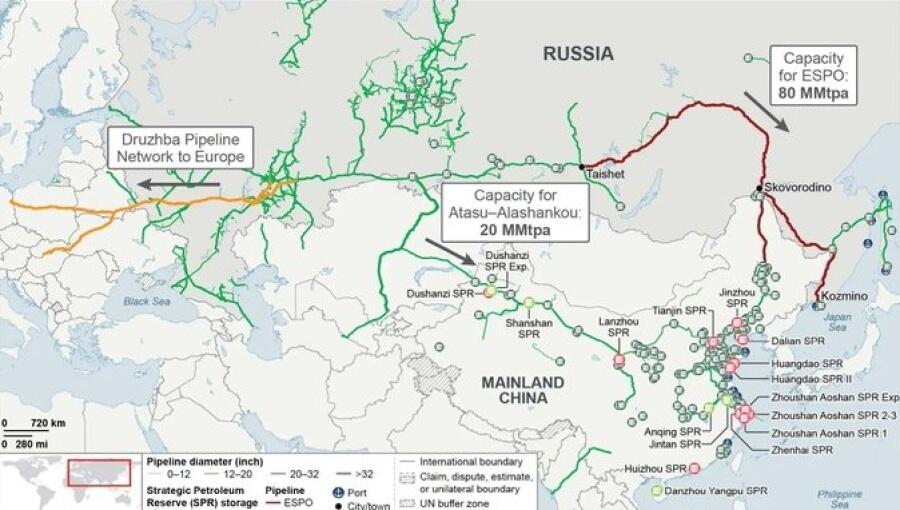
The European Union is taking another step away from Russian oil, but they're not doing it quick enough to crush Russia's energy complex as new customers are found in Asia, Russian analysts told Reuters

On Monday, EU leaders approved the sixth round of sanctions against Russia that reduces Russian oil imports by 90% by year-end but only covers crude and petroleum products by sea, excluding crude routed through pipelines. 

EU's sanctions against Russia are not hard-hitting, which were initially meant by Brussels to penalize Moscow for its invasion of Ukraine. Though Western analysts and market watchers say, the latest round of sanctions won't imminently crush Russia's energy industry.  


 "Although, the measures announced by the European Union look threatening, we don't see a crippling impact on the Russian oil sector - neither imminent nor in six months. Russian oil producers have time to solve logistics problems and change their client base," Russia-based Sinara Investment Bank analysts said.

Those analysts pointed out that Asian buyers purchase more Russian crude than Europeans. They said flows to the EU declined to 2.25 million barrels per day (bpd) from March. At the end of 2021, the EU accounted for 60% of Russia's oil exports, totaling 3 million bpd, adding that supplies the EU isn't taking anymore are being diverted to China and India. 

Moscow shrugged at the EU's new partial ban on Russian oil imports this week, while Mikhail Ulyanov, Russian Permanent Representative to international organizations in Vienna, tweeted:

"Russia will find other importers. Noteworthy that now she contradicts her own yesterday's statement. Very quick change of the mindset indicates that the # EU is not in a good shape." 

The EU is heavily dependent on Russian energy imports, getting around 40% of its natural gas and 25% of oil from Russia. Its ability to 'cold turkey' Russian fossil fuels is near impossible or risk collapsing the bloc. Thus the phased reductions rather than an immediate embargo on Russian oil allow Moscow to reroute volumes to new customers.  

Moscow-based BCS Global Markets said it would take at least two years for the EU to find alternative sources of oil that would replace the Russian supply. 

"We expect large volumes of oil and oil products (from Russia) to continue flowing to Europe - either openly or via grey schemes - in a year or even two," BCS Global Markets said.

One source at a Russian oil company told Reuters: "We had time to prepare," referring to the EU's inevitability of reducing reliance on Russian oil. 

Another trading source said volumes to Europe are being rerouted to hungry customers in Asia.

"There won't be big shocks for Russia," he said. "India takes it all for now. I'm not sure about China, about how the situation with COVID will develop there."

Brussels' harsh words to paralyze the Russian energy complex has been nothing but that and given Moscow ample time to find new buyers abroad, especially ones in Asia. 

Meanwhile, Russia and China are being pushed closer together as the emergence of a multi-polar world becomes more evident. 

Chinese Foreign Minister Wang Yi told a China-Russia think tank forum that China is willing to work with Russia in pushing forward "real democracy" based on the nations' own conditions, according to a ministry statement. Wang says international and regional security won't be met by military groups and cutting off supply chains Russian Foreign Minister Sergei Lavrov also attended the forum, statement says -- Bloomberg 

Asian buyers of Russian crude have an increasing appetite as global supplies of crude and crude products are tight. Moscow's ability to pivot from Europe to Asia is because Brussels' cunning plan to crush Russia's energy complex wasn't implemented fast enough.

https://www.zerohedge.com/commodities/eu-slowly-weening-russia-crude-gives-moscow-time-divert-flows-asia


The US is Provoking a Third World War

 https://www.nytimes.com/2022/05/31/opinion/us-ukraine-putin-war.html?smid=fb-share&fbclid=IwAR1fo2oSUBsjNLf84lDaCacsyv6w8uZvbL_AUBlBbq4PcJSELTjiphy3F68

The War in Ukraine May Be Impossible to Stop. And the U.S. Deserves Much of the Blame.


Credit...Daniel Berehulak for The New York Times
Ukrainian fighters of the Odin Unit, including some foreign fighters, survey a destroyed Russian tank in Irpin, Ukraine, in March.

Mr. Caldwell is a contributing Opinion writer and the author of “The Age of Entitlement: America Since the Sixties” and “Reflections on the Revolution in Europe: Immigration, Islam and the West.”

In the Paris daily Le Figaro this month, Henri Guaino, a top adviser to Nicolas Sarkozy when he was president of France, warned that Europe’s countries, under the shortsighted leadership of the United States, were “sleepwalking” into war with Russia. Mr. Guaino was borrowing a metaphor that the historian Christopher Clark used to describe the origins of World War I.

Naturally, Mr. Guaino understands that Russia is most directly to blame for the present conflict in Ukraine. It was Russia that massed its troops on the frontier last fall and winter and — having demanded from NATO a number of Ukraine-related security guarantees that NATO rejected — began the shelling and killing on Feb. 24.

But the United States has helped turn this tragic, local and ambiguous conflict into a potential world conflagration. By misunderstanding the war’s logic, Mr. Guaino argues, the West, led by the Biden administration, is giving the conflict a momentum that may be impossible to stop.

He is right.

In 2014 the United States backed an uprising — in its final stages a violent uprising — against the legitimately elected Ukrainian government of Viktor Yanukovych, which was pro-Russian. (The corruption of Mr. Yanukovych’s government has been much adduced by the rebellion’s defenders, but corruption is a perennial Ukrainian problem, even today.) Russia, in turn, annexed Crimea, a historically Russian-speaking part of Ukraine that since the 18th century had been home to Russia’s Black Sea Fleet.

One can argue about Russian claims to Crimea, but Russians take them seriously. Hundreds of thousands of Russian and Soviet fighters died defending the Crimean city of Sevastopol from European forces during two sieges — one during the Crimean War and one during World War II. In recent years, Russian control of Crimea has seemed to provide a stable regional arrangement: Russia’s European neighbors, at least, have let sleeping dogs lie.

But the United States never accepted the arrangement. On Nov. 10, 2021, the United States and Ukraine signed a “charter on strategic partnership” that called for Ukraine to join NATO, condemned “ongoing Russian aggression” and affirmed an “unwavering commitment” to the reintegration of Crimea into Ukraine.

That charter “convinced Russia that it must attack or be attacked,” Mr. Guaino wrote. “It is the ineluctable process of 1914 in all its terrifying purity.”

This is a faithful account of the war that President Vladimir Putin has claimed to be fighting. “There were constant supplies of the most modern military equipment,” Mr. Putin said at Russia’s annual Victory Parade on May 9, referring to the foreign arming of Ukraine. “The danger was growing every day.”

Whether he was right to worry about Russia’s security depends on one’s perspective. Western news reports tend to belittle him.

The rocky course of the war in Ukraine thus far has vindicated Mr. Putin’s diagnosis, if not his conduct. Though Ukraine’s military industry was important in Soviet times, by 2014 the country barely had a modern military at all. Oligarchs, not the state, armed and funded some of the militias sent to fight Russian-supported separatists in the east. The United States started arming and training Ukraine’s military, hesitantly at first under President Barack Obama. Modern hardware began flowing during the Trump administration, though, and today the country is armed to the teeth.

Since 2018, Ukraine has received U.S.-built Javelin antitank missiles, Czech artillery and Turkish Bayraktar drones and other NATO-interoperable weaponry. The United States and Canada have lately sent up-to-date British-designed M777 howitzers that fire GPS-guided Excalibur shells. President Biden just signed into law a $40 billion military aid package.

In this light, mockery of Russia’s battlefield performance is misplaced. Russia is not being stymied by a plucky agricultural country a third its size; it is holding its own, at least for now, against NATO’s advanced economic, cyber and battlefield weapons.

And this is where Mr. Guaino is correct to accuse the West of sleepwalking. The United States is trying to maintain the fiction that arming one’s allies is not the same thing as participating in combat.

In the information age, this distinction is growing more and more artificial. The United States has provided intelligence used to kill Russian generals. It obtained targeting information that helped to sink the Russian Black Sea missile cruiser the Moskva, an incident in which about 40 seamen were killed.

And the United States may be playing an even more direct role. There are thousands of foreign fighters in Ukraine. One volunteer spoke to the Canadian Broadcasting Corporation this month of fighting alongside “friends” who “come from the Marines, from the States.” Just as it is easy to cross the line between being a weapons supplier and being a combatant, it is easy to cross the line from waging a proxy war to waging a secret war.

In a subtler way, a country trying to fight such a war risks being drawn from partial into full involvement by force of moral reasoning. Perhaps American officials justify exporting weaponry the way they justify budgeting it: It is so powerful that it is dissuasive. The money is well spent because it buys peace. Should bigger guns fail to dissuade, however, they lead to bigger wars.

A handful of people died in the Russian takeover of Crimea in 2014. But this time around, matched in weaponry — and even outmatched in some cases — Russia has reverted to a war of bombardment that looks more like World War II.

Even if we don’t accept Mr. Putin’s claim that America’s arming of Ukraine is the reason the war happened in the first place, it is certainly the reason the war has taken the kinetic, explosive, deadly form it has. Our role in this is not passive or incidental. We have given Ukrainians cause to believe they can prevail in a war of escalation.

Thousands of Ukrainians have died who likely would not have if the United States had stood aside. That naturally may create among American policymakers a sense of moral and political obligation — to stay the course, to escalate the conflict, to match any excess.

The United States has shown itself not just liable to escalate but also inclined to. In March, Mr. Biden invoked God before insisting that Mr. Putin “cannot remain in power.” In April, Defense Secretary Lloyd Austin explained that the United States seeks to “see Russia weakened.”

Noam Chomsky warned against the paradoxical incentives of such “heroic pronouncements” in an April interview. “It may feel like Winston Churchill impersonations, very exciting,” he said. “But what they translate into is: Destroy Ukraine.”

For similar reasons Mr. Biden’s suggestion that Mr. Putin be tried for war crimes is an act of consummate irresponsibility. The charge is so serious that, once leveled, it discourages restraint; after all, a leader who commits one atrocity is no less a war criminal than one who commits a thousand. The effect, intended or not, is to foreclose any recourse to peace negotiations.

The situation on the battlefield in Ukraine has evolved to an awkward stage. Both Russia and Ukraine have suffered heavy losses. But each has made gains, too. Russia has a land bridge to Crimea and control of some of Ukraine’s most fertile agricultural lands and energy deposits, and in recent days has held the battlefield momentum. Ukraine, after a robust defense of its cities, can expect further NATO support, know-how and weaponry — a powerful incentive not to end the war anytime soon.

But if the war does not end soon, its dangers will increase. “Negotiations need to begin in the next two months,” the former U.S. secretary of state Henry Kissinger warned last week, “before it creates upheavals and tensions that will not be easily overcome.” Calling for a return to the status quo ante bellum, he added, “Pursuing the war beyond that point would not be about the freedom of Ukraine but a new war against Russia itself.”

In this, Mr. Kissinger is on the same page as Mr. Guaino. “To make concessions to Russia would be submitting to aggression,” Mr. Guaino warned. “To make none would be submitting to insanity.”

The United States is making no concessions. That would be to lose face. There’s an election coming. So the administration is closing off avenues of negotiation and working to intensify the war. We’re in it to win it. With time, the huge import of deadly weaponry, including that from the newly authorized $40 billion allocation, could take the war to a different level. President Volodymyr Zelensky of Ukraine warned in an address to students this month that the bloodiest days of the war were coming.


woensdag 1 juni 2022

Zelensky. Servant of the Corrupt


The Servant of the People

Kolomoisky would have his revenge for what happened in his domain. The confrontation with Poroshenko, which was seen as humiliating for the oligarch, concluded in March 2015.

By October, the first episode of a new show, Servant of the People aired on Ukraine’s 1+1 channel, in which Zelensky played the leading role: a high-school history teacher who unexpectedly becomes President of Ukraine and is committed to fighting government corruption. 1+1 is owned by the 1+1 Media Group, one of the largest Ukrainian media conglomerates, whose owner, according to the Atlantic Council, is none other than Kolomoisky himself, giving him “significant political influence in today’s Ukraine. His media assets were used to promote the 2019 election campaign of President Zelenskyy, whose hit shows previously aired on Kolomoisky’s network.”

The Servant of the People series itself was produced by Kvartal 95, the company founded by Zelensky, whose partners were implicated in a network of offshores by the Pandora Papers. After Zelensky’s ascension, key figures of Kvartal 95 joined Zelensky’s administration. Ivan Hennadiyovych Bakanov, for example, went from head of the production studio to the leader of the Security Service of Ukraine under Zelensky.

The show literally created Zelensky’s presidential persona, effectively allowing him to build an unofficial campaign against the incumbent administration until March 2018, when a political party named after the television series was registered with the Ministry of Justice. In December 2018, Zelensky officially announced his presidential candidacy on 1+1.

Zelensky, the creation of an oligarch, campaigned for president as the character he played in a comedy series with a party named after the show to victory in 2019. During the race, Volodymyr Ariev, a political ally of incumbent President Poroshenko, posted a chart on Facebook claiming it showed how Zelensky and his television production partners were beneficiaries of a constellation of offshore firms which allegedly received millions from Kolomoisky’s PrivatBank.

The allegations were dismissed as baseless at the time, but the Pandora Papers revealed that information on several companies in the network corresponded with Ariev’s chart, the OCCRP noted.

Shortly after taking the reins, Zelensky and his Servant of the People party began firing, supposedly for inefficiency, Ukrainian ministers with reputations as anti-corruption reformers. Daria Kaleniuk, head of Ukraine’s Anti-Corruption Action Center, told the Washington Post in March 2020 that the affair sent the message that Zelensky “can fire a person who takes a risk, for doing the right things, and blame this person for inefficiency.” Kiev-based reform reporter Oleg Sukhov echoed the sentiment last year, writing that “Zelensky has consistently protected corrupt officials from prosecution and killed anti-corruption reforms.” On the other hand, when faced with a petition calling for his dismissal, Zelensky refused to fire Oleh Tatarov, his deputy chief of staff, who had been charged with bribery.

The people put on the chopping block were also the ones most likely to threaten the power of oligarchs like Kolomoisky, from whom Zelensky may have learned a thing or two.

In a 2020 press conference, he remarked that he wanted to be “remembered as the president who built good roads in Ukraine.” One of the handful of construction companies that have received a significant share of state funds for building public roads during his tenure is PBS LLC, which is linked to Skorzonera LLC, a company co-owned by Kolomoisky, according to corporate records.

PBS has been accused by Ukrainian investigators of misappropriating millions in state funds for road work. A ruling by a court in Ivano-Frankivsk Oblast noted that together with the Kolomoisky-controlled Skorzonera it is connected as part of a web of related business entities with overlapping addresses and personnel. PBS and Skorzonera had even sent their tax declarations from the same IP address.

Notably, former Customs Minister Maxim Nefyodov was one of the reformers fired by Zelensky. Nefyodov is most well-known for having created ProZorro, a system designed to tackle corruption in Ukraine’s public procurement sector.

After dismissing Nefyodov, Zelensky’s party used its majority to pass legislation that would allow the most expensive road construction project in modern Ukrainian history to be built with zero oversight, ProZorro exempt. Last June, the Kyiv Post reported how Zelensky “has doubled spending on road repairs, reaching into the pocket of the COVID relief fund and spending money Ukraine has won in international courts.” An interesting source of cash, considering that the IMF approved a multi-billion dollar aid package in 2020 “to help Ukraine to cope with COVID-19 pandemic challenges by providing balance of payments and budget support.” Is it possible that Zelensky has taken a page out of Kolomoisky’s book by taking liberties with international aid? It’s hard to say for certain.

Also unclear, is why the State Department decided to once again sanction Kolomoisky last March after he was taken off the bad list despite his own international scheming. In a press statement, Secretary of State Anthony Blinken said the reason was “due to his involvement in significant corruption.” But they were aware of that when they put him on and took him off the list the first time. Stranger still, Blinken specifically cited the years 2014 to 2015, when Kolomoisky “was involved in corrupt acts that undermined rule of law and the Ukrainian public’s faith in their government’s democratic institutions and public processes, including using his political influence and official power for his personal benefit.”

Again, this is not a revelation, considering that Nuland played a role in getting Kolomoisky off the list the first time during that period, back when Blinken served as Deputy National Security Advisor under Obama. Blinken didn’t even mention Kolomoisky’s alleged plundering in America.

Puppet of Intrigue

In 2019, just after Zelensky won his election, Kolomoisky signaled that he was prepared to pour oil over troubled waters and make peace with Russia. The civil war in eastern Ukraine has so far claimed more than 14,000 lives. The oligarch said it was enough: “They’re stronger anyway. We have to improve our relations,” he said about Russia and Ukraine according to the New York Times. But he also saw an obstacle: “People want peace, a good life, they don’t want to be at war. And you [Washington] are forcing us to be at war, and not even giving us the money for it.”

Did the U.S. sanction Zelensky’s patron, the way it did Firtash, to nudge him in the right direction?

In the latter case, the U.S. threatened to arrest Firtash for bribery to pressure Yanukovych into signing a trade deal with the EU. But the deal was, in reality, a ploy to destabilize Russia’s economy.

Despite being characterized as merely “pro-Russian,” Yanukovych, as The Economist explained, preferred “to preserve the status quo and refrain from joining either camp while continuing to milk [the EU and Russia].” And so the United States squeezed his friend to encourage Yanukovych to tilt in the desired direction. “If Yanukovych were to be persuaded to change his mind, threatening to put his sponsor Dmitry Firtash behind bars was a potent lever to apply,” wrote Cockburn. “Four days later, Yanukovych signaled he was ready to sign, whereupon Washington lifted the request to shackle his billionaire ally.”

But Yanukovych changed course and accepted a counteroffer from Moscow, a moment that became the flashpoint for a color revolution. Still Cockburn: “Street protests in Kiev followed, eagerly endorsed by Nuland, who subsequently distributed cookies in gratitude to the demonstrators.”

Yanukovych fled Kiev on February 22. Four days later, Washington renewed its efforts to arrest Firtash. “They duly did. Briefly imprisoned, Firtash posted the equivalent of $174 million bail and waited for a court to rule on his appeal against extradition.”

Whether something similar happened with Zelensky’s oligarch is another good question; likely one that won’t be answered anytime soon.

The Big Lie

The war has completely reinvented Zelensky, thus saving his scandal-plagued presidency marked by broken promises. As a Kyiv International Institute of Sociology poll showed, just 24 percent of voters supported him in late January. But now, thanks to the West’s embracement of the actor’s new persona which often places him beyond reproach, Zelensky has become the recipient of unqualified adoration and enormous amounts of international aid money. “Before the war the U.S. was sending $300 million per year to Ukraine,” said to NPR Mark Cancian, a senior adviser at the Center for International and Strategic Studies. “Now, we’re providing $100 million a day” to what was until recently considered “the most corrupt nation in Europe,” reports (of all newspapers) The Guardian.

As of today, the United States government alone is on track to deliver more than $50 billion in total aid to Ukraine. For comparison, the Department of Homeland Security estimated that Trump’s proposed border wall would cost roughly $21.6 billion. Republicans in particular, spent the first two years of Trump’s term resisting his efforts to fund and build the wall, before reluctantly agreeing to support just a fraction of what they approved for Ukraine at the drop of a hat, even challenging the patriotism of their critics.

What is the likelihood that those billions in international aid will vanish into well-connected pockets?

No one is asking these or any other important questions. Just like no one asked if it was odd when Zelensky stated that Russia would have to “kill all residents” in Ukraine’s capital to take it and get to him. That, seems the high price that the ‘servant of the people’ is willing to let Ukrainians pay; and one that Washington is happy to let Americans subsidize.


If You Want To Stay In Touch

You can follow Pedro Gonzalez on Twitter here, and subscribe to his newsletter here

https://www.zerohedge.com/news/2022-05-28/servant-corrupt


Joods Zionistische Leugens

  Red Collective @RedCollectiveUK Don't take my word that Israel killed the majority of its own civilians on October 7th. Here's Is...