4 June 2021 10:03 UTC | Last update:3 hours 17 mins ago
The symbolic moment of a Palestinian party sitting in government alongside settler leaders will turn sour all too soon
Mansour Abbas (R) signs a coalition agreement with Yair Lapid (L) and Naftali Bennett in Ramat Gan, near Tel Aviv, on 2 June 2021 (AFP/United Arab List)
The photo was unprecedented. It showed Mansour Abbas, leader of an Islamist party for Palestinians in Israel, signing an agreement on Wednesday night to sit in a "government of change" alongside settler leader Naftali Bennett.
Caretaker Prime Minister Benjamin Netanyahu will fervently try to find a way to break up the coalition in the next few days, before a parliamentary vote takes place. But if he fails, it will be the first time in the country’s 73-year history that a party led by a Palestinian citizen has joined - or been allowed to join - an Israeli government.
There will be a reckoning for this moment, and Israel’s 1.8 million Palestinian citizens... will once again pay the heaviest price
Aside from the symbolism of the moment, there are no other grounds for celebration. In fact, the involvement of Abbas’s four-member United Arab List in shoring up a majority for a government led by Bennett and Yair Lapid is almost certain to lead to a further deterioration in majority-minority relations.
There will be a reckoning for this moment, and Israel’s 1.8 million Palestinian citizens, a fifth of the population, will once again pay the heaviest price.
The sole reason that this makeshift coalition exists - the only glue holding it together - is the hostility of the various parties towards Netanyahu. In most cases, that is not a hostility towards his political positions; simply towards him personally, and towards the corrupting stranglehold he has exerted on Israel’s political system for the past 12 years.
The “change” referred to by this proposed government coalition begins and ends with the removal of Netanyahu.
Doubly offended
It barely needs stating again that Bennett, who will serve first as prime minister in rotation with Lapid, is even more right wing than Netanyahu. In fact, three of the new coalition’s main parties are at least, if not more, rabidly nationalistic than the Israel's longtime leader. In any other circumstances, they would be enthusiastically heading into government with his Likud Party.
As Bennett and Mansour huddled inside a hotel near Tel Aviv to sign the coalition agreement as the clocked ticked down on Lapid’s mandate to form a government, far-right demonstrators noisily chanted outside that Bennett was joining a “government with terror supporters”.
Much of the ultra-nationalist right is so incensed by Bennett’s actions that he and other members of his Yamina party have been assigned a security detail for fear of an assassination attempt.
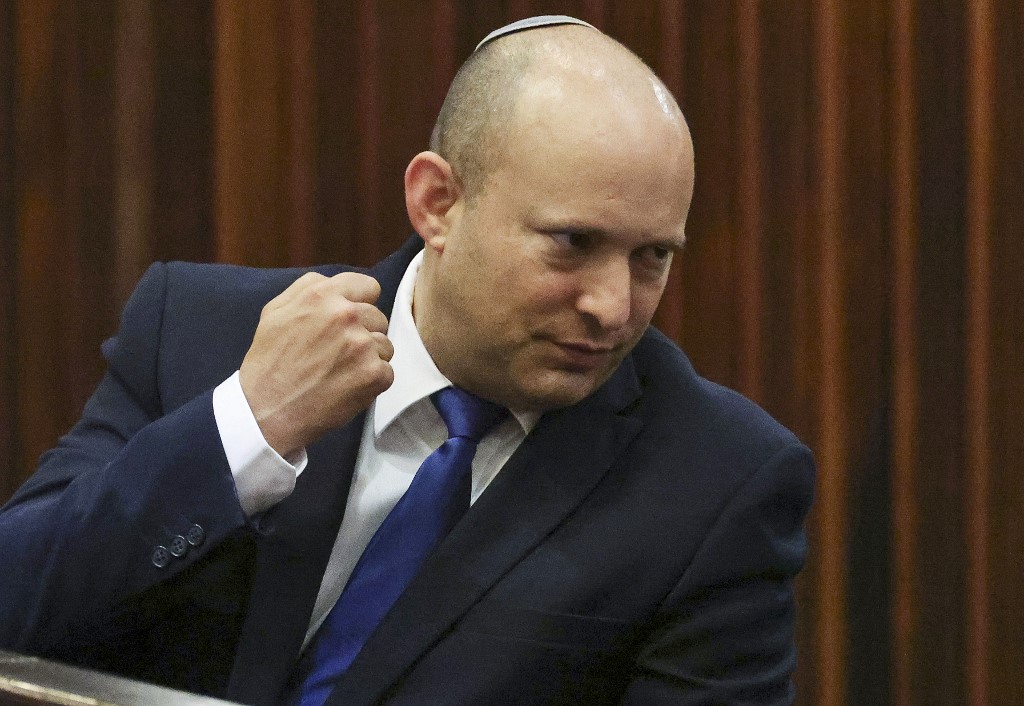
Bennett, set to serve first as prime minister, attends a special Knesset session on 2 June 2021 (AFP)
No one has forgotten that it was Bennett’s own settler camp that produced Yigal Amir, the man who in 1995 shot dead the then-prime minister, Yitzhak Rabin, in a bid to foil the Oslo peace accords with the Palestinians. Amir killed Rabin in large part because the latter was seen to have betrayed the Jewish people by allowing “Arabs” - Palestinian parties in parliament - to prop up his minority government from outside. They did so to pass legislation necessary to begin implementing the Oslo process.
The chain of events that followed the assassination are well-known. Israelis lurched further rightwards and elected Netanyahu. The Oslo track with Palestinian leader Yasser Arafat was derailed. A Palestinian intifada erupted. And - coming full circle - Netanyahu returned to power and is now Israel’s longest-serving prime minister.
Today’s potential Yigal Amirs are doubly offended by Bennett’s behaviour. They believe he has stabbed the right’s natural leader, Netanyahu, in the back, while at the same time allowing Abbas - seen by the right as Hamas’s man in the Knesset - to dictate policy to the Jewish owners of the land.
Digging in heels
It was notable that Bennett and Abbas were the last to sign the coalition agreement, after both made great play of digging in their heels at the final moment for more concessions. Each risks inflaming their own constituency by being seen to cooperate with the other.
Commentators will try to spin this agreement between a settler leader and the head of an Islamic party as a potential moment of healingafter last month’s unprecedented inter-communal fighting inside Israel.
Israel's incoming government is so unnatural only Netanyahu can keep it together
But such a reading is as misleading as the narrative of the recent “Jewish-Arab clashes”. In fact, protests by Palestinian youths against systematic discrimination escalated into confrontations only after Israeli police turned violent and let Jewish gangs take the law into their own hands. Just as the balance of power on the streets was weighted in favour of Jewish vigilantism, so the balance of forces in this new coalition will work solidly against Abbas.
When Bennett spoke publicly on Sunday, as the horse-trading began in earnest behind the scenes, he underscored his credentials as the former head of the Yesha Council of Jewish settlements. That will be the theme of this proposed “government of change”.
Pact with the 'devil'
During the coalition-building negotiations, the more moderate Labor and Meretz parties conceded time and again to the demands of the far-right and settler parties on ministerial positions and policy. That is because the moderates have nowhere else to go.
They have built their whole electoral strategy on ousting Netanyahu at any cost, using the anti-Netanyahu street protests of the past two years as their rallying cry. They cannot afford to be seen as missing this opportunity.
By contrast, as the death threats highlight, Bennett has far more to lose. Some 60 percent of his party’s voters recently told pollsters they would not have backed him had they known he would join a coalition with Lapid. Equally at risk are Gideon Saar, whose New Hope party broke away from Likud to challenge Netanyahu, and Avigdor Lieberman, a settler politician whose right-wing base has found in him their local strongman.
The Achilles heel Netanyahu will keep prodding as viciously as he can is the fact that his rivals on the right have made a Faustian pact with the Arab 'devil'
These three must now do everything in their power during the term of this new government - if it happens - to prove to their constituencies that they are not betraying the far-right’s favourite causes, from settlements to annexation. Baiting them from the sidelines at every turn will be Netanyahu, stirring up passions on the right - at least until he is forced to step down, either by his party or by a verdict against him in his current corruption trial.
The Achilles heel Netanyahu will keep prodding as viciously as he can is the fact that his rivals on the right have made a Faustian pact with the Arab “devil”. Netanyahu has never been shy to incite against the Palestinian minority. To imagine he will restrain himself this time is fanciful.
Bennett understands the danger, which is why he tried to legitimise his dealings with Abbas on Thursday by calling him "a brave leader". But Bennett was also keen to emphasise that Abbas would not be involved in any security matters and that he was not interested in "nationalism" – in this case, indicating that Abbas will neither offer support to Palestinians under occupation nor seek to advance national rights for Palestinian citizens of the kind Israeli Jews enjoy.
Early on Thursday, Netanyahu had decried the new coalition as “dangerous” and “left wing”. He will most likely be in the driving seat, even while in opposition. Far from healing the country, a “government of change” could rapidly provoke yet more street violence, especially if Netanyahu believes such a deterioration would weaken Bennett as prime minister.
Extracting benefits
Abbas, the United Arab List leader, reportedly held out until last before signing. His whole electoral strategy was built on a promise to end the permanent exclusion of Palestinian parties from Israel’s national politics. He will be keen to show how many benefits he can extract from his role inside government - even if most are privileges the Jewish majority have always enjoyed by right.
Abbas trumpeted that the agreement would “provide solutions for the burning issues in Arab society - planning, the housing crisis, and of course, fighting violence and organised crime”. He has reportedly secured some $16bn in extra budgets for development and infrastructure, and three of the many Bedouin villages the state has long refused to recognise will be given legal status.
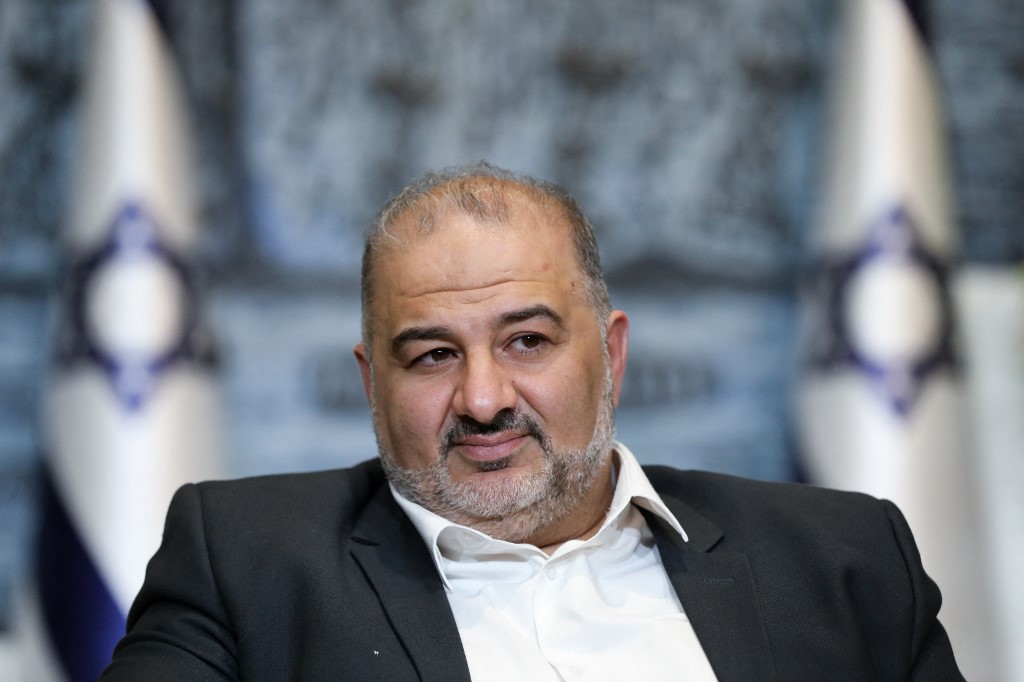
Abbas, the United Arab List leader, is pictured in Jerusalem on 5 April 2021 (AFP)
Abbas is also pushing for the repeal of a 2017 law that makes tens of thousands of homes in Palestinian communities inside Israel vulnerable to demolition.
One of his fellow legislators, Walid Taha, observed of the United Arab List’s new role: “For decades, Arab Israelis [Palestinian citizens] have been without any influence. Now, everyone knows that we’re the deciding votes as far as politics goes.”
Abbas has every incentive to use such claims as a whip to beat his rivals in the Joint List, a coalition of several other Palestinian parties that are staying in opposition. He needs to emphasise his role in bringing about change to make them look weak and irrelevant.
Hostility and disdain
But despite the promises that lured Abbas into the new government, he will face a rough ride getting any of them translated into tangible changes on the ground.
Lapid will be busy as foreign minister, selling this as a new era in Israeli politics. Meanwhile, Benny Gantz, the current defence minister who just oversaw the destruction yet again of Gaza, will offer continuity.
Back home, the key internal ministries will be held by the far-right. Lieberman will control the purse strings through the finance ministry, directing funds to settlements before Palestinian communities inside Israel. Bennett’s partner, Ayelet Shaked, will be interior minister, meaning the settlements in the occupied West Bank will be treated as more integral to Israel than the communities of Palestinian citizens. And Saar will be justice minister, helping to drive the legal system even further to the right.
Israel: Four reasons Benjamin Netanyahu's era is not over yet
Faced with this bloc, all of them keen to be seen as upholding the values of the right, Abbas will struggle to make any progress. And that is without considering the situation he will find himself in if Bennett pushes for annexation of the West Bank, or authorises another police invasion of al-Aqsa, or oversees the expulsion of Palestinian families from Sheikh Jarrah, or launches a fresh attack on Gaza.
Abbas put the coalition negotiations on pause during Israel's assault on Gaza last month. He won't be able to do the same from inside the government. He will be directly implicated.
As a result, Palestinian citizens are likely to end up growing even more disillusioned with a political system that has always treated them with a mix of hostility and disdain. They will finally have representatives inside government, but will continue to be very much outside of it. The triggers for the protests that erupted among young Palestinians in Israel last month are not going away.
The most likely scenario over the coming months is that Netanyahu and Bennett will engage in a furious competition for who deserves the title of champion of the right. Netanyahu will seek to break apart the coalition as quickly as possible by inciting against Abbas and the Palestinian minority, so he has another shot at power. In turn, Bennett will try to pressure Likud to abandon Netanyahu so that Bennett can collapse the “government of change” as quickly as possible and rejoin a large majority, far-right government with Likud.
Rifts will not be healed; coexistence will not be revived. But the preeminence of the ultra-nationalist right - with or without Netanyahu - will be restored.
Naftali Bennett: ‘I’ve Killed Lots Of Arabs In My Life And There’s No Problem With That’
As Middle East peace talks are set to resume after a five-year freeze, 972 Magazine reports a member of Israel’s cabinet has declared his backing for simply killing Palestinian prisoners, rather than bringing them to trial.
On Sunday, Israel announced it would release 104 Palestinian prisoners, a key caveat in the John Kerry-brokered plan to renew peace talks.
But according to the 972 report, Israel’s minister of Industry, Trade and Labor and Jewish Home Party leader Naftali Bennett could not have disagreed more, proposing during Sunday’s cabinet meeting a swifter, but illegal way to deal with prisoners.
A former IDF officer, the right-wing Bennett briefly joined protesters against the decision to release prisoners before attending Sunday’s cabinet meeting. According to The Jewish Press, prior to Sunday’s vote, Bennett said, “Terrorists should be killed, not released.”
Peace talks are slated to begin in Washington on Monday, though both sides remain skeptical about the commitment to resolving the decades-long stalemate.
Since the May 23 publication in the Wall Street Journal of an article titled “Intelligence on Sick Staff at Wuhan Lab Fuels Debate on Covid-19 Origin,” all the outlets of the US media establishment and political and intelligence apparatus have sought to rehabilitate the claim that the COVID-19 pandemic came from a lab in Wuhan, China, even they themselves decried it as false just six months ago.
There is no factual, let alone scientific, basis for the lab allegations. The best that the entire US intelligence community has been able to produce is a claim that several employees at the Wuhan Institute of Virology came down with an illness in November 2019 with symptoms that are “consistent with … common seasonal illnesses.”
The architect of the "yellow rain" conspiracy, Secretary of State Alexander Haig. Credit: Wikipedia
The lie also attempts to defy the mass of evidence presented by the World Health Organization in March, which declared that a man-made origin of the virus is “extremely unlikely.” In promoting these falsehoods, those who have crafted and are now participating in this propaganda campaign are committing an arguably greater fraud than the Bush administration’s baseless claims about Iraqi weapons of mass destruction nearly two decades ago.
This is not the first time that the American government has lied about a massive public health threat to demonize a geopolitical rival and to direct mass internal social anger outward. To understand how US imperialism works to create pretexts for war and attempt to deflect away from its own criminal activity, it is instructive to remember the case of “yellow rain” in the 1980s.
The “yellow rain” campaign began in 1981, when then Secretary of State Alexander Haig gave a speech to the Berlin Press Association on September 13, where he alleged that the Soviet Union was supplying mycotoxins to Vietnam, Laos and Cambodia for use against pro-US insurgencies and of employing the same toxins in Afghanistan. Haig claimed, “We have now found physical evidence from Southeast Asia which has been analyzed and found to contain abnormally high levels of three potent mycotoxins—poisonous substances not indigenous to the region and which are highly toxic to man and animals.”
Like today, sweeping statements were made with only minimal evidence and had vast implications. The Reagan administration was directly implying that, by developing a new dimension in chemical and biological warfare through the use of mycotoxins, that the Soviet Union was violating both the 1925 Geneva Protocol and the 1972 Biological and Toxin Weapons Convention. The former banned the use of chemical and biological weapons in war, after the deployment of various chemical gas agents in World War I, and the latter prohibits the development, production, stockpiling and transportation of biological and toxin-based weapons.
In other words, if such allegations were true, the Soviet Union would have been responsible for war crimes across Southeast Asia and the Middle East. Such actions could have been used as a casus belli justifying imperialist war against the USSR.
The origins of Haig’s claim date back to the end of the Vietnam War and US imperialism’s politically embarrassing retreat from the region. While US forces withdrew, the Central Intelligence Agency established a secret army of Hmong tribesmen in the mountains of Laos, led by a local chief, General Vang Po. While Po was eventually forced to flee to the United States, the army that he led on behalf of the CIA remained and fought against the Soviet-supported Lao and Vietnamese governments. Refugees from those conflicts described to various officials what seemed to be “yellow” chemical weapons dropped from low-flying aircraft.
The Carter and Reagan administrations seized on these reports to produce a hypothesis over the next several years that the Soviet Union had developed mycotoxins for use in warfare. A Special National Intelligence Estimate (reports ordered by the Director of National Intelligence) issued under Reagan claimed, “The one hypothesis that best fits all the evidence is that the trichothecene toxins were developed in the Soviet Union, provided to the Lao and Vietnamese either directly or through transfer of technical know-how, and weaponized with Soviet assistance in Laos, Vietnam, and Kampuchea.”
In fact, another hypothesis that fit the evidence even better had been developed. Starting four months after Haig’s initial public statements, scientists at the British Chemical and Biological Defence Establishment began performing their own independent examination of the “yellow rain” samples. They found that instead of toxin-based chemical weapons, these consisted mainly of pollen. When US officials began to claim that the pollen was being used by the USSR as part of the toxin’s delivery mechanism, Matthew S. Meselson, a professor of biochemistry at Harvard University, looked more closely at the origin of the pollen and realized that the most likely source was actually bees.
To investigate further, Meselson gathered botanists and pollen experts from Harvard, Yale and the Smithsonian Institute to analyze the pollen itself and the liquid in which it was contained. Using a scanning electron microscope, Meselson’s colleague Joan W. Nowicke found that the “yellow rain” on leaf samples had nearly identical properties, including shape, size, color, texture and pollen content, to droppings left by Southeast Asian honeybees.
The “honeybee droppings” finding was further confirmed when Meselson traveled to the region and discovered that local bees do in fact take part in collective “cleansing flights” that produce showers of yellow droplets—bee feces—that can last for several minutes over an acre or more. And because they fly high enough and fast enough, the bees are difficult to see, even more so when one is not actually watching and waiting for that event.
Meselson furthermore uncovered that the intelligence gathered by the US was highly suspect at best, and that the testimonies gathered from locals were highly inconsistent in the accounts of the “attacks” and the “symptoms” they came down with. Moreover, there was no evidence of the necessary high concentrations of toxins to cause the earlier reported symptoms, nor were any fragments of dispersal mechanisms found.
Just as the Biden administration dug its heels in when the WHO findings came out against the suggestion of an artificially made coronavirus, the Reagan administration doubled down when Meselson published his findings, releasing a statement reasserting, “Our conclusion that chemical weapons use has occurred in Southeast Asia is based on evidence collected several years prior to 1984.” Intelligence reports also acknowledged that while “evidence on the Soviet role does not constitute proof in the scientific sense, the Intelligence Community finds the case to be thoroughly convincing.” One could substitute “Soviet” for “China” and have the arguments being put forward today.
Significantly, the Reagan administration was at the time facing its own public health crisis among Vietnam veterans caused by the US military’s use of Agent Orange. The herbicide and forest defoliant had been in use since President John F. Kennedy authorized its use in Laos and Vietnam in 1962, when an estimated 20 million gallons were sprayed over rural villages in an attempt to starve the populations of those countries during “Operation Ranch Hand.”
The side effects on humans, however, were only brought into the American public’s eye after soldiers sprayed with the dangerous chemical came home and began to exhibit mental health problems, as well as numerous instances of their wives having miscarriages or children born with birth defects. Veterans began to file for disability claims related to Agent Orange in 1977, and were routinely denied because they could not “prove” the connection between the production of the weapon, its use in Vietnam and their current condition years later. Such callousness sparked immense outrage among the former soldiers, most of them drafted into the military.
Their unrest intersected with the broader developments in the class struggle, including a wave of strikes and protests by workers, under the impact of both rapid price inflation and a severe recession in industry provoked by the Federal Reserve, which pushed up interest rates to more than 20 percent. Haig gave his initial “yellow rain” speech only a month after Reagan’s mass firing of the PATCO air traffic controllers and only a week after the mass rally of nearly a million workers on Solidarity Day in Washington, the biggest ever demonstration by American workers. American capitalism was in crisis and seized on any opportunity to conceal or justify its immense crimes.
One major difference between the yellow rain and Wuhan lab propaganda campaigns, however, is the role of the US print and broadcast media. By the late 1980s, as “yellow rain” was further and further exposed to be an outright lie, the New York Times, for example, ran several articles with headlines such as “Still Caught in the Yellow Rain” and “Yellow Rain Falls,” noting that the entire affair was a “fiasco” and that, “Yellow rain is bee dung.”
Now, amid a pandemic that has killed more than 610,000 men, women and children in the US alone, for which the US government bears chief responsibility, the Times, Post and every other outlet are aligning themselves with an even more unbelievable lie. And it is one they themselves thoroughly debunked last year!
Vijf predikanten van de Protestantse Kerk in Nederland doen in een open brief een klemmend beroep op hun synode tot het aanbieden van een kerkelijk excuus aan het Palestijnse volk. Volgens Harmen Jansen, Jan den Hertog, Hans Baart, Bram Grandia en Willemien Keuning heeft de Protestantse Kerk 'meegewerkt aan het in stand houden van de zonde van bezetting en onderdrukking.’
In een toelichting op de brief schrijven de predikanten: 'Deze maand bestaat de staat Israël 73 jaar. Een eigen staat moest Joden vrijwaren voor het antisemitisme, dat in de Tweede Wereldoorlog in ons Europa zijn vernietigende gruwelijkheid heeft getoond. Helaas is er een keerzijde: 73 jaar Nakba, ‘de ramp’ die de oprichting van de staat Israël voor Palestijnen inhoudt. Levend in een apartheidsstaat of lijdend onder bezetting worden Palestijnen beroofd van hun menselijke waardigheid. Land wordt stelselmatig geannexeerd, bewegingsvrijheid ingeperkt, terreur van Joodse kolonisten wordt gedoogd, Gaza wordt afgeknepen.'
De vijf auteurs zijn predikant van de Protestantse Kerk in Nederland, en lid van een theologencollectief van Kairos-Sabeel Nederland. Hun oproep tot een kerkelijk excuus aan het Palestijnse volk kan door sympathisanten online worden mede-ondertekend.
Lees hier de oproep en de hele brief van de vijf predikanten van de Protestantse Kerk in Nederland.
Kijk terug Videogesprek Tweede Kamer over huisuitzettingen in Oost-Jerusalem
Afgelopen woensdag vond er een videogesprek plaats tussen de leden van de Tweede Kamercommissie voor Buitenlandse Zaken en inwoners van Sheikh Jarrah, Oost-Jeruzalem, over de geplande huisuitzettingen in de wijk. De vergadering vond plaats op verzoek van de Palestijnse Missie in Nederland. De Tweede Kamerleden gingen in gesprek met Zakaria Odeh, coördinator van de Civic Coalition for Palestinian Rights in Jeruzalem, met Mohammed El-Kurd, een schrijver en activist uit Sheikh Jarrah wiens familie dreigt uitgezet te worden ten gunste van kolonisten, en met Rawan Sulaiman, hoofd van de Palestijnse missie in Den Haag.
Tijdens het gesprek dienden de Palestijnse sprekers een aantal Kamerleden, met name Gert-Jan Segers (ChristenUnie) en Ruben Brekelmans (VVD), van stevige repliek op hun ondoordachte en eenzijdige vragen. Zij leverden daarmee een sterk betoog waarin ze vroegen om rechtvaardigheid voor de Palestijnen, een volk onder bezetting. Om die situatie van rechtvaardigheid te bereiken is politieke wil nodig. Zoals uit de vragen van genoemde Kamerleden maar ook uit een eerder gehouden debat in de Tweede Kamer blijkt ontbreekt die wil (en soms het lef) bij een aantal partijen in de Tweede Kamer. Waar de Nederlandse bevolking, blijkens de vele demonstraties die de afgelopen weken hebben plaatsgevonden en de vele reacties die wij de afgelopen weken hebben gekregen, in steeds grotere aantallen de kant van het internationaal recht en de rechtvaardigheid kiezen, moet een aantal partijen in de Tweede Kamer, na 73 jaar, nog steeds het licht zien.
PodcastDe Kaarten op Tafel - de IHRA-definitie
In De Kaarten op Tafel – Israël & Palestina in podcastformaat gaan Maarten en Wytze samen met een divers palet aan gasten op zoek naar nieuwe en grensverleggende manieren om het Israëlisch-Palestijns conflict te begrijpen. Maandelijks gaan zij in gesprek met sprekers die zich, ieder op hun eigen manier, engageren met Israël en Palestina. Stichting The Rights Forum stuurt Maarten en Wytze, twee onbevangen doch geëngageerde studenten op pad om een nieuw geluid te laten horen, de prangende vragen te stellen, en om voor de luisteraar de kaarten op tafel te leggen.
In de tweede aflevering van de podcast gaat Wytze in gesprek met Anja Meulenbelt (schrijfster, activiste, feministe, bestuurslid Bij1) en Jaap Hamburger (Een Ander Joods Geluid, bestuur The Rights Forum) over een van de meest controversiële documenten in de geschiedenis van pogingen om antisemitisme te bestrijden: de antisemitismedefinitie van de International Holocaust Remembrance Alliance - de IHRA-definitie. De IHRA-definitie speelt de afgelopen jaren een hoofdrol in het systematisch censureren van critici van de politiek van de staat Israël, met de beschuldiging van antisemitisme als wapen. In de aflevering staan Wytze en zijn gasten stil bij de grenzen tussen legitieme kritiek op Israël en antisemitisme, en bespreken zij hoe er vanuit de Israëlische regering en Israëlische lobbygroepen actief wordt gepoogd deze grenzen schimmiger te maken.
Beluister hier de tweede aflevering van De Kaarten op Tafel
Online conferentie Silwan & Sheikh Jarrah - Not a 'Real-Estate Dispute'
Op woensdag 9 juni organiseert Ir Amim, een Israëlische mensenrechtenorganisatie die zich met name richt op Jeruzalem, een online conferentie over de etnische zuivering van Palestijnen uit Oost-Jeruzalem. De conferentie is gratis te volgen en zal plaatsvinden in het Hebreeuws met simultaanvertaling in het Engels. De conferentie begint om 17.00 uur Nederlandse tijd.
De conferentie zal bestaan uit drie verschillende sessies met twee pauzes. Tijdens de eerste sessie zullen inwoners van Sheikh Jarrah vertellen over de huidige situatie. In het tweede blok wordt ingegaan op de rol van sociale media en mainstream media in recente gebeurtenissen. De conferentie sluit af met een gesprek over mogelijke oplossingen.
Via deze link kunt u zich inschrijven en meer te weten komen over het programma.
Kijk terug Online lezing PAX met Jack Munayer
Op donderdag 27 mei organiseerde PAX een webinar met PAX-partner Jack Munayer. Jack Munayer is geboren en getogen in Jeruzalem als zoon van een Britse moeder en een Palestijnse christelijke inwoner van Israël als vader. Hij voltooide onder andere een MA in Mensenrechten en Transitional Justice aan de Hebreeuwse Universiteit in Jeruzalem. Munayer beheert momenteel het oecumenische begeleidingsprogramma van de Wereldraad van Kerken in Palestina en Israël (WCC-EAPPI). Munayer is een echte bruggenbouwer en is onder andere actief op platforms als Christ at the Checkpoint en The Jerusalem-Belfast Initiative.
Opinie 'Mag je het bevolkingsbeleid van Israël wel ‘etnisch zuiveren’ noemen?'
Oud-ambassadeur, schrijver en lid van de Raad van Advies van The Rights Forum Nikolaos van Dam schreef voor Wynia's week een drieluik over ‘Schuivende Panelen in het Midden-Oosten’. Het tweede deel, getiteld Israël: met militaire suprematie kun je nog geen vrede opleggen, heeft diverse reacties ontketend, voornamelijk uit de hoek van de pro-Israël-lobby.
De meeste daarvan vormen een soort ‘framing’, intimidatie, zwartmakerij en laster, aldus Van Dam. 'Het gaat daarbij niet om inhoudelijke argumenten, want dan zouden critici zich op moeilijker terrein bevinden. Lastercampagnes en verdachtmakingen zijn vaak effectiever; zeker in de sociale media. Het doel is natuurlijk om iedere kritiek op Israël, hoe terecht ook, in de kiem te smoren.'
In zijn reactie op de kritiek, die nu ook op de website van The Rights Forum is gepubliceerd, gaat Van Dam onder andere in op de BDS-beweging, het werk van The Rights Forum en Oost-Jeruzalem. Het hele stuk is hier te lezen.