Zoeken in deze blog 🔎🔎

zaterdag 17 november 2018

Saudi Crown Prince Ordered Khashoggi’s Assassination


CIA Determines Saudi Crown Prince Ordered Jamal Khashoggi’s Assassination


The conclusion that Mohammed bin Salman ordered the journalist’s murder contradict the Saudi government’s version.


Khashoggi, a U.S. resident who was a contributor to The Washington Post, was last seen entering the Saudi consulate in Istanbul on Oct. 2. The Saudi writer is believed to have been killed soon after entering the building. It is believed his body was dismembered and disposed of. 
The CIA reportedly examined multiple sources of intelligence, including a phone call to Khashoggi from the prince’s brother Khalid bin Salman, the Saudi ambassador to the United States.
Sources said Khalid told Khashoggi that he should go to the Saudi consulate in Istanbul to retrieve some documents, while assuring him that he would be safe.
Although it’s not clear if Khalid knew that Khashoggi would be killed, he did make the call at his brother’s direction, and it was intercepted by U.S. intelligence.
Khalid bin Salman denied the allegation via Twitter soon after the Post published its article. 

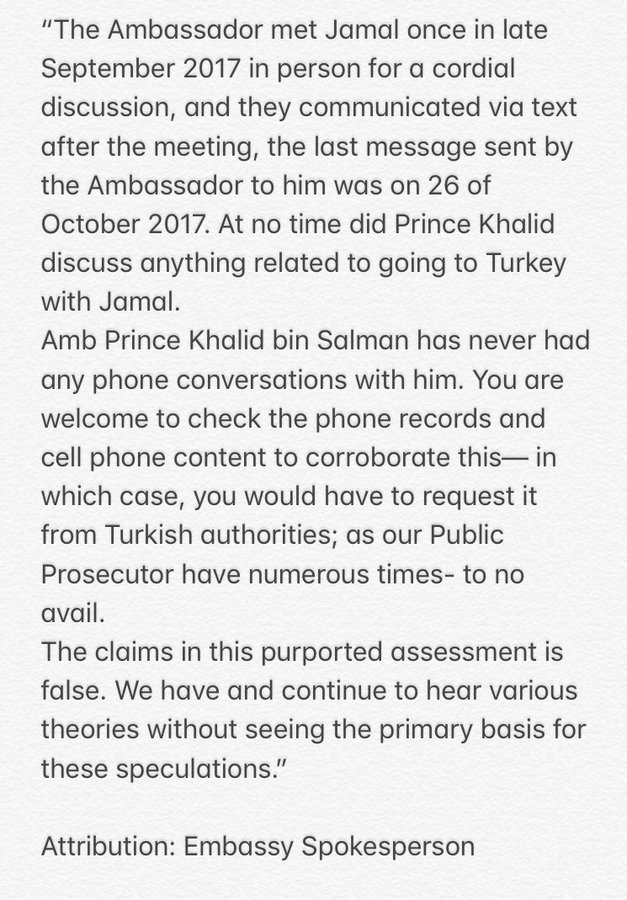
As we told the Washington Post the last contact I had with Mr. Khashoggi was via text on Oct 26 2017. I never talked to him by phone and certainly never suggested he go to Turkey for any reason. I ask the US government to release any information regarding this claim.

6,951 people are talking about this
He elaborated a short time later.


Unfortunately the @washingtonpost did not print our full response. This is a serious accusation and should not be left to anonymous sources. Our full response was the following:

5,946 people are talking about this
A CIA official told The Wall Street Journal on Friday that the agency came to its conclusion the Crown Prince ordered the killing not on “smoking gun” evidence but rather on “an understanding of how Saudi Arabia works.”
“This would not and could not have happened” without Mohammed bin Salman’s involvement, the official said.
On Thursday, Saudi Arabia’s public prosecutor announced it would seek the death penalty for five of 11 suspects, even though Turkish leader Recep Tayyip ErdoÄŸan said the killing was ordered at the “highest levels” of the Saudi government.
Khashoggi was once close to the Saudi royal family, but had grown increasingly critical of human rights abuses in the kingdom and was living in Washington, D.C. Although the kingdom considered him a “dissident,” he never wanted the label, according to a tweet posted last month by fellow Washington Post writer Karen Attiah. 

One thing I keep wanting to stress: Jamal Khashoggi (@Jkhashoggi) would often tell me he never wanted to be labeled a ‘dissident’ or an opposition figure living in exile. He really just wanted to write freely and to be a journalist.

247 people are talking about this


Halsema en Mogadishu

Somalië-vergelijking Halsema is doodsteek voor het debat

TON F. VAN DIJK 16 NOV 2018 MENING
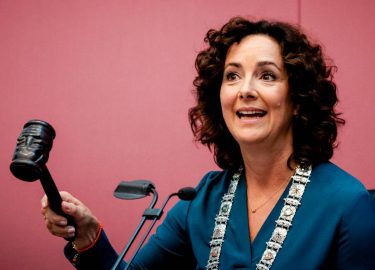
De Amsterdamse burgemeester Femke Halsema (GroenLinks) is boos op de gemeentelijke ombudsman Arre Zuurmond. De klachtenfunctionaris heeft gezegd dat de binnenstad van Amsterdam is verworden tot een ‘wetteloze jungle’. Ook heeft de ombudsman laten weten dat er in de hoofdstad sprake is van een ‘handhavingscrisis’. De uitspraken van Zuurmond waren voor burgemeester Halsema reden om in de telefoon te klimmen en de ombudsman een uitbrander te geven. “Ik heb hem gebeld en gezegd dat hij misschien eens in Somalië moet gaan kijken,” aldus Halsema.
Vraag is nu welke uitspraak meer verbazing oproept. Die van de ombudsman, of die van de burgemeester? Iedere inwoner van Amsterdam weet namelijk wat de ombudsman bedoelt als hij het heeft over de sfeer van wetteloosheid en het gebrek aan handhaving in onze onvolprezen hoofdstad.
Dat geldt in ieder geval voor de Amsterdammers die wanhopig proberen een fiets in eigendom te hebben én te houden. Het is algemeen bekend dat het langdurig kunnen beschikken over je eigen fiets in Amsterdam bijna onmogelijk is. Ieder jaar verwisselen er vele tienduizenden fietsen ongevraagd van eigenaar. Als je een witte fietsenplan zou willen bedenken kan het bijna niet efficiënter. Maar veel burgers ervaren deze situatie toch als behoorlijk ‘wetteloos’ om in de woorden van de ombudsman te blijven.Een derde van de gedupeerde fietseigenaren doet aangifte, zo luidt de schatting. Dat aantal daalde de afgelopen jaren licht. Niet omdat er minder fietsen gestolen worden, maar omdat er met de aangiftes niets gebeurt. De politie heeft geen tijd om gestolen fietsen op te sporen. Dit mag je met recht een handhavingscrisis noemen, want het gaat wel om een strafbaar gesteld misdrijf.
Het is maar één voorbeeld (probeer eens in het weekend uit te gaan op het Rembrandtplein) van de ogenschijnlijk genormaliseerde wetteloosheid in Amsterdam. Er wordt in de hoofdstad op grote schaal de hand gelicht met het alledaagse strafrecht en er is te weinig capaciteit voor handhaving van regels, die formeel gelden, maar in de praktijk niets meer voorstellen.
Maar uitgerekend burgermoeder en korpsbeheerder Halsema vindt dus dat Arre Zuurmond overdrijft wanneer hij dit signaleert. Halsema zette haar argumenten in een telefoontje met de ombudsman zelfs kracht bij door op hoge toon te verwijzen naar de problemen die men in Somalië zoal ondervindt met de handhaving.
Op de website van Buitenlandse Zaken lezen we waar Halsema aan refereert wanneer zij met betrekking tot haar beoordeling van de situatie in Amsterdam verwijst naar dit Afrikaanse land:
“Er is zware criminaliteit in Somalië. In het land is een levendige handel in wapens, goederen en mensen. Dit komt vooral omdat er vanuit de regering geen toezicht is. Daarnaast is het rechtssysteem van Somalië voor een deel afwezig of functioneert het niet. Hierdoor is onduidelijk welk rechtssysteem van toepassing is en dat kan leiden tot rechtsonzekerheid.”
Dat mag je met recht wetteloosheid noemen om over gebrek aan handhaving maar te zwijgen. Somalië is een extreem land, waar je als burger geen enkel recht hebt en bent overgeleverd aan de willekeur van een veelal zelfbenoemde overheid.
Het land is in die zin inderdaad nog nét iets gevaarlijker dan de ‘Somalië-doctrine’ van Burgemeester Halsema zelf. Want sinds wanneer vormt het rechtssysteem in de hoofdstad Mogadishu een referentiekader voor hoe wij in de hoofdstad van Nederland met elkaar willen omgaan?
Burgemeester Halsema kapittelde onlangs openlijk een aantal raadsleden uit de oppositie in relatie tot hun ruwe omgangsvormen in het debat. De volgende keer kunnen zij probleemloos een beroep doen op het door de burgemeester zelf geïntroduceerde Somalië-beginsel en stellen dat het dáár allemaal nog veel erger is gesteld met de politieke mores. Benieuwd wat Halsema dan te zeggen heeft.
Lees ook:
https://www.hpdetijd.nl/2018-11-16/halsemas-somalie/

The Donbass Dilemma

The Donbass Dilemma

18036427_403
The November 11th elections of the leaders of the Donetsk and Lugansk Peoples Republics along with the members of their People’s Councils has again underlined the dilemma facing Ukraine, its NATO masters, and Russia for, as Tass reported, the result makes it very clear that there is a high level of support among the peoples of the Donbass for integration with Russia.
It is a dilemma for the NATO puppet regime in Kiev since the political solidity of the Republics remains even in the face of the assassinations of Donbass leaders that have taken place since 2014 including that of Donetsk leader Alexander Zakharchenko in August of this year and in the face of the constant state of siege under which the peoples of the republics live as they resist the attempts to break them. The regime in Kiev is once again forced to recognise that it rules a divided country that is a direct result of the NATO backed putsch that put them in power and the attempts to suppress the Russian language, culture and influence in Ukraine that immediately followed that putsch.
The Russian government on Tuesday the 13th stated as much, ever hopeful, at the OSCE in Vienna,
Russia believes that Sunday’s elections …represent a major step towards dialogue between Donbass and Kiev on the implementation of the Minsk Agreements.
That belief can only be based on the fact that the elections confirm the political integrity and will of the peoples of the Donbass republics and confirm the failure of the Kiev state of siege to break them. This should, hope the Russians, force NATO and Kiev back to the Minsk agreements and a compromise political solution. But there is little chance of that when the immediate response of the US government was to condemn the elections.
Their State Department spokesperson said on the 12th,
The United States joins our European Allies and partners in condemning the November 11th, sham elections in Russia controlled eastern Ukraine. Yesterday’s illegitimate processes were an attempt by Moscow to institutionalise its Donbass proxies, the so-called …Republics. These entities have no place within the Minsk agreements or within Ukraine’s constitutional government, and they should be dismantled along with their armed formations.
It is in fact a declaration of war, founded on lies. One of them is that Russia has already annexed the territories of the republics when it has not, the other that the peoples governments are just Russian stage sets when they have proven that they are truly representative of the peoples of the Donbass and often have conflicting views with Russia on how to move forward. The third lie is that the Republics have no place in the agreements when in fact the agreements were all about the special status of the republics, or “regions” and the nature of their “interim self-government.”
The Americans finished by stating they regard the elections as a violation of Ukraine’s sovereignty and territorial integrity and that they will continue their illegal economic warfare against Russia, under the quasi-legal guise of “sanctions,” adding in for good measure, until Russia surrenders “its control of Crimea to Ukraine”.
The fact that this is the same United States that, as it spoke, was in illegal occupation of Afghanistan, and Syria, had bombed and occupied Yugoslavia, Iraq and Libya, set up the illegal status of the Serbian province of Kosovo as its puppet state under a confessed war criminal, Hashim Thaci, constantly violates the territorial integrity of China and threatens the DPRK and Iran with imminent attack. This is the same government that was involved in the overthrow of the legitimate government of Ukraine in 2014, revealing the other lie in the American statement because Ukraine does not have a legitimate, constitutional government representative of the people but one riddled with Nazis and ultra reactionary forces willing to sell their country to the Americans and Germans. The evidence of members of the present Kiev regime being involved, along with foreign snipers, including US Army snipers, in the killings in the Maidan in Kiev in 2014 is strong evidence that the shootings, chaos and final putsch were an organised NATO operation to install a puppet regime.
It is a dilemma for NATO because with the putsch they had hoped to secure control of the big naval base at Sevastopol and place their battle formations directly on Russia’s border. Russia’s quick action of acceding to the request of the Crimean people to have a referendum on Crimea’s integration with Russia saved both the Russians living there from the nightmare of rule by the Nazi infected regime of Poroshenko and saved their strategic base from falling into NATO’s hands. Instead of the quick victory they had hoped for NATO are faced with a determined opposition from two buffer states that are closely allied to and supported by Russia while stuck with a corrupt and incompetent cabal in Kiev that cannot deliver what they want, complete control of Ukraine.
For Russia the dilemma is whether to absorb the republics into Russia or maintain the very messy status quo of stalemate and siege and the danger of being dragged into a larger war in Ukraine. Integration would have a number of advantages, including bringing under Russian control the mining and industrial strength of those republics, the loyalty of their people, their military experience and resources, and a resolution of the stalemate. On the other the Russian leadership fears that integration will be deemed by the NATO gang as an “invasion and annexation” of Ukraine and would be used as a pretext for a wider war against Russia. A wider war can lead to a nuclear war something that Russia, unlike the United States, wants to avoid. But as we see they are already accused of annexing those territories, and that propaganda narrative is not going to change.
And so, the stalemate remains. The dilemma remains. The peoples of the Donbass have expressed their wish. They have shown their courage and their determination, their resilience. They cannot be ignored. But neither can the real concerns of the Russian government. The Minsk Accords of 2015 provide a workable framework for a political resolution that requires compromises to be made. The Donbass republics and Russia have tried to adhere to the agreements consistently while Kiev and NATO violate them at every turn and maintain a state of siege against civilian populations and cities, with daily bombardments, small but deadly engagements, always the threat of larger ones, assassinations, committing war crimes on a daily basis, all supported by the NATO democracies who, as they spent November commemorating the war dead of the past, at the same time celebrated the large scale military exercises they are holding in Norway; practise for an attack on Russia.
The United States, unpleasant as it is to tell you, seizes every opportunity for bloodshed, like a raven flying to the stink of carrion. One day its unbounded greed will deliver the fate it deserves, but its leadership is not interested in political solutions that involve compromise. They want everything. In the case of Ukraine it is clear with the assassination of Zakharchenko that their intention is to resolve the problem with war. Their reaction to the elections confirms it.
Everything the American government does points to war. Not that the world is not already at war. When has it not been, and when has he United States and it allies not been behind them? But the very quick build up of economic warfare on Iran, China, Russia, the DPRK, the rejection of nuclear arms treaties under pretexts, the continuous series of military exercises surrounding Russia, Iran, China, the occupation of Afghanistan, the reactivation of the US 2nd Fleet, the ever hysterical anti Russian, and now beginning to build, anti-Chinese propaganda, are signs they have a military solution in mind in order to solve their problems.
For Russia and the Republics the way out of the dilemma is good will, negotiations and a peaceful resolution. For the US and its allies the way out is more hostility, diktats and violence. Is there an answer?
Clausewitz gives us a clue when he says,
“Since war is not an act of senseless passion but is controlled by its political object, the value of the object must determine the sacrifices to be made for it in magnitude and also in duration. Once the expenditure of effort exceeds the value of the political object, the object must be renounced and peace must follow.”
Russia is saying simply, “your war, your siege, your assassinations, your “sanctions” have failed. The elections are a statement of strength and determination to resist. You cannot subdue them. You must abandon the effort and restore the peace. To continue is illogical, an act of stupidity, a danger to the world. The risks are not worth the object.”
Unfortunately, we all know the NATO leadership is locked into their self created fantasies and delusions and so cannot perceive reality or comprehend it when they do, any more than the captain and officers of the NATO Norwegian frigate that, despite all its high tech gear, were unable to see what was right in front of them and collided with a slow moving oil tanker and then sank after returning from the NATO exercise in the area; because they believed in their own infallibility. But this is how all wars start, with delusions, with insanity.

Christopher Black is an international criminal lawyer based in Toronto. He is known for a number of high-profile war crimes cases and recently published his novel “Beneath the Clouds. He writes essays on international law, politics and world events, especially for the online magazine “New Eastern Outlook.”
https://journal-neo.org/2018/11/16/the-donbass-dilemma/?fbclid=IwAR1B0Nj6z9dkXlqy47I7AT4J1nQIV3TleMKRI2m6uZawBOqXcGxrfFVgioM

vrijdag 16 november 2018

Democracy? Which Democracy?

FRIDAY, NOVEMBER 16, 2018

'Stop talking so much about democracy'


To understand the importance of such subordinate elites, look back to the Cold War's early days when a desperate White House was searching for something, anything that could halt the seemingly unstoppable spread of what Washington saw an anti-American and pro-communist sentiment.

In December 1954, the NSC [National Security Council] met in the White House to stake out a strategy that could tame the powerful nationalist forces of change then sweeping the globe. Across Asia and Africa, a half-dozen European empires that had guaranteed global order for more than a century were giving way to new nations, many--as Washington saw it--susceptible to "communist subversion." In Latin America, there were stirrings of leftist opposition to the region's growing urban poverty and rural landlessness.

To make it "absolutely clear we will not tolerate Communism anywhere in the Western Hemisphere," influential Secretary of the Treasury George Humphrey advised his NSC colleagues that they should "stop talking so much about democracy" and instead "support dictatorships of the right if their policies are pro-American." At that moment, Dwight Eisenhower interrupted to observe, with a flash of strategic insight, that Humphrey was, in effect, saying: "They're OK if they're 'our' s.o.b.'s." The secretary agreed, adding: "Whatever we may choose to say in public about ideas and idealism, among ourselves we've got to be a great deal more practical and materialistic."

It was a moment to remember. The president had just articulated, with crystalline clarity, the system of global dominion that Washington would implement for the next fifty years--setting aside democratic principles for a tough realpolitik policy of backing any reliable leader who backed us, building a worldwide network of national (and often nationalist) leaders who would nonetheless put Washington's needs above local ones. To consolidate its dominion, Washington would build a worldwide system of subordinate elites that became nothing less than an Archimedean lever to shift the globe in its direction.

~ Alfred McCoy, In the Shadows of the American Century: The Rise and Decline of U.S. Global Power


Israel and Anti-Semitism


Consciousness and Vibration

Could consciousness all come down to the way things vibrate?


Why is my awareness here, while yours is over there? Why is the universe split in two for each of us, into a subject and an infinity of objects? How is each of us our own center of experience, receiving information about the rest of the world out there? Why are some things conscious and others apparently not? Is a rat conscious? A gnat? A bacterium? 
These questions are all aspects of the ancient “mind-body problem,” which asks, essentially: What is the relationship between mind and matter? It’s resisted a generally satisfying conclusion for thousands of years. 
The mind-body problem enjoyed a major rebranding over the last two decades. Now it’s generally known as the “hard problem” of consciousness, after philosopher David Chalmerscoined this term in a now classic paper and further explored it in his 1996 book, “The Conscious Mind: In Search of a Fundamental Theory.”
Chalmers thought the mind-body problem should be called “hard” in comparison to what, with tongue in cheek, he called the “easy” problems of neuroscience: How do neurons and the brain work at the physical level? Of course they’re not actually easy at all. But his point was that they’re relatively easy compared to the truly difficult problem of explaining how consciousness relates to matter.
Over the last decade, my colleague, University of California, Santa Barbara psychology professor Jonathan Schooler and I have developed what we call a “resonance theory of consciousness.” We suggest that resonance – another word for synchronized vibrations – is at the heart of not only human consciousness but also animal consciousness and of physical reality more generally. It sounds like something the hippies might have dreamed up – it’s all vibrations, man! – but stick with me.


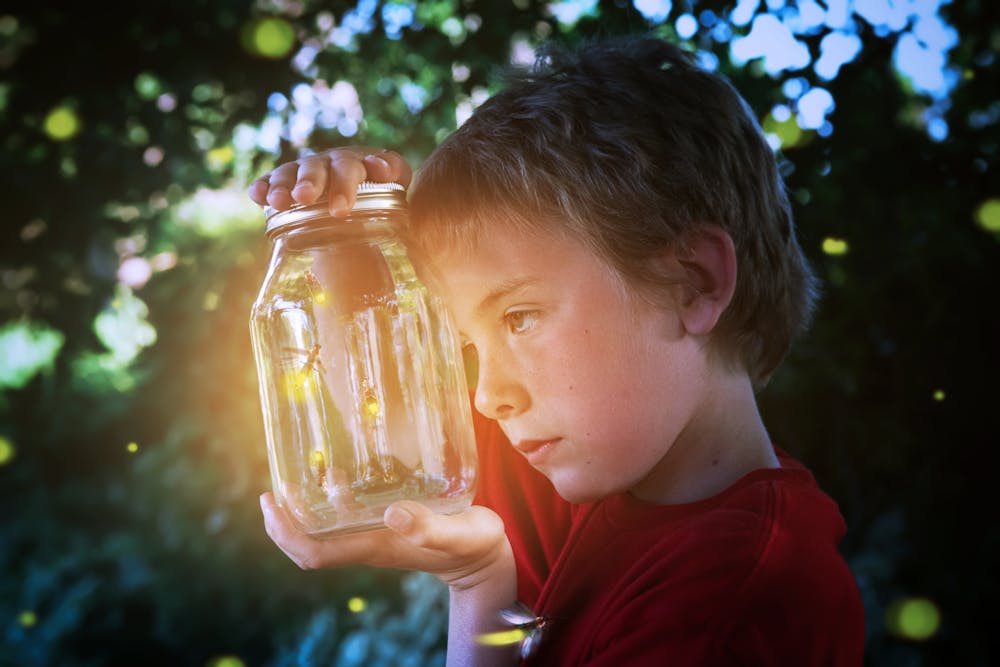
How do things in nature – like flashing fireflies – spontaneously synchronize? Suzanne Tucker/Shutterstock.com

All about the vibrations

All things in our universe are constantly in motion, vibrating. Even objects that appear to be stationary are in fact vibrating, oscillating, resonating, at various frequencies. Resonance is a type of motion, characterized by oscillation between two states. And ultimately all matter is just vibrations of various underlying fields. As such, at every scale, all of nature vibrates. 
Something interesting happens when different vibrating things come together: They will often start, after a little while, to vibrate together at the same frequency. They “sync up,” sometimes in ways that can seem mysterious. This is described as the phenomenon of spontaneous self-organization
Mathematician Steven Strogatz provides various examples from physics, biology, chemistry and neuroscience to illustrate “sync” – his term for resonance – in his 2003 book “Sync: How Order Emerges from Chaos in the Universe, Nature, and Daily Life,” including:
  • When fireflies of certain species come together in large gatherings, they start flashing in sync, in ways that can still seem a little mystifying.
  • Lasers are produced when photons of the same power and frequency sync up.
  • The moon’s rotation is exactly synced with its orbit around the Earth such that we always see the same face.
Examining resonance leads to potentially deep insights about the nature of consciousness and about the universe more generally.


External electrodes can record a brain’s activity. vasara/Shutterstock.com

Sync inside your skull

Neuroscientists have identified sync in their research, too. Large-scale neuron firing occurs in human brains at measurable frequencies, with mammalian consciousness thought to be commonly associated with various kinds of neuronal sync.
For example, German neurophysiologist Pascal Fries has explored the ways in which various electrical patterns sync in the brain to produce different types of human consciousness. 
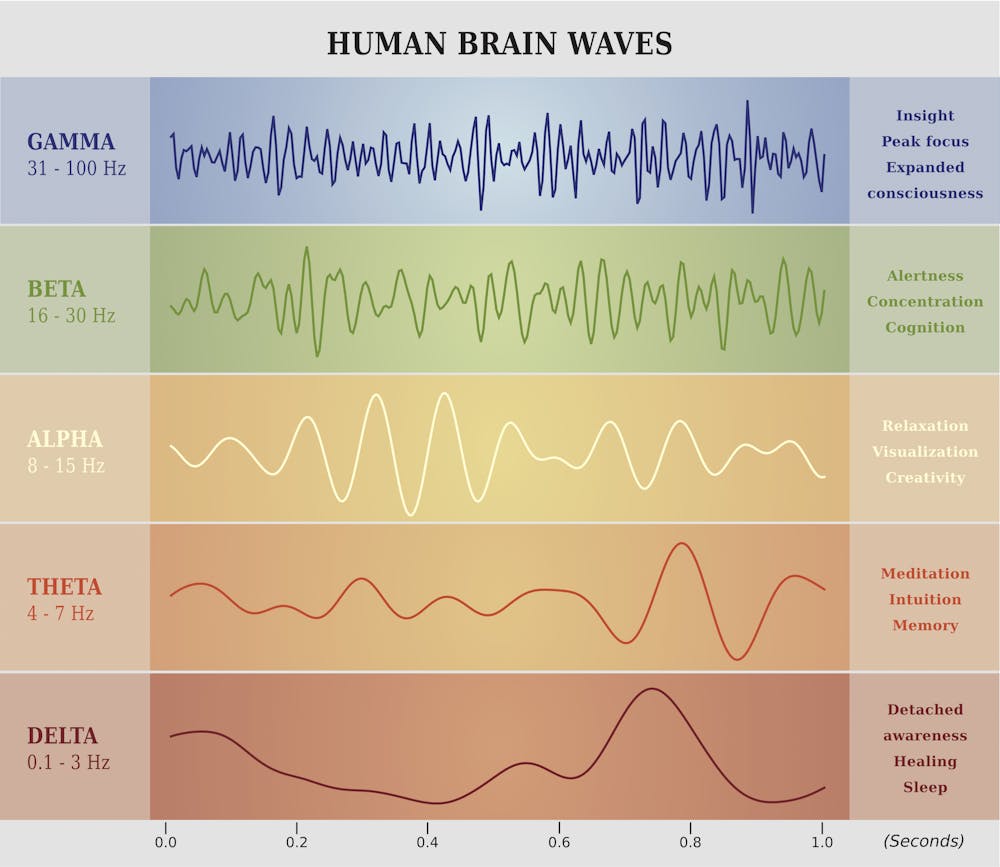
Fries focuses on gamma, beta and theta waves. These labels refer to the speed of electrical oscillations in the brain, measured by electrodes placed on the outside of the skull. Groups of neurons produce these oscillations as they use electrochemical impulses to communicate with each other. It’s the speed and voltage of these signals that, when averaged, produce EEG waves that can be measured at signature cycles per second.


Each type of synchronized activity is associated with certain types of brain function. artellia/Shutterstock.com

Gamma waves are associated with large-scale coordinated activities like perception, meditation or focused consciousness; beta with maximum brain activity or arousal; and theta with relaxation or daydreaming. These three wave types work together to produce, or at least facilitate, various types of human consciousness, according to Fries. But the exact relationship between electrical brain waves and consciousness is still very much up for debate.
Fries calls his concept “communication through coherence.” For him, it’s all about neuronal synchronization. Synchronization, in terms of shared electrical oscillation rates, allows for smooth communication between neurons and groups of neurons. Without this kind of synchronized coherence, inputs arrive at random phases of the neuron excitability cycle and are ineffective, or at least much less effective, in communication. 

A resonance theory of consciousness

Our resonance theory builds upon the work of Fries and many others, with a broader approach that can help to explain not only human and mammalian consciousness, but also consciousness more broadly.
Based on the observed behavior of the entities that surround us, from electrons to atoms to molecules, to bacteria to mice, bats, rats, and on, we suggest that all things may be viewed as at least a little conscious. This sounds strange at first blush, but “panpsychism” – the view that all matter has some associated consciousness – is an increasingly accepted position with respect to the nature of consciousness. 
The panpsychist argues that consciousness did not emerge at some point during evolution. Rather, it’s always associated with matter and vice versa – they’re two sides of the same coin. But the large majority of the mind associated with the various types of matter in our universe is extremely rudimentary. An electron or an atom, for example, enjoys just a tiny amount of consciousness. But as matter becomes more interconnected and rich, so does the mind, and vice versa, according to this way of thinking.
Biological organisms can quickly exchange information through various biophysical pathways, both electrical and electrochemical. Non-biological structures can only exchange information internally using heat/thermal pathways – much slower and far less rich in information in comparison. Living things leverage their speedier information flows into larger-scale consciousness than what would occur in similar-size things like boulders or piles of sand, for example. There’s much greater internal connection and thus far more “going on” in biological structures than in a boulder or a pile of sand.
Under our approach, boulders and piles of sand are “mere aggregates,” just collections of highly rudimentary conscious entities at the atomic or molecular level only. That’s in contrast to what happens in biological life forms where the combinations of these micro-conscious entities together create a higher level macro-conscious entity. For us, this combination process is the hallmark of biological life. 
The central thesis of our approach is this: the particular linkages that allow for large-scale consciousness – like those humans and other mammals enjoy – result from a shared resonance among many smaller constituents. The speed of the resonant waves that are present is the limiting factor that determines the size of each conscious entity in each moment
As a particular shared resonance expands to more and more constituents, the new conscious entity that results from this resonance and combination grows larger and more complex. So the shared resonance in a human brain that achieves gamma synchrony, for example, includes a far larger number of neurons and neuronal connections than is the case for beta or theta rhythms alone.
What about larger inter-organism resonance like the cloud of fireflies with their little lights flashing in sync? Researchers think their bioluminescent resonance arises due to internal biological oscillators that automatically result in each firefly syncing up with its neighbors.
Is this group of fireflies enjoying a higher level of group consciousness? Probably not, since we can explain the phenomenon without recourse to any intelligence or consciousness. But in biological structures with the right kind of information pathways and processing power, these tendencies toward self-organization can and often do produce larger-scale conscious entities. 
Our resonance theory of consciousness attempts to provide a unified framework that includes neuroscience, as well as more fundamental questions of neurobiology and biophysics, and also the philosophy of mind. It gets to the heart of the differences that matter when it comes to consciousness and the evolution of physical systems. 
It is all about vibrations, but it’s also about the type of vibrations and, most importantly, about shared vibrations.

Truthout Sunday 20/11/2026

  SUNDAY, SEPTEMBER 20, 2026 Walking September 11’s Other Crime Scenes Millions had fled along the highway I had taken. Behind them Iraq was...