Zoeken in deze blog 🔎🔎

zaterdag 20 februari 2016

Mike Whitney on Syria and Turkey


Could a Bomb Blast in Ankara Change the Outcome of the War in Syria?

Turkish President Recep Tayyip Erdogan seems to think so. In fact, Erdogan is acting like Wednesday’s explosion in the capital was a gift from God. You see, Erdogan and his fellow Islamists think that if they pin the blame for the bombing on luckless patsy,  Salih Neccar, who has links to the Kurdish YPG, then they’ll be able to convince Washington that the YPG is a terrorist organization. And if they can convince Washington that the YPG a terrorist organization,  then Obama will have to break off relations with the YPG even though the Kurdish militia has been helping the US defeat ISIS in Syria.  And if  Obama breaks off relations with the YPG, then he’ll have to depend more on good old Turkey for his footsoldiers which is just hunky-dory with Erdogan  provided that Washington meet his numerous demands, that is.
So, could a bomb blast in Ankara change the outcome of the 5 year-long war in Syria?
It certainly could, if Obama is stupid enough to fall into Erdogan’s trap. But so far that looks unlikely.
The problem with Erdogan’s rationale is that the Obama administration is not convinced that the YPG is a terrorist organization. Nor are they certain that Neccar is guilty.  More important, the US maintains a crucial alliance with  the YPG in Syria which has helped them recapture strategic cities and territory from ISIS in the northern part of the country. The militia has provided the boots on the ground the US needs to prosecute its war in Syria.  Naturally, they are not going to end a relationship like that without solid evidence that the charges are true.
And there are plenty of reasons to believe the charges aren’t true. For example, the head of the Syrian PYD, Salih Muslim, has not only denied all responsibility for the Ankara bombing, but also stated that neither he nor any of his lieutenants have any idea who the perpetrator is.  (The PYD is the political wing of the YPG)
“We have never heard of this person Salih Necar,” said Muslim, after which he added, “These accusations are clearly related to Turkish attempts to intervene in Syria.”
Of course, Muslim could be lying, but you have to ask yourself whether or not the bombing achieves its political objectives if the perpetrators deny responsibility?  And the answer is “No, it doesn’t.” So why lie?
Here’s more from the New York Times:
“…some analysts questioned the plausibility of (Erdogan’s) accusation, since mounting such an attack would jeopardize the group’s American support.
“These allegations are unfounded — lies with no truth to them,” Redur Xelil, a spokesman for the group said via WhatsApp from Qamishli, Syria.
“We are not enemies of Turkey, and our goal is to fight Daesh inside the Syrian borders,” he added, using an Arabic acronym for the Islamic State. “We have no interest in being enemies with Turkey.”…
“Sponsoring or being involved with car bombings in Turkish cities would break its alliance structure with the U.S. and Russia,” said Michael Stephens, research fellow at the Royal United Services Institute for Defense and Security. “Neither of which the P.Y.D.-Y.P.G. wants. In short, the Y.P.G. have nothing to gain and everything to lose by being involved in this.” (“Turkey Blames Kurdish Militia for Ankara Attack, Challenging U.S.”, New York Times)
So who is responsible for Wednesday’s terrorist attack?
While no one knows for sure, many people think the Turkish government itself might have been involved which isn’t too far fetched when you consider that this same administration was implicated in a similar incident in 2014 when the foreign minister (who is currently the Prime Minister) was caught on tape cooking up a false flag operation with the head of Turkish Intel to create a pretext for invading Syria. Sound familiar? (See here for more.)
The fact that the Erdogan administration has been involved in this type of skullduggery before suggests that they might have gone to the well one time too often.. In any event, given what we know of their past,  the members of the Turkish government should, at the very least, feature very prominently on any list of probable suspects.  Add to that the fact that there’s now tons of evidence showing that the government has been arming, training and  funding terrorists in Syria, and the only conclusion a reasonable person can draw is that Turkey is governed by a thoroughly untrustworthy lot of  fanatical miscreants whose spurious accusations should be taken with a very large grain of salt..   Here’s more from yesterday’s Hurriyet:
“Although the PKK and the PYD are denying it, the information from the Interior Ministry and intelligence show that they are behind [the attack],” said ErdoÄŸan, referring to the Kurdistan Workers’ Party (PKK) and the Democratic Union Party (PYD)…….
“This process will convince our friends in the international community to understand how tight the PYD and YPG’s connection to the PKK is,” ErdoÄŸan said, repeating that Turkey had insisted on the link, submitting documents.”
See? This is all about convincing Washington that they’ve backed the wrong horse. Erdogan wants to muscle-out the Kurds, so he can take their place as place. That way, he can achieve his dream of annexing a 10-by-70 mile-wide strip of Syrian territory just south of the Turkish border that he wants to convert into a “safe zone” to provide a sanctuary for Sunni militants. The plan will prevent the Kurds from creating a contiguous state on the Syrian side of the border and, also, it will help keep open vital supply lines for jihadist allies conducting military operations in other parts of the Syria.
The Obama administration was sympathetic to this plan at one time, but Russia’s entry into the war in late September changed everything. Now the Syrian Arab Army (SAA), Iranian Quds Forces and Hezbollah are closing in on the Turkish border which has dashed any chance Turkey might have had to seize and hold Syrian territory without a direct confrontation with Russia, which Washington definitely does not want.  Bottom line: Washington has adjusted its strategy to the new reality on the ground while Turkey and the Saudis are still grasping at straws thinking the war can be won.
Sealing the border is a top priority for Moscow which pins its hopes for ending the war largely on its ability to stop the flow of Sunni fighters crossing over from Turkey.  According to Russian Foreign Minister Sergey Lavrov:  “The key point for the ceasefire to work is a task of blocking illegal trafficking across the Turkish-Syrian border, which supports the militants.  Without closing the border it is difficult to expect the ceasefire to take place.” (The ceasefire is scheduled to begin on Friday)
So Russia is going to persist in its plan to close the border regardless of what Turkey does. At the same time, it has tried to signal to Turkey that if it goes ahead with its plan to invade Syria, there will be hell to pay. Check this out from Today’s Zaman:
A senior Russian official threatened Turkey, saying that it will face Russia and Iran if carries out a ground intervention in Syria….. Russia proved in Syria how powerful its weapons are and showed everybody that it will not hesitate to use them if necessary.”  (“Official: Turkey to face Russia, Iran if intervenes in Syria“)
Interestingly, the Russian foreign ministry delivered another chilly warning early Friday after receiving reports that  “Turkish military vehicles had crossed into an area in Syria controlled by the Kurds and were starting to dig trenches near Meidan Ekbis, a town in Aleppo province…. Dozens of Turkish military vehicles advanced 200 meters into the Syrian Kurdish region in Aleppo province on Thursday.” (ANHA news agency)
According to AMN News: ”
Asked about the implications of any ground incursion into Syria, Russian foreign ministry spokeswoman Maria Zakharova told reporters: “We view Syria’s territory as the territory of a sovereign state. Any incursion into the territory of a sovereign state is illegal.” (AMN News)
The question is whether Putin will engage the Turkish military in a full-blown war just to recapture a few hundred meters of Syrian sovereign territory. I expect Putin will let the incident slide and chalk it up to “frustration” on Turkey’s part. If that’s the only victory that Erdogan requires, then it’s a price that’s worth paying. Putin has to stay focused on the big picture, and not get diverted by trivialities.
Of course, if Erdogan plans to push further into Syria, then there’s going to be trouble. After all, Moscow’s hands are tied. The only way it can hope to extricate itself from the conflict in Syria is by defeating the jihadists as quickly as possible, clearing out the hotbeds of resistance, and reestablishing security. If Turkey enters the war, that throws a wrench in everything. The tit-for-tat fighting will drag on for years, and there will probably never be a clear winner. This is exactly what Putin hopes to avoid. So, if Turkey launches an invasion and sends in ground troops, Putin will be forced to strike with everything-he’s-got to see if one, big shock and awe display of raw military power is enough to reverse the trend and send Erdogan’s legions packing. If it doesn’t work, and Turkey digs in, Syria could devolve into the mother of all quagmires, which is why we’re a little surprised that Obama is not pursuing a plan that would draw Turkey deeper into the fray, after all, Washington gains nothing strategically from its support for the YPG. In a way, the alliance makes no sense. Does Washington care about Kurdish aspirations for a homeland?
No. Does Obama want to help Putin clear the area North of Aleppo of jihadists, militants and opposition forces?
Of course not. Then what does Washington get?
Nothing.
An alliance with Erdogan, on the other hand, provides Washington with the footsoldiers it needs to fight its proxy war with Russia. It also creates a situation where Russia could get bogged down for years in a conflict that could drain its resources, undermine morale, and precipitate social unrest at home. Isn’t that exactly what Washington wants?
Indeed, it is, but there’s one glitch to the strategy that obviously has US ruling elites so worried that they have abandoned their support for any Turkish-led invasion into Syria.
What is that glitch?
It’s the fact that Turkish ground troops would require US air-cover and that, in turn, would pave the way for a military confrontation between Washington and Moscow. And that’s why Obama and Co. have scrapped the idea and moved on to Plan B.
So as reckless as one might think US foreign policy is, Washington still does not want to mix-it-up with Russia. We can all be thankful for that.
Screen Shot 2016-02-19 at 10.18.51 AM
MIKE WHITNEY lives in Washington state. He is a contributor to Hopeless: Barack Obama and the Politics of Illusion (AK Press). Hopeless is also available in a Kindle edition. He can be reached at fergiewhitney@msn.com.

Paul Craig Roberts 162

Presstitutes At Work — Paul Craig Roberts

Presstitutes At Work
Paul Craig Roberts
This morning I was stuck in front of a Fox “News” broadcast for a short period and then with a NPR news program. It was enough to convince me that Nazi propaganda during Hitler’s Third Reich was very mild compared to the constant stream of dangerous lies that are pumped out constantly by the American media. 
The New York Times, Washington Post, and a couple of think-tank types were represented on NPR. They delivered the most crude propaganda imaginable and questioned no US government statement. 
Did you know that all the trouble in Syria is due to the Russians and Assad? The US has no blame whatsoever. The US is trying to fight ISIS (which the US created, aids and abets), but the evil Russians and Assad are fighting the innocent “democratic rebels” who are trying to bring democracy to Syria as a replacement for a “brutal dictator” (elected by a large majority vote). The Russians are also bombing schools and hospitals, “collateral damage” when the US does it but war crimes when the Russians are accused of doing it. The accusers had no evidence for their accusations against Russia beyond the unverified claims of the US government. Despite nonexistent Iraqi “weapons of mass destruction,” nonexistent Iranian nukes, and nonexistent use of chemical weapons by Assad “against his own people,” the talking heads continue to accept without question whatever the US government says. I was especially disappointed in Karen DeYoung. As a young reporter she aggressively covered the neoconservatives’ misadventures in Nicaguara. However, to become the Washington Post’s senior foreign affairs reporter she had to give up and join the presstitutes.
Did you know that China was militarizing the South China Sea by building up atolls to accommodate runways and by placing weapons on the site? It is not militarization when the “exceptional country” allocates 60% of its large fleet to the Pacific, declares the South China Sea, which is thousands of miles from America, to be an area of “American national interest,” and sends warships to patrol the sea. That’s simply “countering the Chinese threat.”
Did you know that the clamor by the British people for UK exit from the European Union has nothing to do with perserving UK national sovereignty and the legal protections of British civil liberty? It is all to do with rejecting refugees, a sign of racism.
Fox “News” informed us that due to his great service to our nation, Justice Antonin Scalia was lying in state in the Supreme Court to be paid homage by both the government representatives and public victims of the police state of which he was an architect. Under Republican leadership the Supreme Court has helped the executive branch elevate its authority above that of the US Constitution, refusing to even hear challenges to indefinite detention. Among Scalia’s accomplishments are:
— Stopping the Florida vote recount in order to install George W. Bush as President
— Kentucky v. King: police should have greater leeway to break into homes without a warrant
— Florence v. Burlington: allowing jail officials freedom of action is more important
than protecting American citizens from debasing strip searches. 
Like the Supreme Court the presstitutes have aligned themselves with the rich and powerful. Fox “News” reported that Marco Rubio, a candidate for the Republican presidential nomination, declared that to make the poor rich requires making the rich poor and we shouldn’t make the rich poor. Apparently, Fox “News” believes that aligning Rubio with the One Percent is helpful to his political career. Fox showed Rubio’s audience cheering and applauding his defense of the One Percent. 
This is “democratic America” where the people have no representation.

Glenn Greenwald


Former President Bill Clinton on Monday met in secret (no press allowed) with roughly 100 leaders of South Florida’s Jewish community, and, as the Times of Israel reports, “He vowed that, if elected, Hillary Clinton would make it one of her top priorities to strengthen the U.S.-Israel alliance.” He also “stressed the close bond that he and his wife have with the State of Israel.”
It may be tempting to dismiss this as standard, vapid Clintonian politicking: adeptly telling everyone what they want to hear and making them believe it. After all, is it even physically possible to “strengthen the U.S.-Israel alliance” beyond what it already entails: billions of dollars in American taxpayer money transferred every year, sophisticated weapons fed to Israel as it bombs its defenseless neighbors, blindly loyal diplomatic support and protection for everything it does?
But Bill Clinton’s vow of even greater support for Israel is completely consistent with what Hillary Clinton herself has been telling American Jewish audiences for months. In November, she published an op-ed in The Forward in which she vowed to strengthen relations not only with Israel, but also with its extremist prime minister, Benjamin Netanyahu.
“I have stood with Israel my entire career,” she proclaimed. Indeed, “as secretary of state, [she] requested more assistance for Israel every year.” Moreover, she added, “I defended Israel from isolation and attacks at the United Nations and other international settings, including opposing the biased Goldstone report [which documented widespread Israeli war crimes in Gaza].”
Clinton media operatives such as Jonathan Alter have tried to undermine the Sanders campaign by claiming that only Sanders, but not Clinton, has committed the sin of criticizing Obama: “Hillary stopped criticizing Obama in 2008, when [Obama] was nominee; Sanders stopped in 2015, so he could run as Dem.” Aside from being creepy — it’s actually healthy to criticize a president and pathological to refuse to do so — this framework is also blatantly false. Clinton, in her book and in interviews, has often criticized Obama for being insufficiently hawkish: making clear that she wanted to be more militaristic than the Democratic president who has literally bombed seven predominantly Muslim countries (thus far).
Her comments on Israel have similarly contained implicit criticisms of Obama’s foreign policy: namely, that he has created or at least allowed too much animosity with Netanyahu. In her Forward op-ed, she wrote that the Israeli prime minister’s “upcoming visit to Washington is an opportunity to reaffirm the unbreakable bonds of friendship and unity between the people and governments of the United States and Israel.” She pointedly added: “The alliance between our two nations transcends politics. It is and should always be a commitment that unites us, not a wedge that divides us.” And in case her message is unclear, she added this campaign promise: “I would also invite the Israeli prime minister to the White House in my first month in office.”
Last month, Clinton wrote an even more extreme op-ed in the Jewish Journal, one that made even clearer that she intends to change Obama’s policy to make it even more “pro-Israel.” It begins: “In this time of terrorism and turmoil, the alliance between the United States and Israel is more important than ever. To meet the many challenges we face, we have to take our relationship to the next level.”
“With every passing year, we must tie the bonds tighter,” she wrote. Tie those bonds tighter. Thus:
As part of this effort, we need to ensure that Israel continues to maintain its qualitative military edge. The United States should further bolster Israeli air defenses and help develop better tunnel detection technology to prevent arms smuggling and kidnapping. We should also expand high-level U.S.-Israel strategic consultations.
As always, there is not a word about the oppression and brutality imposed on Palestinians as part of Israel’s decadeslong occupation. She does not even acknowledge, let alone express opposition to, Israel’s repeated, civilian-slaughtering bombing of the open-air prison in Gaza. That’s because for Clinton — like the progressive establishment that supports her — the suffering and violence imposed on Palestinians literally do not exist. None of this is mentioned, even in passing, in the endless parade of pro-Clinton articles pouring forth from progressive media outlets.
Beyond progressive indifference, Clinton has been able to spout such extremist rhetoric with little notice because Bernie Sanders’ views on Israel/Palestine (like his foreign policy views generally) are, at best, unclear. Like many American Jews, particularly of his generation, he has long viewed Israel favorably, as a crucial protective refuge after the Holocaust. But while he is far from radical on these matters, he at least has been more willingthan the standard Democrat, and certainly more willing than Clinton, to express criticisms of Israel. Still, his demonstrated preference for focusing on domestic issues at the expense of foreign policy has unfortunately enabled Clinton to get away with all sorts of extremism and pandering in this area.
Clinton partisans — being Clinton partisans — would, if they ever did deign to address Israel/Palestine, undoubtedly justify Clinton’s hawkishness on the ground of political necessity: that she could never win if she did not demonstrate steadfast devotion to the Israeli government. But for all his foreign policy excesses, including on Israel, Obama has proven that a national politician can be at least mildly more adversarial to Israeli leaders and still retain support. And notably, there is at least one politician who rejects the view that one must cling to standard pro-Israel orthodoxy in order to win; just yesterday, Donald Trump vowed “neutrality” on Israel/Palestine.
As I noted a couple of weeks ago, Clinton advocates are understandably desperate to manufacture the most trivial controversies because the alternative is to defend her candidacy based on her prior actions and current beliefs (that tactic was actually pioneered by then-Clinton operative Dick Morris, who had his client turn the 1996 election into a discussion of profound topics such as school uniforms). If you were a pro-Clinton progressive, would you want to defend her continuous vows to “strengthen” U.S. support for the Netanyahu government and ensure that every year “we must tie the bonds tighter”?

CONTACT THE AUTHOR:

Glenn Greenwaldglenn.greenwald@​theintercept.com@ggreenwald


Hillary Clinton's Politics

Playing Whack-a-Terrorist in Libya


The Libyan “regime change” of 2011 – aggressively promoted by then-Secretary of State Hillary Clinton – turned a relatively prosperous and secular country into another failed state where terrorism is finding a home, prompting new calls for a Western “whack-a-mole” intervention, as ex-CIA analyst Paul R. Pillar explains.


The “next front against Islamic State,” as a headline in The Economist puts it, appears to be Libya. The chairman of the U.S. Joint Chiefs of Staff, General Joseph Dunford, had talks last month with his French counterpart with an eye toward taking “decisive military action” against ISIS.
Regardless of how far such planning may or may not have come already, it is not surprising to hear such talk, given that ISIS reportedly has established as large a presence in Libya — a real, material presence, and not just one defined in terms of expressions of sympathy or allegiance — as it has anywhere outside of Iraq and Syria.
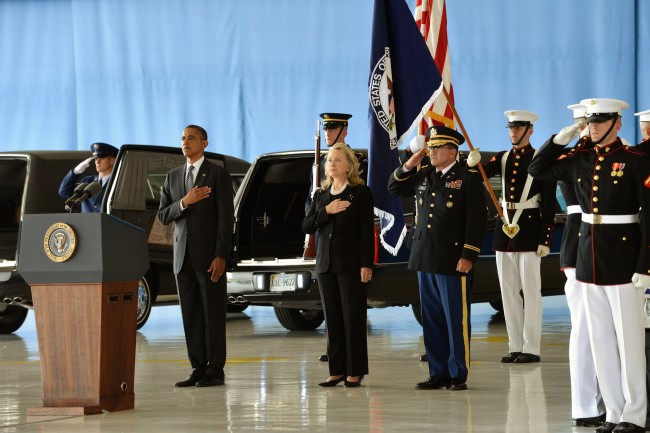
President Barack Obama and Secretary of State Hillary Clinton honor the four victims of the Sept. 11, 2012, attack on the U.S. mission in Benghazi, Libya, at the Transfer of Remains Ceremony held at Andrews Air Force Base, Joint Base Andrews, Maryland, on Sept. 14, 2012. [State Department photo)
President Barack Obama and Secretary of State Hillary Clinton honor the four victims of the Sept. 11, 2012, attack on the U.S. mission in Benghazi, Libya, at the Transfer of Remains Ceremony held at Andrews Air Force Base, Joint Base Andrews, Maryland, on Sept. 14, 2012. (State Department photo)
Opening up a real military front against it with Western armed forces might seem to be an appropriate going to where the action is, but it also would perpetuate a fundamentally flawed conception of counterterrorism as revolving around military offensives against whatever presence on the ground has been established by whatever radical group currently worries us the most.
This conception embodies the fallacy that control of a patch of distant real estate is to be equated with threats of terrorist attacks against the West and especially the United States. Even if the connection between distant real estate and proximate terrorism were greater than it really is, there is the further common but also fallacious corollary that whatever particular patch has most recently caught our attention is somehow more significant than other patches, including ones that have not yet come into being or gotten headlines as well as ones that have.
The case of ISIS in Libya ought itself to demonstrate the misguided nature of this corollary, showing as it does that the ISIS enclave in Iraq and Syria is not really as special in the world of counterterrorism or even in the world of ISIS as it has generally been regarded for most of the last couple of years. Similarly, the establishment of that prominent enclave belies the previously presumed special nature of the redoubt in Afghanistan of the Al Qaeda group from which ISIS broke away. Other Al Qaeda off-shoots, notably the one in Yemen, demonstrate the same thing.
The result is a game of whack-a-mole spanning multiple unstable foreign countries. The game is potentially endless, given that there is no shortage of such countries. The game is even worse than classic versions of whack-a-mole in that the perceived trouble spots seem to be additive rather than a matter of one substituting for another.
Our concern with Syria and Iraq has not eliminated our concern about Afghanistan. Jumping into Libya would not eliminate our concern about Syria and Iraq. This pattern is partly testimony to the counterproductive side of militarized counterterrorism, in which antagonism against foreign forces and the collateral damage they cause tend to breed more extremists and add credibility to the messaging of the group being targeted.
The underlying problem in a place such as post-Gaddafi Libya is a lack of good governance or of any governance. Inadequate governance has multiple bad effects, including the sort of chaos that violent extremists exploit. Libya does not have a governance problem because ISIS is there; ISIS is there because Libya has a severe governance problem.
Yet another fallacy in common thinking about counterterrorism is that whacking the offending group is progress. It is not, if what is left after the whacking is just more of the inadequate governance that led to the group establishing its presence there in the first place.
The prospects for creating a sound, strong and credible authority in Libya any time soon remain very weak. The spectacle of competing coalitions in the western and eastern portions of the country persists — and that does not even count some of the other smaller power centers.
The progress of the UN-sponsored reconciliation process has been so slow and meager that the slightest advance gets cheered — most recently, agreement by some but not all members of an interim collective presidency on the membership of a proposed unity government.
An anti-ISIS armed intervention in this situation would be without effective local coordination and probably would introduce the moral hazard of the competing Libyan factions feeling that much freer to continue the quarrels among themselves rather than doing more against ISIS.
The whole sequence of successive armed interventions is all the more depressing when one thinks about how the process not only has failed to kill the terrorist mole but has given it life. This was especially true, of course, of the war of choice in Iraq, which gave rise to the group that we now know as ISIS.
Libya was different in that an uprising was already taking place and the intervention was more a European-promoted project than an American one. But otherwise the result is parallel. In knocking off another dictator whom everyone loved to loathe, the intervention killed off a ruler who had, through a negotiated agreement, not only gotten out of his previous involvement in international terrorism but had begun to cooperate effectively against radical Islamist terrorists.
Now look at what we have in his place.

Paul R. Pillar, in his 28 years at the Central Intelligence Agency, rose to be one of the agency’s top analysts. He is now a visiting professor at Georgetown University for security studies. (This article first appeared as a blog post at The National Interest’s Web site. Reprinted with author’s permission.)


Saudi Collapse


Preparing for the Collapse of the Saudi Kingdom

It can’t last. The U.S. better get ready.
U.S. Secretary of State John Kerry meets with Saudi King Salman bin Abdulaziz in Riyadh, Saudi Arabia.Reuters

For half a century, the Kingdom of Saudi Arabia has been the linchpin of U.S. Mideast policy. A guaranteed supply of oil has bought a guaranteed supply of security. Ignoring autocratic practices and the export of Wahhabi extremism, Washington stubbornly dubs its ally “moderate.” So tight is the trust that U.S. special operators dip into Saudi petrodollars as a counterterrorism slush fundwithout a second thought. In a sea of chaos, goes the refrain, the kingdom is one state that’s stable.
But is it?
In fact, Saudi Arabia is no state at all. There are two ways to describe it: as a political enterprise with a clever but ultimately unsustainable business model, or as an entity so corrupt as to resemble a vertically and horizontally integrated criminal organization. Either way, it can’t last. It’s past time U.S. decision-makers began planning for the collapse of the Saudi kingdom.
In recent conversations with military and other government personnel, we were startled at how startled they seemed at this prospect. Here’s the analysis they should be working through.
Understood one way, the Saudi king is the CEO of a family business that converts oil into payouts that buy political loyalty. They take two forms: cash handouts or commercial concessions for the increasingly numerous scions of the royal clan, and a modicum of public goods and employment opportunities for commoners. The coercive “stick” is supplied by brutal internal-security services lavishly outfitted with American equipment.
The United States has long counted on the ruling family having bottomless coffers of cash with which to rent loyalty. Even accounting for today’s low oil prices, and even as Saudi officials step up arms purchases and military adventures in Yemen and elsewhere, Riyadh is hardly running out of funds.
Still, expanded oil production in the face of such low prices—until the February 16 announcement of a Saudi-Russian output freeze at very high January levels—may reflect an urgent need for revenue as well as other strategic imperatives. Talk of a Saudi Aramco IPO similarly suggests a need for hard currency.
A political market, moreover, functions according to demand as well as supply. What if the price of loyalty rises?
It appears that is just what’s happening. King Salman had to spend lavishly to secure the allegiance of the notables who were pledged to the late King Abdullah. Here’s what played out in two other countries when this kind of inflation hit. In South Sudan, an insatiable elite not only diverted the newly minted country’s oil money to private pockets but also kept up their outsized demands when the money ran out, sparking a descent into chaos. The Somali government enjoys generous donor support, but is priced out of a very competitive political market by a host of other buyers—with ideological, security, or criminal agendas of their own.
Such comparisons may be offensive to Saudi leaders, but they are telling. If the loyalty price index keeps rising, the monarchy could face political insolvency.
Looked at another way, the Saudi ruling elite is operating something like a sophisticated criminal enterprise, when populations everywhere are making insistent demands for government accountability. With its political and business elites interwoven in a monopolistic network, quantities of unaccountable cash leaving the country for private investments and lavish purchases abroad, and state functions bent to serve these objectives, Saudi Arabia might be compared to such kleptocracies as Viktor Yanukovich’s Ukraine.

Increasingly, Saudi citizens are seeing themselves as just that: citizens, not subjects. In countries as diverse as Nigeria, Ukraine, Brazil, Moldova, and Malaysia, people are contesting criminalized government and impunity for public officials—sometimes violently. In more than half a dozen countries in 2015, populations took to the streets to protest corruption. In three of them, heads of state are either threatened or have had to resign. Elsewhere, the same grievances have contributed to the expansion of jihadist movements or criminal organizations posing as Robin Hoods. Russia and China’s external adventurism can at least partially be explained as an effort to re-channel their publics’ dissatisfaction with the quality of governance.
For the moment, it is largely Saudi Arabia’s Shia minority that is voicing political demands. But the highly educated Sunni majority, with unprecedented exposure to the outside world, is unlikely to stay satisfied forever with a few favors doled out by geriatric rulers impervious to their input. And then there are the “guest workers.” Saudi officials, like those in other Gulf states, seem to think they can exploit an infinite supply of indigents grateful to work, whatever the conditions. But citizens are now heavily outnumbered in their own countries by laborers who may soon begin claiming rights.
For decades, Riyadh has eased pressure by exporting its dissenters—like Osama bin Laden—fomenting extremism across the Muslim world. But that strategy can backfire: Bin Laden’s critique of Saudi corruption has been taken up by others, and it resonates among many Arabs. And King Salman (who is 80, by the way) does not display the dexterity of his half-brother Abdullah. He’s reached for some of the familiar items in the autocrats’ toolbox: executing dissidents, embarking on foreign wars, and whipping up sectarian rivalries to discredit the demands of Saudi Shiites and boost nationalist fervor. Each of these has grave risks.
There are a few ways things could go, as Salman’s brittle grip on power begins cracking.
One is a factional struggle within the royal family, with the price of allegiance bid up beyond anyone’s ability to pay in cash. Another is foreign war. With Saudi Arabia and Iran already confronting each other by proxy in Yemen and Syria, escalation is too easy. U.S. decision-makers should bear that danger in mind as they keep pressing for regional solutions to regional problems. A third scenario is insurrection—either a nonviolent uprising or a jihadi insurgency—a result all too predictable given episodes throughout the region in recent years.
The United States keeps getting caught off-guard when purportedly solid countries come apart. To do better this time, U.S. military and intelligence officials should at the very least, and immediately, run some rigorous planning exercises to test different scenarios and potential actions aimed at reducing codependence and mitigating risk. They should work hard to identify the most likely, and most dangerous, regional outcomes of a Saudi collapse—or the increasingly desperate efforts of its rulers to avoid one. And above all, they should abandon the automatic-pilot thinking that has been guiding U.S. policy to date.
“Hope is not a policy” is a hackneyed phrase. But choosing not to consider alternatives amounts to the same thing.

http://www.theatlantic.com/international/archive/2016/02/saudi-arabia-collapse/463212/?


Truthout Sunday 20/11/2026

  SUNDAY, SEPTEMBER 20, 2026 Walking September 11’s Other Crime Scenes Millions had fled along the highway I had taken. Behind them Iraq was...