The following report was funded by the CounterPunch Investigative Fund. To support our work and more in-depth reports like this, consider donating.
+++
The Los Amigos biological station is perched at the top of a hundred-foot-tall cliff of red clay on the north bank of the Madre de Dios River in southeastern Perú. The river below seethes and purls, roiling as it makes a sharp turn, the centrifugal force of its flow digging it further into the bank. The trunks of fallen trees rise upside down from the water below, the clay clinging to their roots, held upright in the afternoon sun.
To reach the station, you travel upriver about 70 miles in a straight line from the regional capital of Puerto Maldonado, although with the sinuous twisting of the watercourse, the actual distance traveled is actually about twice that. I had arrived in Puerto the previous day to meet a group of 14 scientists and volunteers, mostly from the UK and cohered by British entomologist and author Ross Piper, with whom I’d struck up a long-distance internet friendship. Along with a Peruvian herpetologist and a few grad students from a university in Belfast whose projects formed the primary motivation for the trip, we were an assortment of people with a general interest in biodiversity and science, and an opportunity to explore a more or less remote corner of the largest forest on the planet. From Puerto, a minibus had delivered us to the port hamlet of Laberinto, where narrow skiffs loaded with passengers and their belongings embark for journeys upriver. The river at Laberinto was fast, full of torn branches and treetrunks, and all the boats were loaded down with extra barrels of gasoline being laid on to hedge against the shortage that struck Perú just as the US and Israel launched their war in Iran. During the bus ride, every gas station we had passed had trailed long queues of morose people in plastic ponchos balancing empty plastic jerrycans on the handlebars of their mopeds. A lot of them looked like they had been there since long before dawn.
We had a boat to ourselves, and it was fast, even as the river pushed past in the opposite direction. The wakes of other boats braided with ours, and the clouds crowded around us, the heavy air condensing on our raingear.
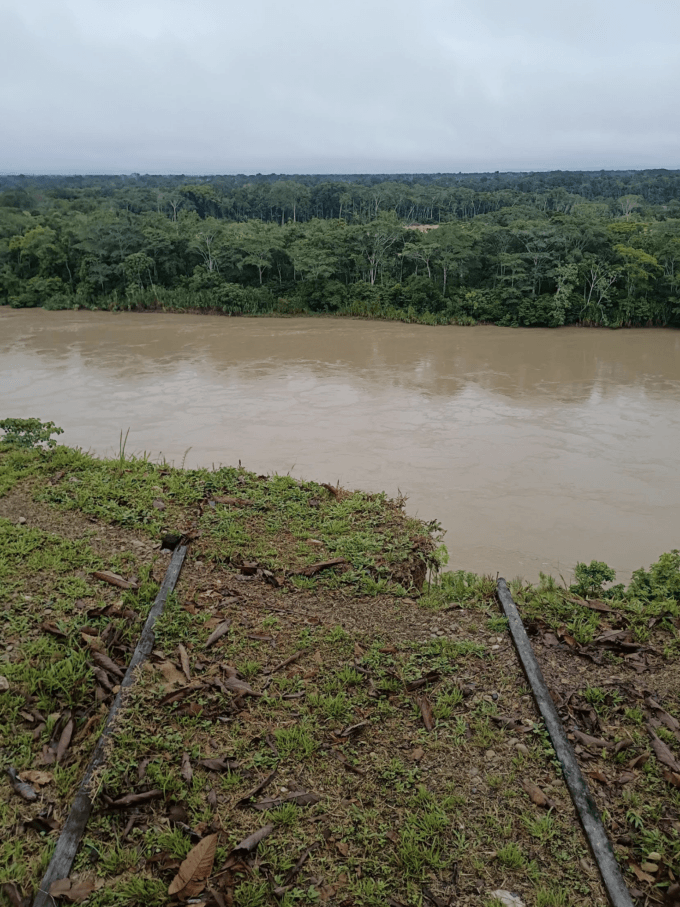
Trail to the riverbank cliff, Los Amigos Biological Station.
The banks of the river on both sides were marked by signs of artisanal gold mining, the major industrial and economic activity in this vast forest region. Miners, mostly small operators with their own equipment, take a position on a section of riverbank, cut down and bulldoze the standing forest, and dredge the riverbed gravel below for microscopic traces of gold. Their rigs are ramshackle gut-like assemblages of tubes and plank platforms, one end sucking the gravel from the water’s edge and pumping it up an incline where it drops down through a series of sluices, sorting the smooth river stones into conical piles as finer silt collects in drums at the center. Into this silt is mixed liquid mercury, which combines with gold particles in the silt to aggregate the precious metal into masses that can be extracted. This mercury-gold amalgam is then smelted to release the gold, using the downed trees from the former forest as fuel. The mercury vapor passes out into the surrounding environment, entering the food chain at all levels, descending from the leaden skies in the warm rain that falls almost incessantly at this time of year.
Mercury itself as a metal is hard to ingest; it’s heavy and dense, and usually you would have to drink it to get it into your bloodstream. When it enters the environment, however, it is consumed by bacteria during their normal metabolic processes and excreted as methylmercury, a substance that can be easily absorbed by organisms of all kinds. Methyl mercury penetrates skin, collects on leaves, saturates soil, and billows through the water column of turbid rivers. It laces the undersides of clouds and drips ceaselessly into the lives of everything it touches, its toxicity cascading through the environment at an exponential rate. That rate is rapidly increasing as illegal mining expands into areas of forests that have remained untouched until recently. The spike in gold prices that brought the price of a single ounce to more than $5,000 in late 2025 has made it feasible for operators to enter increasingly remote regions in search of metal and to bring their dredges, chainsaws, shotguns, and barrels of quicksilver with them. International criminal organizations are getting in on the game as well, creating new markets and new demands which local mining concerns are happy to fill. The mercury’s origin is traceable; it enters the region via Bolivia from exporters in Russia. The gold it helps to produce passes out of the region into the world’s insatiable appetite for heavy, malleable, conductive metals, and disappears.
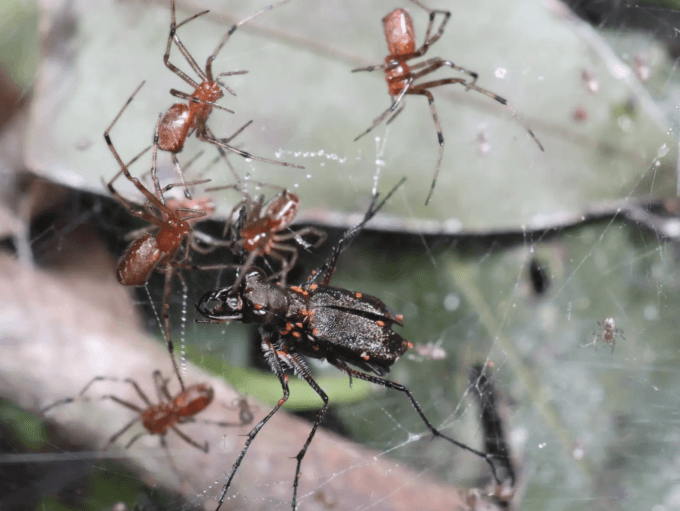
A tiger beetle fighting for its life in a social spider web.
The miners have a pretty clear understanding of the forest’s value, seeing it as the minuscule grains of gold that can be amalgamated into larger pieces through the application of labor, mercury, and heat. That value is attached directly to the international market, in which gold continues to serve the function it has served for the past several thousand millennia: a store of value, whatever that may be, which almost everyone can agree on the worth of, and which almost everyone will accept in return for something else. Other ways of valuing the forest are harder to explain and take longer to vest.
The biological station is itself a former mining facility, three concrete buildings built under government contract about twenty years ago, and taken over by one of Peru’s largest conservation NGOs in 2006. The site hosts dorms, a cafeteria, and an assortment of labs used by both visiting and resident scientists. Research centers on the impossibly profligate biodiversity of the surrounding rainforest and, in most contexts, on how that biodiversity is coping with rising levels of mercury contamination from the gold mines.
+++
On our first evening, the group gathered in the screened-in open-air library for a presentation on the station and the research underway. The mesh walls were partially covered by posterboard presentations of the projects of other scientists; assessments of bird speciation, primate morphology, and dung beetle diversity– this area of the Amazon basin boasts the world’s highest diversity of scarabs. The facility’s director described the station’s integration into a network of rainforest research initiatives, with major funding from Intel and technical materials contributed by the AI initiatives of both Microsoft and Amazon. Microsoft is using its AI systems to analyze the massive output of images from thousands of camera traps across the basin, and the production and administration of knowledge is the basis of the funding stream that pay everyone’s salaries, that stocks the labs with specialized equipment, that installs and monitors the networks of sensors and cameras in the forest, and maintains the boats, the buildings, and the cellular towers that link out to the rest of the world. Everything comes around to gold mining, however, and almost all the research taking place at the station focuses, in one way or another, on how mercury affects organisms and how those effects catalyze the collapse of some of the most complex biological assemblages on the planet.
The private concession that the station occupies abuts a much larger concession that the administering NGO leases from the Peruvian state for a fifty-year term. That property encompasses some 200,000 hectares and stretches north to the boundary of the massive Manu National Park. These are forests without permanent settlements, and in satellite view, they stretch unbroken for hundreds of miles toward the northern and northeastern horizons.
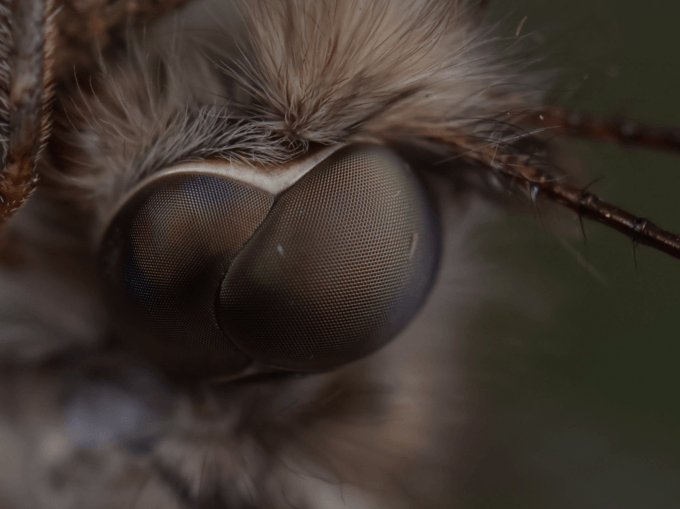
The compound eye of an owlfly.
The South, however, is another story. Further upriver from here on the Madre de Dios is a region known as La Pampa, the heartland of gold exploitation in the Peruvian Amazon. This area is easily located on the map by its color; dun smears extending out from the sides of the riverbank for hundreds of miles, an expanse of treeless sludge pocked with deep red pools of toxic water, solutions of heavy metals and mercury saturating a landscape that has been effectively sterilized, so poisoned that not even the hyper-aggressive rainforest bamboo can find a foothold.
For the next ten days, I tagged along with segments of the expeditionary group as we performed an assortment of scientific tasks in the forest immediately surrounding the biological station. Two graduate students from the UK were pursuing research for their PhD’s under the supervision of a Peruvian herpetologist. This involved stalking and collecting the innumerable rainforest frogs from the surrounding forest; wading into swamps to grab them from the stalks of heliconia, pacing along the margins of trails to swipe them up out of the leaf litter, and tubing them off large rainforest leaves with clear perspex cylinders. One of the students was gathering samples of the frogs’ feces to measure how a diet high in arthropods affects mercury concentration, and the other was analyzing the rates at which bacterial conversion of mercuryfacilitated its passage through the amphibians’ delicate skin.
The science happening all around me was all well and good, but my interest lay at a slightly orthogonal position to that of the group, namely with the insects. I’m an artist and an extremely amateur entomologist, and my interest in this whole expedition had been principally as a way to get closer to the impossibly high levels of arthropod diversity found in the Amazon in general. My relationship to insects has several levels; I’m curious about the complex biological networks they encompass, and their bewildering behavioral and reproductive complexity as well as how they eat and are eaten by all the other organisms that surround them, but I’m also a glutton for the aesthetics. I use a 60 mm macro lens and a rather annoying and janky dual flash rig to get as close as I can to as many of the small world denizens as possible, sometimes seeking to capture them in forms of microscopic portraiture, but often just seeking to approach so intimately that their strange integuments and their appendages billow up in rippled sheens of metallicized acrylic, the geometry of compound eyes bristling with ultrafine hairs and the obscenity of their lush, hypersexual jaws yawning open and clattering with sounds that seem, at that magnification, like they should shake the trees. My appreciation of them happens at the level of pattern and texture, as complex assemblage of sculptural forms and units, as engines of desire and destruction, and as food for the larger world that reassembles itself around me as I sit up out of the mud, where I have been crawling gently forward to press the distal end of my lens towards a still figure sitting just underanimate on a slick and waxy leaf. I find that my boundaries blur down there, and in the Amazon, the opportunities for that loss of self often seem more numerous than the stars in the sky.
+++
The daily rhythm of the expedition lent itself neatly to these massive fluctuations of scale. I helped sift leaf litter for one of the herpetologists, using a tool the British call a pooter to aspirate small arthropods from the debris that made it through a centimeter-mesh screen. Dumping this into a tray and chasing around small wasps, flies, and spiders with a rubber hose was amusing, and each time I thought I had cleared the field, I would adjust the magnifying plastic on the headset I was wearing and realize that there was another scale of microinsects still waiting to be hoovered up, and then another beyond that. I reached a level of tininess where the wasps stopped having wings, waving instead strange, transparent structures that looked like feathers, standing like kaiju athwart the even more minuscule bodies of acrobatid mites. After I had aspirated all the mites, I gave up and returned to the human world.
In between the science, I was out on the network of trails that led out into the surrounding forest from the station, in pursuit of whatever bright and beautiful creatures I could find. I bent slowly into the foliage to focus my camera on a beautiful fly with a slick and geometrically slabbed red head and blue-metal wings shimmering with radiant light, only to trip a nearby twig and spook it. It slipped under another larger leaf, and when I shifted my weight to pursue it, something else emerged from the site where it had disappeared, a waspish cylinder of blue-green metal vibrating with a glassy orange shine in an unrecognizable form. It tapped its white-tipped antenna twice on the leaf and vanished. Above me, small primates hurled what I can only assume were insults. Beyond them in the middle canopy, two blue and yellow macaws arrowed across through shafts of late afternoon light, illuminated like vivid and screaming portals into an alternate evening.
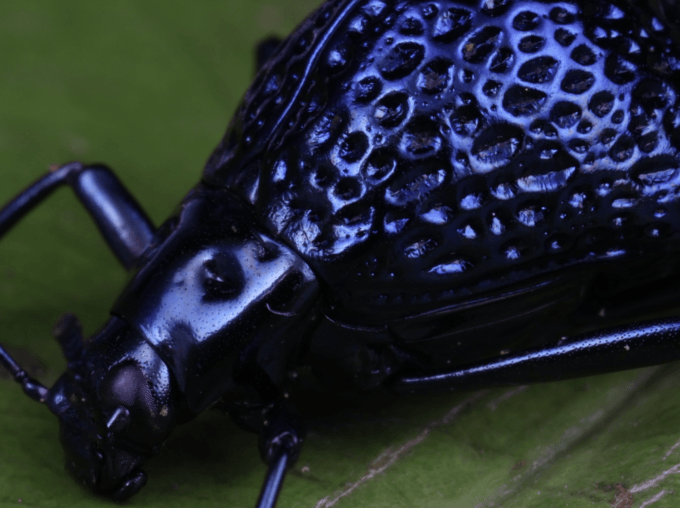
Cuphotes ericksoni, a tenebrionid beetle.
One trail led out to the edge of the concession, where a curve of the Los Amigos river bent back on itself in a dramatic horseshoe. We lined up on the crumbling bank as Ross, the entomologist, waved his butterfly net at the expanse of trees across the river, describing the forest beyond: a tract of unbroken primary rainforest that extended some 700 miles to the north and 500 miles to the east. In that forest live several “uncontacted” tribes, groups of indigenous people who have retreated from contact with Peruvian society to live off the land. They are protective of their territory; a patrol boat from the conservation concession that ventured too far upriver at the wrong time of year was struck by a seven-foot bamboo arrow through its tarpaulin roof. The threat of death is not simply to keep out outsiders, but also to exclude their way of making a living- the territory of the Los Amigos river is unmined and uncut, and the logic of the market holds no sway out there. From the riverbank, you can’t see into that vastness, but if you allow it, it will draw parts of you in, even if just to consider what the idea of value implies in a realm with so few people in it.
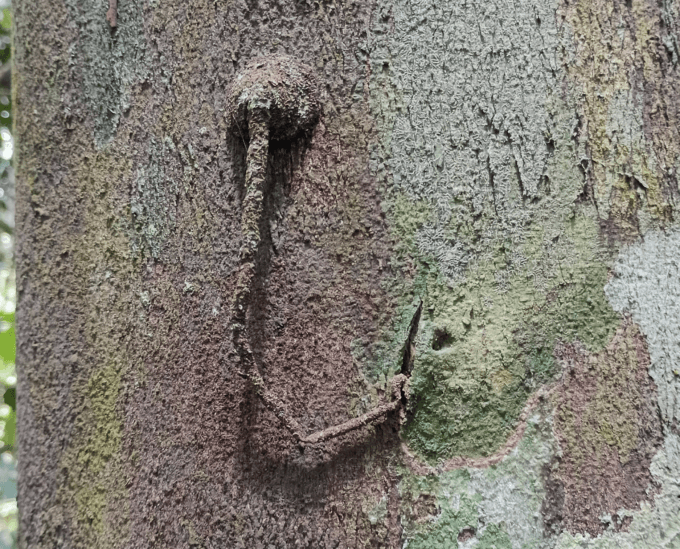
Protective dome-web of undescribed caterpillar.
On the way back to the station from the river at dusk, we saw two of the grad students from a Colombian group kneeling in the forest about twenty paces off the trail. We waved and asked if we could come over; they nodded. As we approached, we could hear a low hum, mobile and dopplering through the deepening shade. Small shapes were orbiting the copse of small trees where the students were bent over a shallow pit. Something the size of a golf ball hit me in the chest, and I looked down. A vividly gunmetal-blue scarab was clinging to the damp nylon of my shirt. I left it there and greeted the two Colombians, who were sitting on either side of a hunk of rank chicken breast lashed with nylon cord to a short stick. In front of the piece of chicken, a sheet of clear acrylic descended down one of the walls of the pit, and behind it, the awkward forms of more dung beetles could be seen scrabbling through rough tunnels. I plucked the beetle from my shirt to try to get a better look at it. It refused my grip and used the surprisingly sharp spikes on its forelimbs to lever itself out of my fingers, muscular and extremely dense, prying itself loose and tumbling to the ground, where I bent to grab it again. I tried to hold it by its glittering thorax, but it reached up to thrust my fingers apart. I noted that it had torn off its tarsi, the small end-limbs that all beetles and most insects have at the ends of their legs, a series of linked lozenges with hooks at the end that grip. I couldn’t prevent it from moving, and the spikes were quite painful. I dropped it next to the lump of chicken as another came roaring out of the gloom to collide with the corner of the acrylic sheet and tumble off into the duff like a limbed cannonball.
This was Coprophanaeus lancifer, a dung beetle that eats carrion. Most scarabs utilize dung as a substrate to lay their eggs in and protect their young. Coprophanaeus is a rare outlier that goes straight for the meat of large, dead animals, burrowing beneath them to carve off portions of flesh, which they drag into a network of burrows to provision their grubs. The Colombians explained their observations of the beetles as they moved through the tunnels they had dug in the earth behind the acrylic sheet, assessing how they interacted with each other at a food source. One of the biologists was taking notes as the other narrated, in a low voice suited for twilight: “8 is now fighting with 10, both up on their back legs and pawing at each other. 7 is pushing backward against the advances of 5, who is trying to move down the main tunnel”.
We could hear the soft cadence of the descriptions receding behind us as we turned on our headlamps and made our way back to the station in the imminent dark, pausing to examine insects and spiders that we passed. Ross stooped to scoop up another scarab from a trailside log. This one is Deltochilum valgum, he said, letting the pebble-sized black beetle with deeply incised wing-covers crawl from finger to finger. It’s one of the only fully predatory scarabs in a field full of scavengers. It feeds by locating an injured millipede, and only one that’s already been injured, mind you, and it uses its mandibles to saw off the millipede’s head. It takes up the headless trunk of the myriapod into its jaws and hauls it into its burrow for the young to feed on. He placed the beetle delicately on the surface of a broad leaf, but it drew in its legs into a defensive posture and tumbled off into the undergrowth.
+++
The next morning, Ross, the two Colombian students, and I walked out on the trail that paralleled the river. We were in pursuit of a particular kind of caterpillar that the Ross suspected was a new species, undescribed by science. This caterpillar, a larval moth, constructs a strange mobile dwelling for itself on the smooth trunks of trees: a tube composed of silk and leaf fragments, attached to the bark at one end and hollow, with a curious domed structure at the far end. The caterpillar uses the dome as a refuge within which it can graze the algal growths on the trunk while remaining invisible to the innumerable predators that flit and crawl through the midstory of the forest. Although there was another similar caterpillar species with a similar nest that had been scientifically described, this one had a distinctive shape and structure to the tube and dome that marked it as likely something new. We scanned the trees along the trail for specimens, and when we located one, Ross described to the grad students a structure he wanted them to build around it to capture the adult moth that would emerge after the caterpillar pupated inside the tube. To formally describe a new species, all stages of the animal’s life cycle need to be photographed and measured, and, to date, the adult of this species has been unknown. Ross tapped the distal end of the tube, where it emerged from a crack in the bark where the adult of a previous generation had laid its eggs. The tubes and nests are sold in markets as love charms, he said, and the vendors tell customers that they’re made by lizards. Supposedly, you take one of the tubes and put it under your lover’s pillow when you’re having a fight, and in the morning, she’ll be amicable towards you. Do people make a lot of money off selling those, I asked. I don’t know, said Ross, shrugging. They probably make enough to make it worth it.
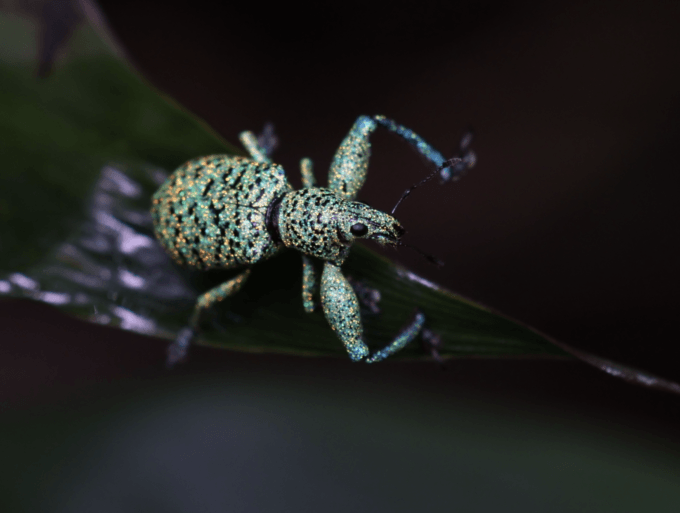
A weevil in the genus Hadromeropsis.
On the way back to the station, I fell into conversation with Jessica, one of the Colombian grad students, about her research. She studied the big blue scarabs and how they responded to mercury in their environment. Just as in marine mammals, she said, the mercury concentrates the higher up the food chain you go. Her research was conducted through a broad survey analysis across three regions with varying levels of contamination, incorporating 30 species from 6 insect orders. She had spent a month in the moonscape of La Pampa, followed by another here, at an intermediate zone of contamination, and the third would take place in untouched forest deep inside Manu National Park. The species that show the highest concentration of mercury out of all the insects we’ve studied, she said, are the meat-eating scarabs, Coprophanaeus, with a more ordinary fecal decomposer a distant second. Both are concentrating mercury from the already contaminated meat of animals feeding higher up the food chain, just as tuna concentrate mercury and other metals from the organisms they consume in the open ocean. I asked what effect the mercury seemed to be having on them. Mainly, she said, it inhibits beetles’ ability to thermoregulate, causing them to fail to respond to environmental temperature signals, overheat, and die. In the contemporary context of climate change, she said, this can have a profound effect on beetle populations.
Mercury exposure affects people as well. Prolonged exposure to methyl mercurycauses physiological changes, making people irritable and slow. Towns like Laberinto are full of people who are twisted and curled into themselves from a lifetime of exposure, their limbs bent and distorted. Persistent mercury contamination decreases people’s cognitive abilities and causes a suite of dramatic physiological deformities as well as birth defects. The gold trade similarly distorts; transnational criminal organizations involved in the gold trade exercise control over Peruvian political institutions at the local and national levels, and the value gold generates influences environmental and legal enforcement. The government sends agents to destroy the infrastructure of illegal operations, but the firms that provide the equipment are always ready to resupply, and the flow of mercury into the country is unhampered by the presence of several international frontiers.
At dinner in the cafeteria, one of the herpetologists described a problem affecting her research. In the state-of-the-art mercury lab at the station, the scientists had access to a Direct Mercury Analysis machine, a tabletop object about the size of a suitcase and manufactured by an American technology firm. The machine, nicknamed Puffy, was crucial to the mercury analysis at the station, and it had been only partially functional for the last few weeks. The device functioned by taking in a sample of biological material, such as skin, shit, hair, leaves, and vaporizing it (hence the name). Any mercury in the resulting vapor was collected on a gold plate inside the machine, following the same chemical principle the miners used to extract gold dust from river sediment. The gold plate was then reheated to release the mercury for measurement. The problem arose with the gold plate: something was preventing the machine from getting accurate readings, and it was assumed that damage to the gold surface or to its attachment to the sensor structures was causing the issue. A replacement had been on order from the manufacturer in California for several months. The irony of being short on the gold necessary to measure the mercury that gold mining had released into the environment, and which had accumulated in the tissues of the backlog of samples waiting to be fed into Puffy to be analyzed, was not lost.
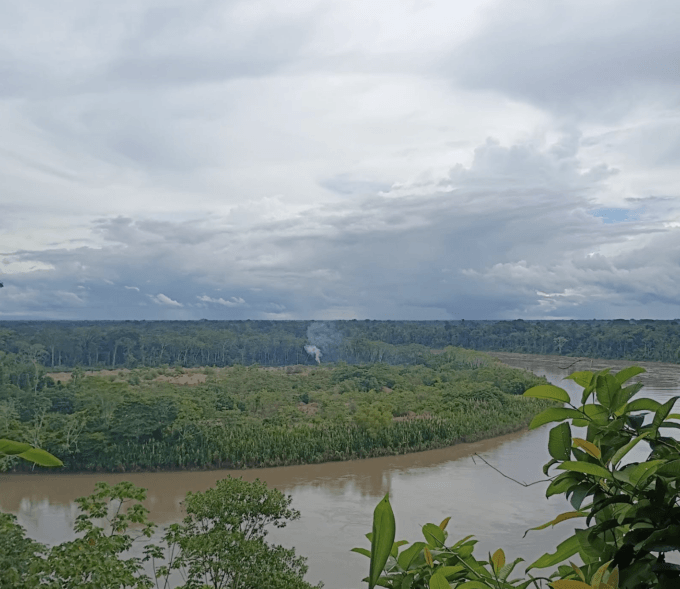
Smoke from a mining encampment on the Madre de Dios river.
On one of our last evenings at the station, we sat as a group on the rim of the steep red clay bank that faced west towards the sunset, the steam from the lush foliage of the forest before us mixing with the plumes of smoke rising from mining camps below. Just as in North American forests, the miners had left a “beauty strip” of trees about thirty feet deep on the opposing riverbank, obscuring the poisoned landscape of grey gravel and the red and yellow sludge of mercury-contaminated ponds. In the far distance, the low peaks of the smallest foothills of the Andes mountains could just be made out through the haze. The gold in the river sediments descends from those mountains, as it has for millions of years, and as the river churns through the forest, twisting and oxbowing its channel slowly across the continent’s faint incline, it deposits new layers of sediment with fresh particles of precious metal. It will do this for as long as there are mountains for rivers to rise within and descend from.
The contamination in the forest is not simply from mercury, but from gold itself. As mercury distorts bodies, gold distorts the imaginations of the people who come to understand it as the site of value, and seek to find ways to accumulate that value for themselves. People come to the Peruvian rainforest from all over the world seeking ways to extract value from the abstractions associated with it. For some, that comes from tourists, for some from science, and for many it comes from gold and the shapes it takes in the imagination; but everyone knows that there is value hidden there under the trees and swamps, in the shapes of insects, in the cries of macaws at dusk; something for the taking. All the research in the world into the problems that mercury creates in the societies of dung beetles, frogs, and people will fail to remediate those threats as long as the value people ascribe to gold is waiting out there, latent and heavy and cool to the touch, ready to be raised from the muck and amalgamated. If value does so much damage to the world, should it not be possible to seek to destroy it somehow, once and for all? The project has been tried, with varying degrees of success, but efforts to eliminate the concentration of value without simultaneously generating its converse quantity in nihilism produce unpredictable results. The great leveling that might prevent this contamination from building up and distorting our societies continues to evade us, scrabbling muscularly from our grasp like a blue-metal beetle in the gathering dark.


Geen opmerkingen:
Een reactie posten