A Fourth of July Story You’ve Never Heard and Why It Matters to Me

 RSS
RSS
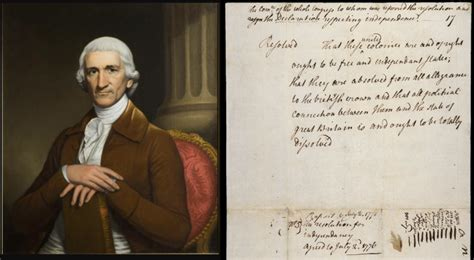
This is a story you have probably never heard. Please read to the end to learn why it is important to me. Charles Thomson is one of the most consequential forgotten men of the American founding — a figure who sat at the center of the revolutionary enterprise for fifteen years, knew everything, and then vanished so completely that most Americans have never heard his name.
Origins and Early Life
Charles Thomson was born in County Derry in the north of Ireland in 1729, the son of a Presbyterian Scots-Irish merchant named John Thomson. He was one of several children. In 1739, when Thomson was ten years old, his father loaded the family onto a ship bound for America, intending to join the waves of Scots-Irish Presbyterians settling in Pennsylvania and the Carolinas. John Thomson died on the voyage, and the children arrived in America as orphans without resources or connections.
Thomson’s older brothers were taken in by relatives or found their own way. Charles was initially left at the dockside in New Castle, Delaware — accounts vary as to whether he was simply abandoned or temporarily overlooked — before a blacksmith took him in. A local gentleman noticed the boy’s evident intelligence and arranged for him to be properly educated. Thomson eventually made his way to a Latin school run by Francis Alison, a Presbyterian minister and classicist of considerable reputation who educated many of the men who would later lead the American Revolution. Thomson proved an exceptional student of Greek and Latin, sufficiently skilled that he would later publish a translation of the entire Bible from the original Greek Septuagint — the first such translation by an American.
After completing his education Thomson taught school in New Castle and then in Philadelphia, where he became master of a Latin school attended by the sons of Philadelphia’s leading families. Through teaching he entered the social world of the city’s merchant and professional elite.
Merchant, Activist, and Friend of the Delaware
Thomson left teaching to become a merchant and trader, eventually achieving considerable commercial success. But what defined him in this period was his relationship with the Lenape (Delaware) people, and his remarkable reputation for honesty in a world where European dealings with Native Americans were characterised almost universally by fraud and manipulation.
Thomson became an adopted member of the Delaware nation, who gave him the name Wegh-wu-law-mo-end, meaning “the man who tells the truth.” This was not a ceremonial honour — it reflected a genuine relationship built over years of advocacy. When the Walking Purchase of 1737 — a notorious land fraud perpetrated by the Penn family against the Delaware — was re-examined at a council in 1756, Thomson served as secretary and witness, and his testimony and documentation were crucial in establishing the record of the fraud. The Delaware trusted him in a way they trusted almost no other colonial official.
Benjamin Franklin, who knew Thomson well, wrote that Thomson was “the Sam Adams of Philadelphia” — meaning the man most responsible for organizing and sustaining revolutionary sentiment in Pennsylvania’s capital.
The Road to Revolution
Through the 1760s Thomson became increasingly central to Philadelphia’s resistance movement. He was involved in the non-importation agreements that followed the Stamp Act and Townshend Acts, helping to organise merchant boycotts of British goods and enforce compliance through social pressure and public shaming of violators. He was a skilled political organiser with a talent for building coalitions across factional lines — no small achievement in a city divided between Quakers, Presbyterians, Anglicans, merchants, artisans, and the Penn family’s proprietary interests.
Thomson was not a lawyer or a planter like many of the founding generation. He was a merchant and a civic organiser, and his power came from his knowledge of Philadelphia’s people, his reputation for absolute integrity, and his ability to write clearly and persuasively.
When the First Continental Congress assembled in Philadelphia in September 1774, Thomson was not a delegate — Pennsylvania’s official delegation did not include him, partly because the conservative proprietary faction in the colony distrusted his radicalism. But the delegates from other colonies knew him by reputation. John Adams arrived in Philadelphia and immediately sought him out, describing Thomson in his diary as “the life of the cause of liberty.”
When the Congress needed a secretary, Thomson was the unanimous choice of the delegates even though he was not a member. He was brought into Carpenters’ Hall and appointed on September 5, 1774, the very first day the Congress met. He would hold that position without interruption for the next fifteen years.
Secretary of the Continental Congress
The role of Secretary of the Continental Congress was not a clerical position. Thomson was the institution’s permanent professional officer — the one figure who provided continuity across the rotating membership of delegates, who came and went as their states recalled and replaced them. While presidents of Congress served for short terms and delegates served variable terms, Thomson was always there. He kept the journals, authenticated all official documents, managed correspondence, maintained the seal, and served as the living institutional memory of the entire enterprise.
His responsibilities were vast and his authority subtle but real. Every resolution, every treaty ratification, every commission and appointment passed through Thomson’s hands. His signature on a document made it official. He was present for the signing of the Declaration of Independence — though, contrary to popular legend, most delegates did not sign on July 4th but rather on August 2nd, 1776, and the original document bears only John Hancock’s signature and Thomson’s as the authenticating officers of Congress.
Thomson was the first person to read the Declaration of Independence aloud publicly — when Congress ordered the official public reading on July 9, 1776, it was Thomson who performed that duty. And one more astonishing fact… Thomson also personally wrote out the engrossed parchment copy of the Declaration — the formal handwritten document that the delegates then signed — making him not merely the custodian but the scribe of the founding document itself.
From the moment the Declaration was engrossed on parchment in 1776, it became part of the official records of the Continental Congress, and as Secretary, Thomson was responsible for all of those records. The engrossed copy of the Declaration — the formal parchment document — was in his custody from that point forward as an integral part of the congressional archive he managed.
Over the course of these thirteen years in the care of Charles Thomson, the engrossed parchment found a home in four different states, spending a total of about six years at its first home, Independence Hall. As Congress was forced to evacuate Philadelphia in December 1776 with British forces approaching, Thomson moved with it — and the Declaration moved with Thomson. The document passed through Baltimore, Lancaster, York, Annapolis, Trenton, Princeton, and ultimately New York, always in Thomson’s custody as part of the congressional archive he personally managed.
This was not a passive or merely clerical responsibility. Thomson became the custodian of the entire revolutionary government, especially during those times when the Congress could not meet in Philadelphia due to the close proximity of British forces.
When Thomson formally resigned and retired in July 1789 at the age of 60, he described his own role in terms that make the transfer of custody explicit. His resignation letter read in part:
Having had the honor of serving in quality of Secretary of Congress from the first meeting of Congress in 1774 to the present time, a period of almost fifteen years… I now wish to return to private life. With this intent I present my self before you to surrender up the charge of the books, records, and papers of the late Congress which are in my custody & deposited in rooms of the house where the legislature assemble, and to deliver into your hands the Great Seal of the federal Union, the keeping of which was one of the duties of my Office.
The transition of custody came with the establishment of the Federal Government. On July 21, 1789, two days before Thomson retired, Congress approved the establishment of a Department of Foreign Affairs. In September 1789 the name and duties were changed and this agency became the Department of State. This new department was entrusted with the records of the Continental Congress and the Congress of the Confederation, including the Declaration of Independence. On September 26, 1789, President Washington appointed the first Secretary of State: Thomas Jefferson — the man remembered as author of the Declaration of Independence was now its official custodian.
It was Thomson who certified the results of the first presidential election. When the Electoral College chose George Washington in February 1789, it was Charles Thomson who rode to Mount Vernon to notify Washington personally that he had been elected the first President of the United States — a journey of several days on horseback in February. Thomson carried the official letter of notification, and the conversation between the two men at Mount Vernon — Washington’s first formal acknowledgement of his election — was one of the pivotal moments of the founding.
Thomson was widely assumed to be in line for a major appointment in Washington’s administration. He had served the new republic since its first day. He knew every secret, every negotiation, every internal conflict of the Continental Congress. He was seventy years old but still vigorous in mind.
Washington did not appoint him.
The Vanishing
The reasons for Thomson’s exclusion from the new government are not entirely clear and have been debated by historians ever since. Some accounts suggest Thomson was offered a minor position and declined it. Others suggest Washington and the new administration simply moved past him. Thomson himself never publicly complained or explained.
What Thomson did instead was one of the most striking acts of voluntary self-erasure in American history. He retired to his estate, Harriton House, in what is now Bryn Mawr, Pennsylvania, with his wife Hannah. He spent the next decade completing his monumental translation of the Greek Septuagint Bible into English — the first complete translation of the Septuagint by an American, published in four volumes in 1808. He also compiled a Synopsis of the Four Evangelists.
And he destroyed his papers.
Thomson had accumulated an extraordinary archive — fifteen years of confidential correspondence, private notes on congressional debates, records of what was said behind closed doors in the most critical period of the republic’s founding. He destroyed almost all of it deliberately. When pressed by friends and historians to write his memoirs or at least preserve his recollections, he declined. His reported explanation was that if he told the truth he would offend the families of men now regarded as heroes, and he was not willing to do that. Better silence than a history that diminished the reputation of the founding.
He said, more or less: I could tell you stories that would make you think less of your heroes. I will not do that.
Legacy
Thomson lived to the extraordinary age of 95, dying in 1824. He had outlived almost everyone who remembered him and his role. His wife Hannah had predeceased him. Harriton House still stands in Bryn Mawr, Pennsylvania, preserved as a historic site.
What survives of his legacy beyond the physical record is fragmentary precisely because of his deliberate destruction of his papers. We know he designed, or substantially contributed to the design of, the Great Seal of the United States — the eagle, the shield, the motto E Pluribus Unum, the olive branch and arrows. Thomson’s design was submitted to Congress in 1782 and adopted with modifications. The imagery on the dollar bill descends from his work.
He authenticated more documents of the founding era than any other individual. His signature appears on the Declaration of Independence. He informed Washington of his election. He kept the records of the Continental Congress through the Revolutionary War, the Articles of Confederation, and the transition to the Constitution.
And then he chose to be forgotten.
The man the Delaware called “the man who tells the truth” decided that the truest service he could render to the republic he had helped create was to take its secrets with him to the grave.
So why did I write this? Charles Thomson is my 5th great-uncle on my mother’s side of the family. His older brother, William, who became a modest farmer in Virginia, served in the militia during the Revolutionary War. I’m not sure the brothers ever met again following their separation upon arrival in Philadelphia. I like to think that what I do today, 250 years later, reflects on this part of my family’s legacy.